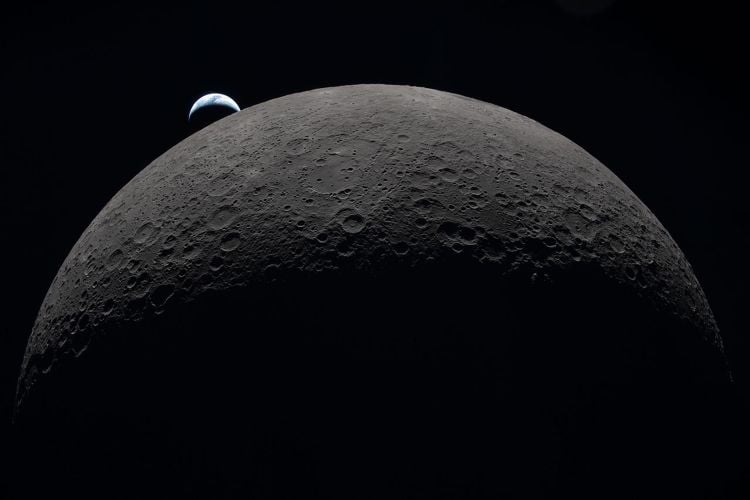
NASA's concern about forward contamination at the lunar poles has escalated based on new research into microbial survival. The agency warns that hardy Earth bacteria could survive in the harsh environment around the Moon's polar regions, where astronauts plan to establish a sustained human presence under the Artemis program.
The threat centers on extremophile microorganisms that can withstand radiation, extreme cold, and desiccation. Unlike equatorial lunar regions where surface temperatures swing violently between sunlit and shadowed areas, the permanently shadowed craters near the poles maintain stable, frigid conditions around minus 170 degrees Celsius. Some bacteria from Earth species like Deinococcus radiodurans possess DNA repair mechanisms that allow survival in high-radiation environments. In the stable cold of lunar shadows, such microbes could enter a dormant state and persist for extended periods.
This contamination risk matters because the lunar poles hold the greatest scientific and exploratory value. Ice deposits discovered in permanently shadowed craters by instruments aboard NASA's Lunar Reconnaissance Orbiter represent crucial water resources for future human settlements. More importantly, scientists want to investigate whether microbial life ever existed on the Moon or elsewhere in the solar system. If Earth bacteria reach subsurface or shadowed environments, they could compromise the scientific record and make genuine extraterrestrial discoveries indistinguishable from contamination.
The Outer Space Treaty, signed by 114 nations including the United States, legally obligates signatories to avoid harmful contamination of celestial bodies. NASA implements planetary protection protocols that sterilize spacecraft components and set contamination budgets. Robotic missions receive more rigorous sterilization than crewed missions because human landings inherently introduce more microbes through respiration, perspiration, and shed skin cells.
Artemis missions present unprecedented contamination challenges. Unlike the Apollo era landings at the equator, Artemis targets the lunar south pole beginning with Artemis III, planned for the mid-2020s. NASA's Artemis II mission, which flew humans around the Moon in April 2026, gathered new data on radiation exposure and environmental conditions that informed current contamination assessments. Crewed lunar sortie missions will establish habitats and conduct extended surface operations, increasing microbial dispersal risks compared to brief Apollo expeditions.
Researchers now model how terrestrial microbes might behave in polar environments. Studies show that bacteria in spacecraft materials, spacesuits, and equipment containers could survive the journey and potentially remain viable in permanently shadowed regions if protected from vacuum exposure. The stable temperature eliminates thermal cycling that typically kills dormant cells during standard lunar day-night cycles.
NASA responds through enhanced sterilization of Artemis hardware destined for the south pole, particularly equipment that enters lava tubes or subsurface ice deposits. The agency also plans containment protocols for human waste and regolith samples collected near polar sites. International coordination with ESA, JAXA, and other space agencies reinforces contamination prevention standards across all lunar activities.
The stakes extend beyond the Moon. Lessons learned from lunar forward contamination strategies directly inform protocols for Mars missions, where the search for past or present microbial life ranks among the top scientific priorities. Protecting the scientific integrity of planetary exploration requires treating contamination prevention not as bureaucratic overhead but as foundational to discovery itself.