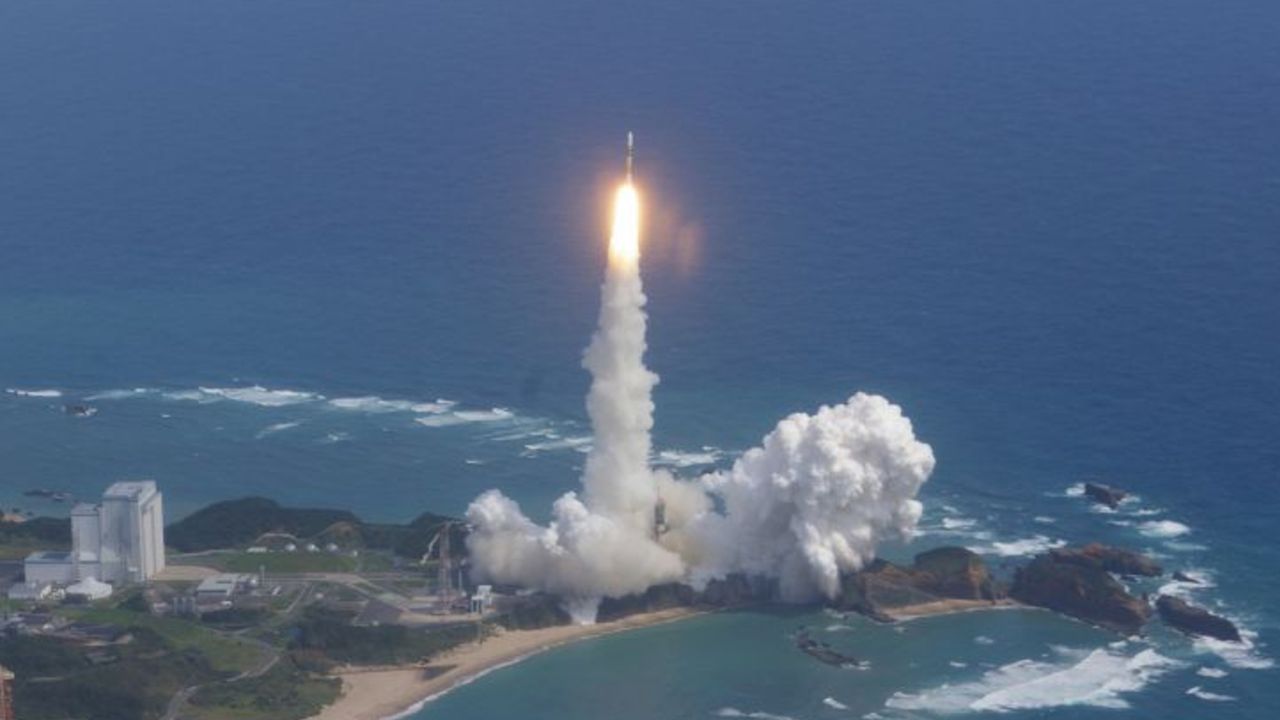
Japan's JAXA (Japan Aerospace Exploration Agency) launched the Kaguya spacecraft on September 13, 2007, aboard an H-IIA rocket from Tanegashima Space Center. This mission marked a watershed moment in lunar exploration technology and represented Japan's most ambitious moon program to that date.
Kaguya, also known by its Japanese name Selene (Selenological and Engineering Explorer), arrived at lunar orbit in October 2007 after a four-month journey. The spacecraft carried an unprecedented suite of high-definition imaging equipment designed to create the most detailed maps of the lunar surface ever produced. Its primary mission ran for approximately 1.5 years in orbit above the moon.
The spacecraft deployed two subsatellites into lunar orbit to conduct relay communications and gravitational measurements. This three-satellite constellation allowed Kaguya to gather data that previous lunar missions could not obtain. The main orbiter carried 14 instruments, including high-definition cameras capable of capturing video and still imagery at resolutions that revealed surface features smaller than 10 meters across. This represented a dramatic leap forward from earlier reconnaissance systems.
Kaguya mapped the moon's elemental composition by studying how different minerals reflect and absorb radiation. Its instruments analyzed the distribution of aluminum, iron, magnesium, silicon, and other elements across the lunar surface. The spacecraft also measured the moon's gravity field with unprecedented precision, creating three-dimensional models of subsurface mass distribution. These gravity maps proved essential for future mission planning and understanding the moon's internal structure.
The mission produced comprehensive topographical data that scientists used to identify potential landing sites for future exploration. Kaguya's measurements of surface roughness, slope gradients, and radiation exposure levels helped NASA and other space agencies plan missions like the Lunar Reconnaissance Orbiter. The spacecraft also detected water ice signatures in permanently shadowed craters near the lunar poles, confirming what telescopic observations had suggested.
Kaguya's high-definition video footage from lunar orbit captivated global audiences. The spacecraft captured stunning views of Earth rising above the lunar horizon, the moon's rugged terrain, and solar transits. These images strengthened public interest in lunar exploration during a period when moon missions had become less frequent than during the Apollo era.
The mission operated longer than originally planned. Kaguya remained scientifically productive until June 2009, when JAXA deliberately crashed the spacecraft into the lunar surface to end its mission. The impact provided additional seismic data for instruments left by earlier missions.
Kaguya's achievements established Japan as a serious player in lunar science. The spacecraft's data continues to inform lunar geology studies and exploration planning. Its legacy includes the most comprehensive HD dataset of the moon's surface compiled to that date, making it a reference for scientists worldwide studying lunar geology, geochemistry, and potential resource distribution. The mission demonstrated that nations outside the United States and Soviet Union could mount sophisticated, science-rich lunar programs that advanced human knowledge of Earth's nearest neighbor.