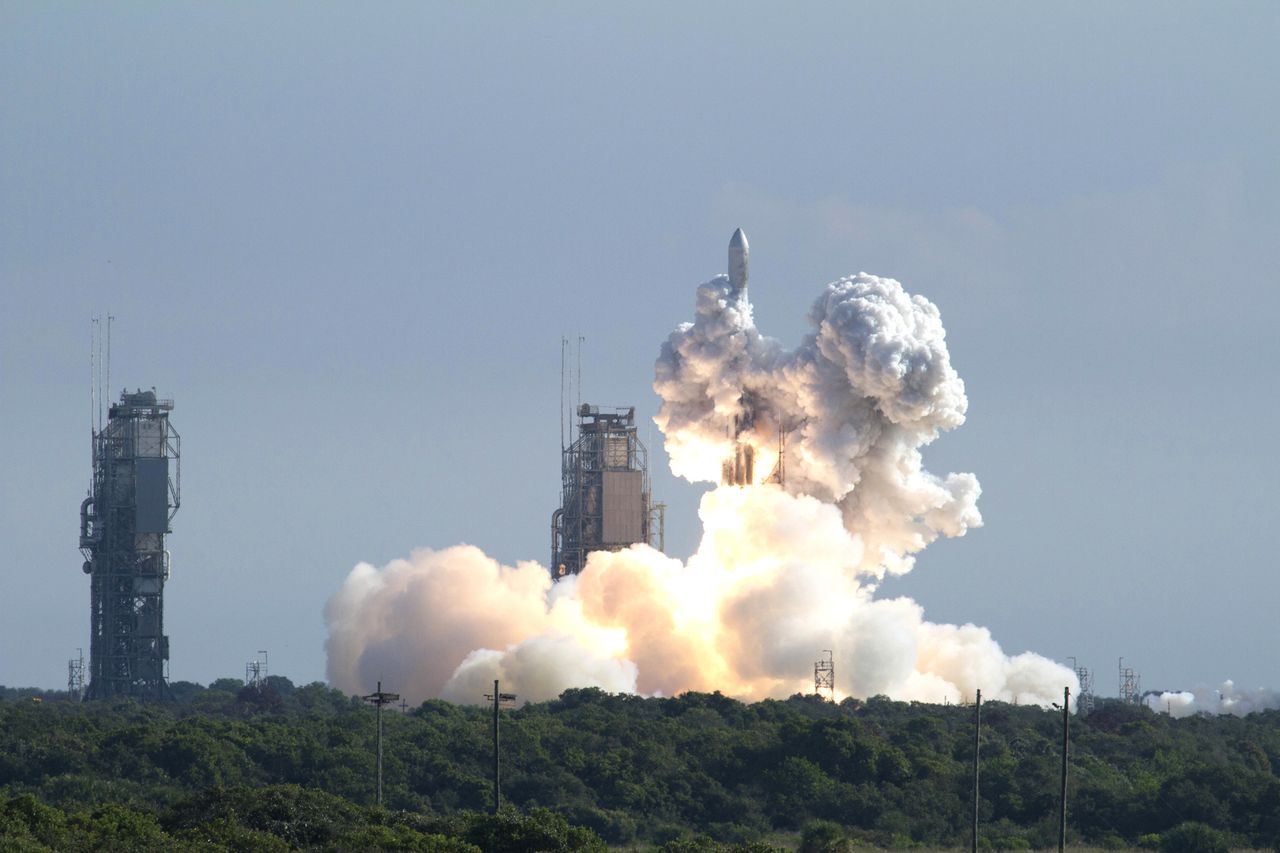
NASA launched two spacecraft known as GRAIL (Gravity Recovery and Interior Laboratory) on September 10, 2011, beginning a mission that would fundamentally reshape our understanding of the Moon's internal structure and gravitational field.
The twin probes lifted off aboard a Delta II rocket from Cape Canaveral Air Force Station in Florida. The mission's goal centered on measuring the Moon's gravitational variations with unprecedented precision, revealing how mass distributed itself beneath the lunar surface. This data would expose subsurface anomalies, ancient impact basins, and the architecture of the Moon's crust and mantle in ways that no previous mission had achieved.
GRAIL consisted of two identical spacecraft, nicknamed Ebb and Flow. They followed a four-month trajectory to lunar orbit, arriving in late 2011 and entering a near-polar orbit just 34 miles above the Moon's surface. Once operational, the two probes maintained precise relative positioning through radio signals. Minute changes in their separation distance, triggered by variations in the Moon's gravity, allowed scientists to construct an extraordinarily detailed gravitational map.
The data GRAIL collected addressed long-standing questions about lunar geology. Scientists discovered that the Moon's crust possessed greater density variations than previously thought. The mission revealed the structure of ancient impact basins, some of which dated back 3.8 billion years. These basins contained mass concentrations, called mascons, that warped the gravitational field in measurable ways. GRAIL data showed how crustal thickness varied across different regions, informing theories about the Moon's thermal history and how it cooled after its formation 4.5 billion years ago.
The scientific returns extended beyond lunar science. Understanding the Moon's interior structure provided context for interpreting similar data from other bodies. The techniques GRAIL employed influenced subsequent gravity mapping missions targeting Mars, Jupiter's moons, and other worlds. NASA's Juno spacecraft, launched in 2011 to study Jupiter, later adopted comparable gravitational measurement strategies to study that gas giant's internal composition.
GRAIL operated successfully for nine months. In December 2012, both spacecraft performed a controlled impact into the lunar surface near the Moon's north pole. The intentional crashes completed their mission and provided data on subsurface composition through the energy released during impact. The mission left behind a detailed gravitational map covering 99 percent of the Moon's surface with resolution approximately 1,000 times greater than any previous measurement.
The legacy of GRAIL persists in lunar science today. The gravitational data continues informing models of the Moon's evolution, mantle composition, and crustal structure. For future human exploration, GRAIL's maps identify regions of subsurface water ice and characterize hazardous terrain features. NASA's Artemis program, aiming to return humans to the lunar surface within this decade, relies on GRAIL data for site selection and mission planning. The gravity maps also support resource prospecting and geological hazard assessment for sustained lunar operations.
GRAIL demonstrated how remote sensing of planetary gravity fields revolutionizes our view of worlds we cannot directly sample. The mission transformed the Moon from a body with generalized features into a complex world whose internal architecture scientists could read with precision.