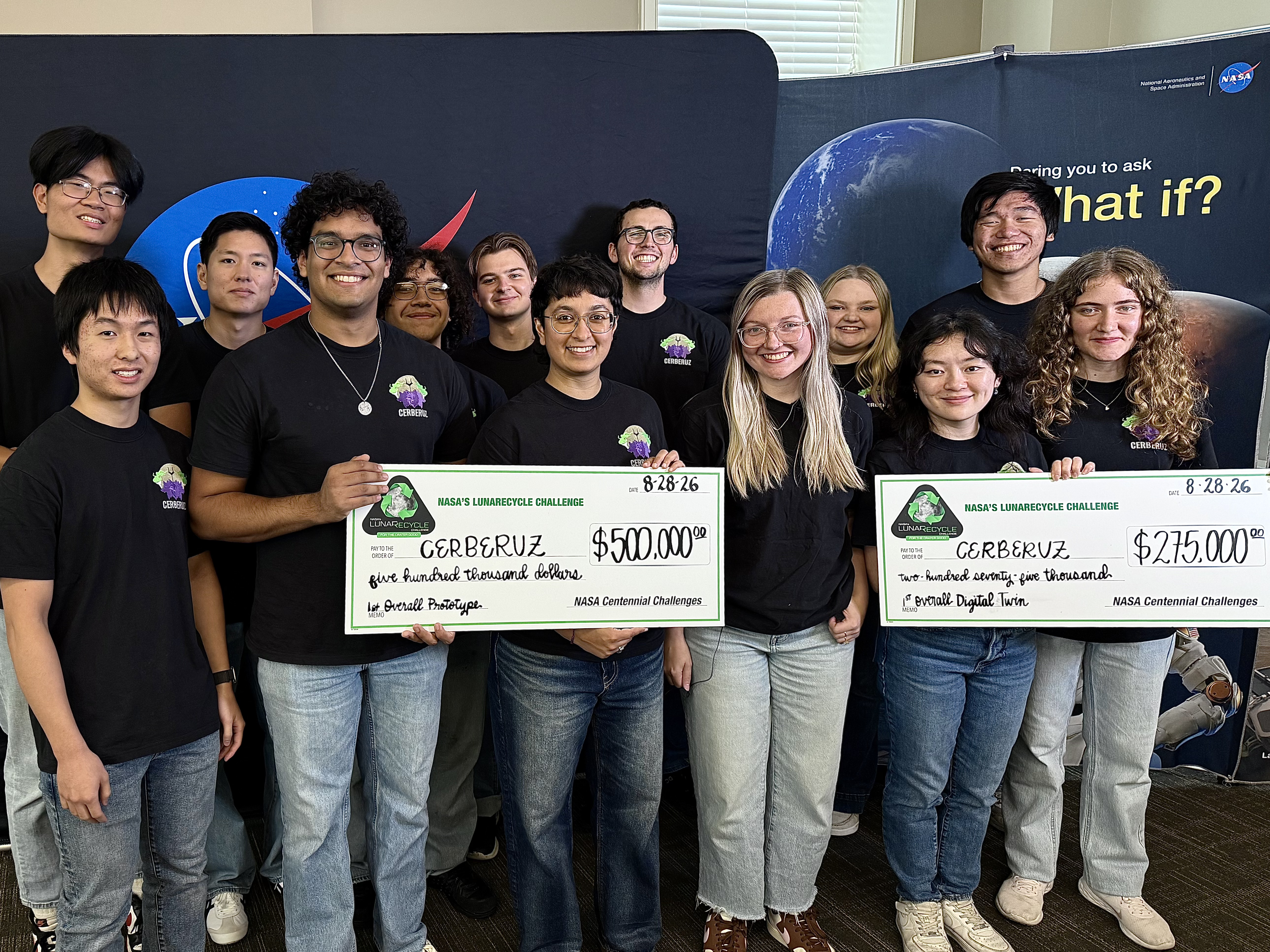
NASA has awarded $775,000 in prize money to MIT's CERBERUZ team for winning Phase 2 of the LunaRecycle Challenge, a competition focused on solving one of lunar exploration's practical obstacles: waste management in space.
The competition addresses a real problem facing deep space missions. Astronauts and equipment generate substantial waste during long-duration missions to the Moon or Mars. In the current space architecture, crews cannot simply discard materials. Every kilogram of waste represents mass that must either stay on a spacecraft or be left on the lunar surface, creating logistical and environmental concerns. CERBERUZ, which stands for Composites for Extraterrestrial Recycling By Engineering the Reuse and Upcycling of Zotek, proposes a solution that transforms mixed waste streams into usable materials.
The MIT team's winning technology grinds mixed trash into fine powder. This approach tackles the challenge of processing multiple material types—fabrics, plastics, foam, and metals—that would accumulate during extended missions. Rather than stockpiling refuse, the system converts waste into powder that could serve as raw material for 3D printing, construction, or other manufacturing processes on the Moon or aboard spacecraft.
NASA structured the LunaRecycle Challenge across multiple phases to encourage iterative innovation. Phase 2 specifically demanded functional prototypes and demonstration of recycling systems. Teams submitted designs showing their technology could realistically process the waste streams that actual lunar missions would generate. CERBERUZ emerged from this competitive field with a solution that balancedefficiency, scalability, and practicality for space environments.
The competition represents NASA's broader strategy for sustainable lunar exploration. As the agency plans extended human presence through the Artemis program, in-situ resource utilization and waste management become operational necessities rather than nice-to-haves. Recycling technologies reduce the mass that launch vehicles must carry from Earth, lowering mission costs and increasing cargo capacity for scientific instruments or crew supplies.
CERBERUZ comprises undergraduate, graduate, and doctoral students, reflecting NASA's investment in training the next generation of space engineers. Student-led teams often approach problems with unconventional thinking unconstrained by industry precedent. Their involvement in the LunaRecycle Challenge connects academic research to NASA's mission architecture directly.
Other teams competing in Phase 2 also received recognition and smaller awards, though CERBERUZ's powder-based recycling approach proved most compelling to NASA's evaluators. The competition continues to iterate toward flight-ready systems. Phase 3 and beyond will likely push toward further miniaturization, power efficiency, and integration with proposed lunar habitats.
The LunaRecycle Challenge sits within NASA's broader innovation ecosystem alongside other competitions like the Centennial Challenge Program. These competitions unlock solutions from organizations outside traditional aerospace contractors, accelerating technological development while distributing research investment across the innovation landscape.
For Artemis missions launching in the coming years, waste management systems derived from challenges like LunaRecycle will become standard hardware. The difference between mission success and failure often hinges on these unglamorous but essential systems. MIT's CERBERUZ team has demonstrated that powder-based recycling offers a practical pathway toward truly sustainable lunar exploration.