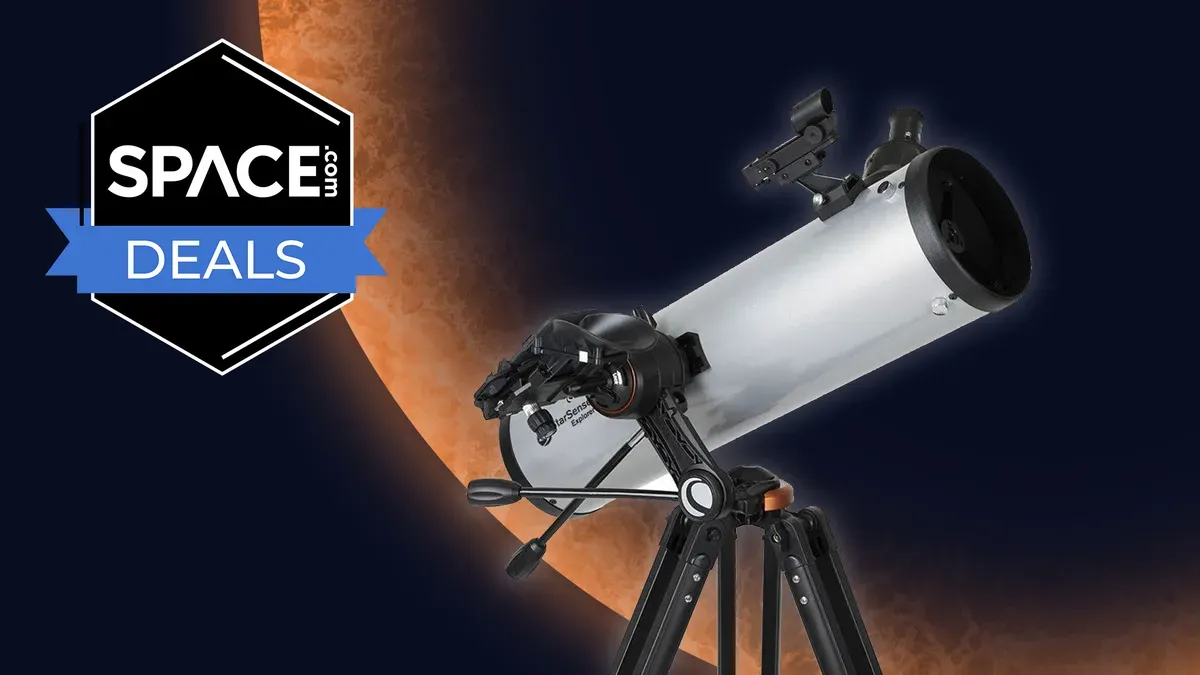
# Celestron StarSense Explorer DX 130AZ Drops to Lowest Price This Year
The Celestron StarSense Explorer DX 130AZ telescope, which earned top marks from Space.com's testing team as one of the best budget options for amateur astronomers, now carries a 17% discount on Amazon. The price reduction marks one of the lowest points this year for the reflector telescope, making this a limited-time opportunity for buyers seeking entry-level astronomy equipment without premium costs.
The StarSense Explorer DX 130AZ uses a 130-millimeter Newtonian reflector optical tube paired with an altitude-azimuth mount. The telescope's defining feature is its integrated StarSense technology, a smartphone-based computerized system that locates and tracks celestial objects automatically. Users point the telescope at two bright reference stars, then the system's app identifies thousands of deep-sky targets including galaxies, nebulae, and star clusters. The smartphone attachment eliminates the need for traditional hand controllers or expensive computerized mounts.
The 130mm aperture collects sufficient light for viewing lunar craters, Jupiter's cloud bands, Saturn's rings, and the Orion Nebula from moderately dark skies. The focal length of 650mm produces a focal ratio of f/5, which balances wide-field viewing with reasonable magnification capacity. The Alt-Az mount provides smooth manual tracking along both axes, while the StarSense system handles object location once initialized.
Space.com's expert review highlighted the telescope's value proposition for beginners and intermediate observers. The combination of adequate optical performance, smartphone integration, and affordability addresses common barriers to entry in amateur astronomy. The StarSense technology appeals particularly to observers who lack familiarity with star atlases and constellations, as it removes navigation complexity from the observation session.
The telescope's aluminum tube assembly resists corrosion and maintains structural rigidity during use. The 25mm eyepiece delivers 26x magnification for wide-angle observation, while optional 9mm eyepieces increase magnification to 72x for planetary detail work. The 2-inch diagonal accepts both 1.25-inch and 2-inch eyepiece formats, providing upgrade flexibility as observers advance their skills.
Typical applications include lunar observation, bright planetary viewing, and deep-sky scanning under reasonably dark skies. Urban and suburban observers will find the telescope capable of detecting major Messier catalog objects including the Andromeda Galaxy, the Hercules Cluster, and various planetary nebulae. Performance depends heavily on viewing site darkness, atmospheric stability, and observer experience with eyepiece selection and collimation.
Current discount pricing makes this reflector competitive with other entry-level designs, though potential buyers should verify current availability and exact pricing on Amazon. The limited-time nature of the promotion suggests inventory or pricing constraints that may affect purchase windows. Observers planning purchases should act within the promotional window, as similar deep discounts rarely persist beyond weekly promotional cycles.