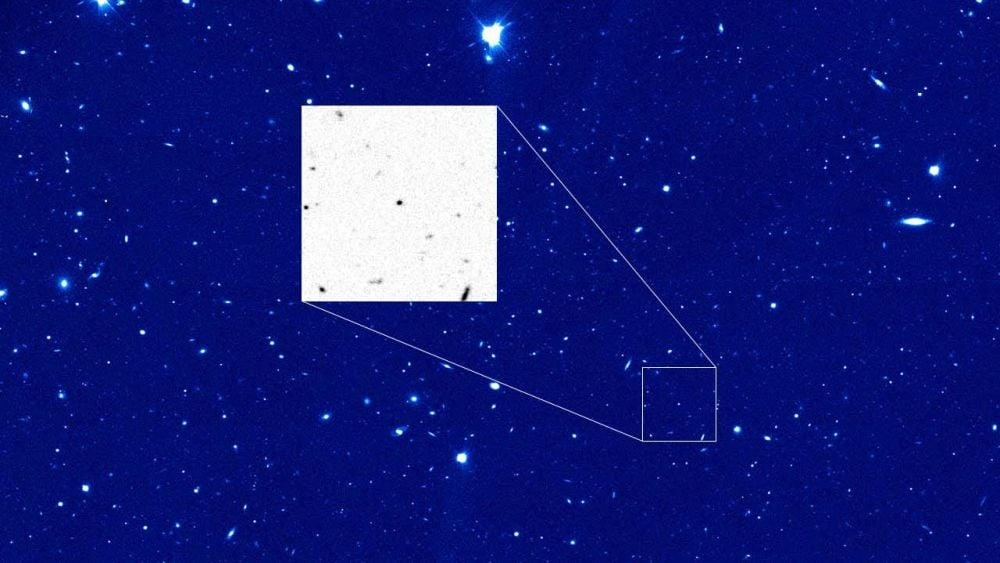
Japanese astronomers discovered archival images of comet 28P/Neujmin captured by the Subaru Telescope that provided an unusually clear view of the object's nucleus. The comet appeared in data collected by Subaru's Prime Focus Camera (Suprime-Cam) from an optimal viewing angle, allowing researchers to study surface features that typically remain hidden beneath the dusty envelope, or coma, that surrounds active comets.
The find represents a rare observational opportunity. Most comets develop prominent comae as solar heat vaporizes their ices, ejecting dust and gas that obscures the underlying nucleus. Comet 28P/Neujmin belongs to a small class of "naked comets" that either lack sufficient volatiles to produce substantial comae or have exhausted their ices through repeated passages near the Sun. The Subaru images captured the comet at a geometry that minimized coma interference, revealing direct views of the solid nucleus itself.
The Subaru Telescope, operated by the National Astronomical Observatory of Japan (NAOJ) and located atop Mauna Kea in Hawaii, functions as one of the world's most capable ground-based observatories. Its 8.2-meter primary mirror and the specialized Suprime-Cam instrument excel at wide-field imaging, making it well-suited for detecting faint extended structures around celestial objects. The archival discovery demonstrates how legacy telescope data continues yielding scientific returns years after acquisition.
Studying naked comets provides direct access to primordial material from the solar system's formation. Unlike active comets surrounded by dust shells, exposed nuclei allow astronomers to measure surface composition, texture, rotation rates, and outgassing patterns with precision. These measurements constrain models of comet structure, thermal behavior, and volatile content. Understanding how comets evolve through repeated solar passages informs our knowledge of small bodies that delivered water and organic compounds to the early Earth.
The 28P/Neujmin discovery exemplifies serendipitous science. Researchers weren't specifically targeting this comet when Suprime-Cam recorded it; rather, the comet appeared in the background of other observations. This accidental imaging became valuable precisely because the orbital geometry provided that rare angle of incidence. Such discoveries underscore why maintaining comprehensive archival databases matters for astronomy. Technological improvements in image analysis and computational methods allow researchers to extract previously overlooked details from decades-old data.
Japanese teams continue analyzing the Subaru observations to characterize the nucleus dimensions, surface reflectivity, and any detectable activity. Results will feed into broader surveys tracking how comets change during their lifetimes and how different families of these icy bodies behave near the Sun. The work also informs strategies for space missions targeting comets, such as sample-return efforts that require detailed knowledge of target surfaces and dust environments.
This finding reinforces the scientific value locked within telescope archives worldwide. Institutions like NAOJ maintain vast repositories of observational data spanning decades. As computing power and analytical techniques advance, researchers routinely discover new insights buried in historical images that observers never initially recognized. The Subaru Telescope's contribution to understanding comet 28P/Neujmin demonstrates how patience, comprehensive data preservation, and archival research continue advancing planetary science.