# The Discovery That Rewrote Our Solar System's Geography
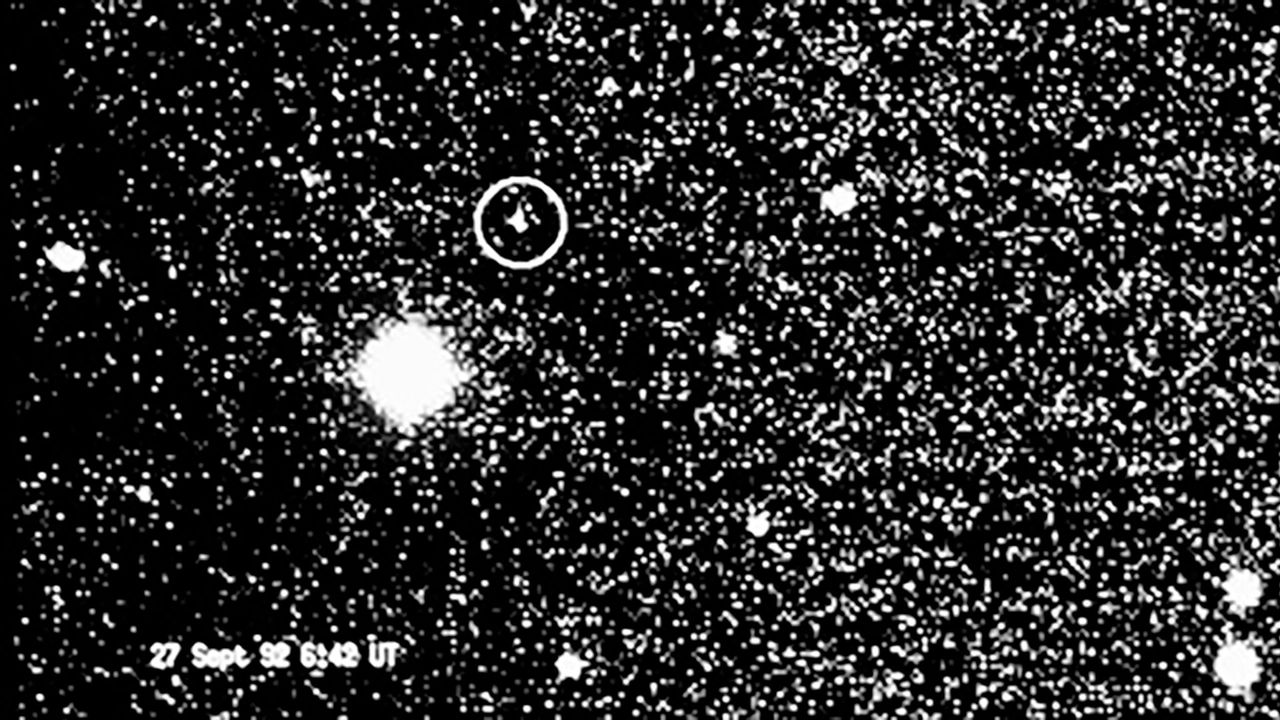
On August 30, 1992, astronomers David Jewitt and Jane Luu identified 1992 QB1, the first confirmed object in the Kuiper Belt. The discovery fundamentally altered our understanding of the solar system's structure and composition.
1992 QB1 orbits approximately 41 astronomical units from the sun, far beyond Neptune's orbital path and well past Pluto. At roughly 100 kilometers in diameter, this icy body represents something theorists had predicted but never observed: the beginning of a vast population of small objects circling the sun in a region beyond the giant planets.
The Kuiper Belt itself had been theorized since 1951 by Gerard Kuiper, a Dutch-American astronomer who proposed that a disk of icy bodies should exist beyond Neptune. The belt remained hypothetical for four decades. Astronomers lacked telescopes sensitive enough to detect small, distant objects reflecting minimal sunlight. Jewitt and Luu used the University of Hawaii's 2.24-meter telescope on Mauna Kea to overcome this limitation. They discovered 1992 QB1 through methodical systematic searching.
The significance extended beyond one discovery. The Kuiper Belt represents the solar system's primordial architecture. These icy bodies preserve material from the solar nebula that birthed our planetary system 4.6 billion years ago. They contain frozen volatiles—water ice, methane, ammonia, and other compounds—that reveal conditions during the sun's youth.
1992 QB1's discovery opened a floodgate. Astronomers soon identified dozens, then hundreds, then thousands of Kuiper Belt objects (KBOs). The catalog now includes over 700,000 known objects larger than 100 kilometers. This population dwarfs the asteroid belt, making the Kuiper Belt the dominant reservoir of small bodies in our solar system.
The discovery had direct consequences for planetary science. In 2006, the International Astronomical Union reclassified Pluto as a "dwarf planet" rather than a full planet, partly because discoveries showed Pluto resembles other Kuiper Belt objects more than Earth, Venus, Mars, or Jupiter. Pluto orbits the sun as one member of a vast congregation of icy bodies, not in solitary planetary dominion.
Kuiper Belt science advanced further with the New Horizons spacecraft. Launched by NASA in 2006, New Horizons flew past Pluto in July 2015, revealing it as a geologically active world with nitrogen ice plains, water-ice mountains, and a complex atmosphere. The spacecraft later encountered Arrokoth, a contact binary KBO, in January 2019. These encounters revealed that Kuiper Belt objects undergo substantial geological evolution despite their distance from the sun.
The belt remains partially explored. New Horizons continues operating in the Kuiper Belt, transmitting data about the environment beyond the planets. Astronomers continue discovering KBOs with ground-based telescopes. The James Webb Space Telescope now observes these distant objects, measuring their composition and physical properties with unprecedented precision.
1992 QB1 catalyzed a revolution in planetary science. It exposed an entire region of the solar system that fundamentally altered our knowledge of planetary formation, solar system architecture, and the abundant small bodies orbiting the sun. That August discovery three decades ago transformed the Kuiper Belt from theoretical prediction into observational reality.