Recent observations from the James Webb Space Telescope have revealed a problem that planetary scientists did not expect to solve. Exoplanets orbiting extremely close to their host stars, particularly lava worlds, possess thick atmospheres that should not exist according to established theory. Stanford researchers have now developed a model that reconciles this contradiction and reshapes our understanding of atmospheric escape across the galaxy.
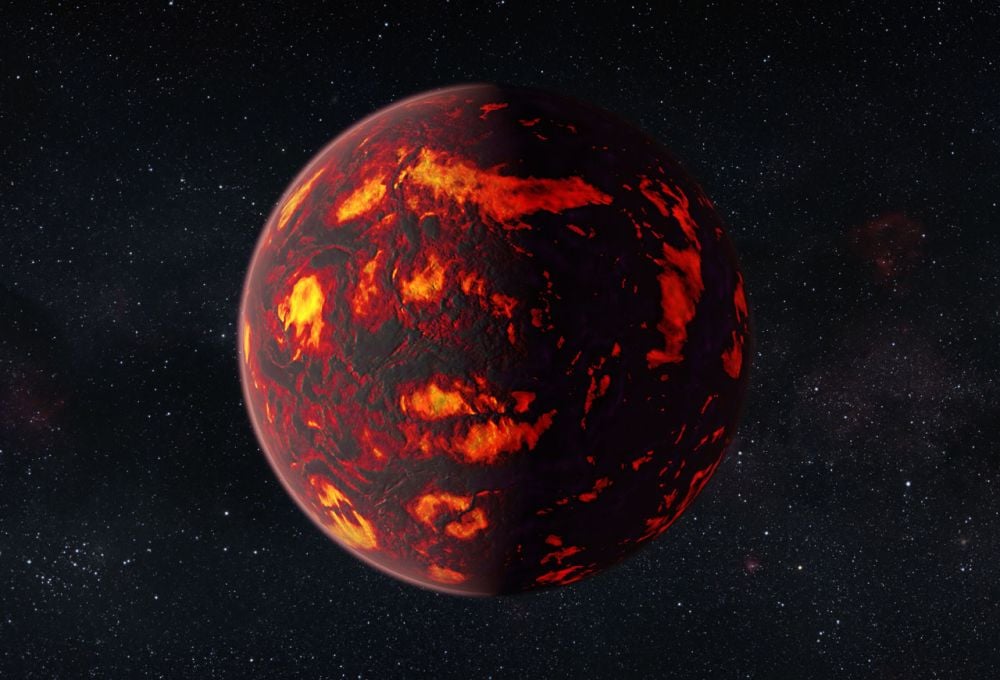
The discovery centers on planets like 55 Cancri e, a super-Earth so proximate to its star that surface temperatures reach thousands of degrees. Such worlds should lose their atmospheres rapidly to space. Extreme stellar radiation and intense heat drive atmospheric particles to escape velocities, a process that operates unfailingly in current models. Yet JWST observations show these lava worlds retain substantial atmospheres despite conditions that theory predicts would strip them bare within geological timescales.
This contradiction forced a fundamental reassessment of how atmospheres behave near stars. Planetary scientists had developed the concept of the "cosmic shoreline," a theoretical boundary beyond which planets cannot retain atmospheres. Planets closer to their stars than this line should become barren. The persistence of atmospheres on lava worlds like 55 Cancri e demolishes this simplified picture.
The Stanford team's new model addresses the problem by examining the interaction between stellar radiation and atmospheric composition. The researchers demonstrate that certain atmospheric conditions create a thermodynamic state that actually resists escape. When planetary surfaces reach extreme temperatures, the atmosphere enters a regime where particles move with such high energy that they overcome the traditional escape mechanisms that dominate cooler planetary environments. Instead of a simple race between gravitational pull and thermal energy, the dynamics become more complex.
The discovery has immediate implications for exoplanet demographics and habitability studies. If close-orbiting lava worlds retain atmospheres through unexpected physics, the inventory of potentially habitable planets changes. Detection of atmospheric signatures around ultra-hot exoplanets becomes feasible with instruments like JWST. Spectroscopic observations can reveal atmospheric composition, providing clues about formation histories and chemical processes operating under extreme conditions.
This rethinking also affects our models of planetary evolution. Lava worlds may represent a stage in planetary development rather than a terminal state. Planets that migrated inward from cooler regions might retain thicker atmospheres than planets that formed close to their stars, introducing new pathways for atmospheric loss and retention.
The implications extend beyond individual exoplanet characterization. As astronomers expand the catalog of confirmed exoplanets with JWST and future missions like the Nancy Grace Roman Space Telescope, they will encounter increasingly exotic planetary configurations. Each discovery testing the boundaries of existing theory strengthens the models that describe how planetary systems actually function across the universe.
Stanford's model provides a framework for interpreting these observations systematically rather than treating each anomaly as an isolated puzzle. The work exemplifies how direct observations from space telescopes force theoretical refinements that broaden our comprehension of planetary science across fundamentally different stellar environments than our own solar system.