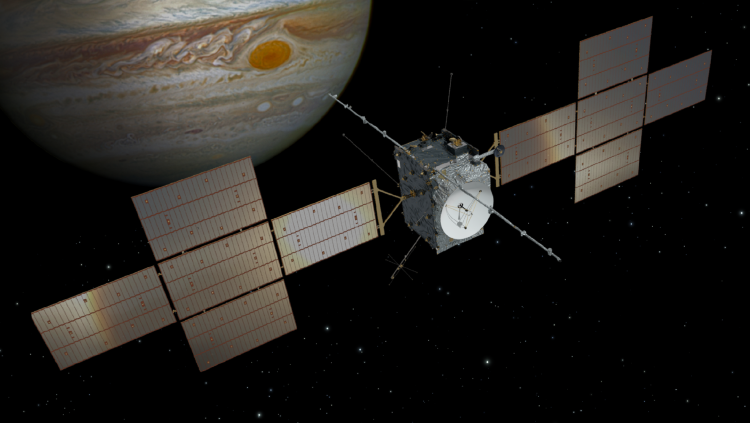
The European Space Agency's JUICE probe has plotted a course to investigate Kallichore, one of Jupiter's diminutive and poorly understood irregular moons, during its planned 2031 encounter with the Jovian system. This shift in scientific priorities reflects a growing recognition that Jupiter's smaller satellites hold clues to planetary formation and early solar system evolution that the famous Galilean moons cannot provide.
JUICE, which stands for JUpiter ICy moons Explorer, launched in April 2023 from French Guiana aboard an Ariane 5 rocket. The spacecraft will conduct a comprehensive survey of the Jovian system over its eight-year mission, with primary focus on three ice-covered Galilean moons: Ganymede, Europa, and Callisto. These worlds command attention because of their dramatic geology. Io ranks as the most volcanically active body in the solar system, while Europa harbors a subsurface ocean beneath its frozen exterior, making it a prime candidate in the search for extraterrestrial life.
Yet Kallichore represents an emerging research frontier. This small irregular satellite, discovered in 2003, belongs to Jupiter's population of over 100 moons, most of which remain distant targets for scientific inquiry. Unlike the geologically active Galilean moons, these smaller bodies have undergone minimal change since the early solar system. Their preserved surfaces contain a geological record spanning billions of years, offering astronomers an unaltered view of how planets and moons formed within the young Jupiter system.
Irregular moons like Kallichore likely entered Jupiter's orbit as captured asteroids or comet-like bodies, rather than forming with the planet itself. Studying their composition, surface features, and orbital characteristics yields data about the primordial solar nebula and the dynamical processes that shaped planetary architecture. The 2031 flyby represents an opportunity to gather high-resolution imagery and spectroscopic data that ground-based telescopes cannot deliver.
JUICE carries a sophisticated instrument suite designed for this expanded science agenda. Its cameras, spectrometers, and magnetometers can characterize moon surfaces, analyze chemical composition, and study radiation environments around Jupiter. The probe's architecture incorporates data from previous Jovian missions, including NASA's Galileo and Juno spacecraft, which revolutionized understanding of the giant planet and its magnetic field.
The decision to include Kallichore in JUICE's trajectory also reflects broader shifts in planetary science. Traditional missions focused on the most geologically active worlds because their dynamic processes offered immediate scientific drama and evidence of potential habitability. However, astronomers now recognize that pristine, undisturbed bodies preserve information about conditions that shaped the entire solar system. Kallichore and its small moon siblings offer that preservation.
The mission timeline positions JUICE to enter Jupiter orbit in 2031, then conduct a series of flybots of the Galilean moons before eventually reaching orbit around Ganymede. The Kallichore encounter slots into this sequence, allowing the spacecraft to gather comparative data across Jupiter's diverse satellite population. This approach maximizes scientific return from a single mission while establishing methodologies for future exploration of the outer solar system.
JUICE represents a collaborative effort spanning ESA member states and international partners including NASA and JAXA. Its success depends on precise navigation across billions of kilometers of space and intricate planning of gravitational assists at Earth, Venus, and potentially other bodies. The 2031 Kallichore encounter marks another chapter in humanity's systematic investigation of the Jovian system.