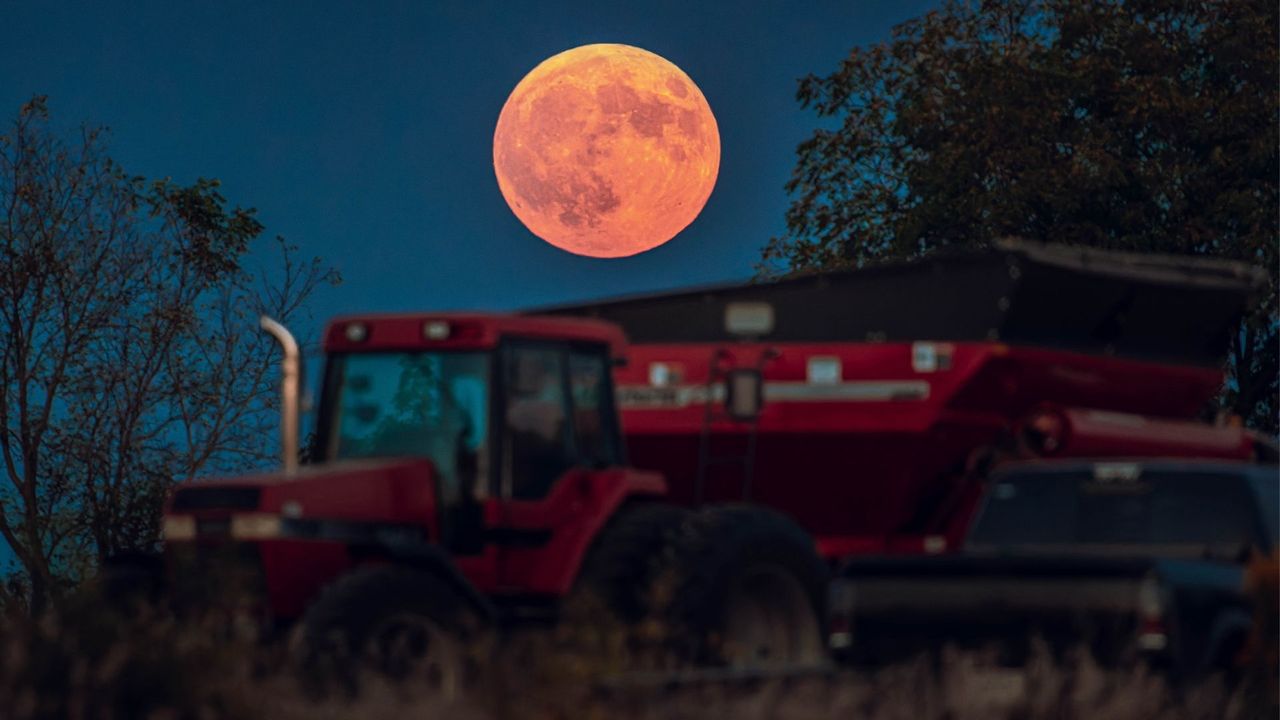
# September 2026 Harvest Moon: Complete Viewing Guide
September 2026 will deliver the Harvest Moon, the full moon that occurs closest to the autumnal equinox in the Northern Hemisphere. This lunar event carries practical and cultural weight that extends back centuries to agricultural rhythms, while offering modern skywatchers a reliable opportunity to observe lunar features with naked eyes and optical equipment.
The Harvest Moon earned its name from pre-industrial farming communities across North America and Europe. Unlike other full moons that rise roughly 50 minutes later each night, the Harvest Moon rises at nearly the same time on successive evenings near the autumn equinox. This consistent illumination provided farmers with extended twilight hours to complete final harvests before winter. The effect results from the geometry between Earth's orbit and the lunar orbital plane, which creates a shallow angle at the horizon during this season.
September 2026's Harvest Moon will reach peak fullness at a specific moment that skywatchers can mark with precision using astronomical tables. The timing matters for photographers and lunar observers seeking optimal viewing conditions. Cloud cover and local light pollution will determine visibility across different regions. Urban observers should travel to darker sites away from city lights to experience the moon's true brightness and crater detail.
The Harvest Moon typically appears larger and more orange near the horizon, though this represents an optical illusion rather than a physical change in the moon's size. The Rayleigh scattering effect, which also causes sunset colors, bends shorter blue wavelengths of moonlight as they pass through the atmosphere at shallow angles. This scattering leaves orange and red wavelengths to reach observers' eyes. As the moon climbs higher in the sky, it appears smaller and whiter.
Observers with binoculars or small telescopes can resolve lunar features including the Sea of Tranquility, the crater Tycho with its distinctive ray system, and the towering peaks of the Leibnitz and Huygens mountain ranges bordering the lunar south pole. The terminator line, where shadow meets sunlit terrain, reveals the most dramatic topography. September's Harvest Moon offers a high-resolution view of the lunar surface despite sitting high in the night sky.
The full moon phase persists for roughly three days as Earth moves through space relative to the Earth-Moon-Sun geometry. The moon technically becomes full at a precise moment in September 2026, but observers will find the moon noticeably round and bright for several nights surrounding that date.
No special equipment beyond human vision is required to experience the Harvest Moon. Simple planning improves results. Check local weather forecasts the night before. Allow 20 minutes for eyes to adjust to darkness away from artificial lights. Note the moonrise time for your latitude using NASA's Skywatching Guide or similar resources.
The Harvest Moon represents one of the most accessible astronomical events. It requires no telescope, no travel to remote locations, and no particular expertise. It appears the same throughout the world, making it a shared human experience across cultures and continents.