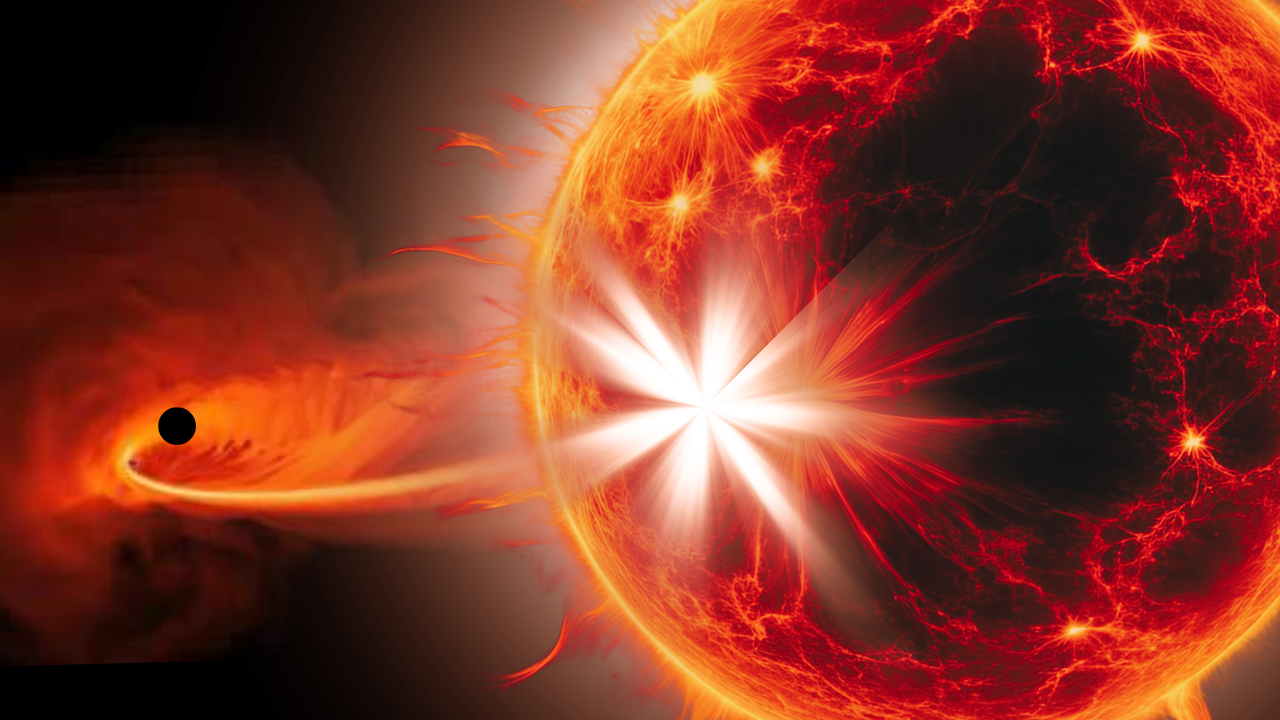
# Black Hole Flares Fade Because of How Stars Spin, New Research Reveals
Stars that venture too close to supermassive black holes experience violent gravitational encounters. These near-miss interactions unleash brilliant flares of energy across the electromagnetic spectrum. But astronomers have noticed something puzzling: when the same star approaches the black hole multiple times, each successive flare dims. New research now explains why stellar spin dynamics govern this fading pattern.
The mechanism centers on orbital mechanics and angular momentum transfer. When a star passes near a supermassive black hole, the extreme tidal forces stretch and heat the stellar material. This generates the intense flare as material heats to millions of degrees and radiates energy. Crucially, the encounter also imparts angular momentum to the star, altering how it rotates.
On subsequent passes, the star's modified spin affects how much material gets torn from its surface. A faster-spinning star sheds less material during tidal disruption. Slower material removal means less energy release. The flares thus decline in brightness with each orbit, following a predictable trajectory based on the star's spin rate.
This discovery has direct implications for how astronomers interpret black hole accretion events. Tidal disruption events, or TDEs, were long treated as one-time catastrophic occurrences. The new findings suggest that repeated flares from the same star can persist for years or decades. This extends the observable window for studying supermassive black holes using stellar encounters.
The research team analyzed data from multiple tidal disruption observations, tracking how flare brightness correlates with orbital parameters. They found that stars with higher spin rates consistently produced dimmer subsequent flares. The relationship held across different black hole masses and stellar types, pointing to a universal principle governing these interactions.
Ground-based telescopes and space observatories including NASA's Swift satellite and ESA's XMM-Newton contributed observations. The datasets spanned years of monitoring, capturing the decay in radiation output across ultraviolet, X-ray, and optical wavelengths.
Understanding stellar encounters with supermassive black holes matters beyond academic curiosity. These events serve as cosmic laboratories. They probe extreme gravity near the event horizon. They test general relativity under conditions impossible to recreate on Earth. Each dimming flare provides another data point for measuring black hole mass and spin.
The finding also clarifies how galaxies evolve. Supermassive black holes sit at the centers of most large galaxies. Their growth through accretion shapes galaxy structure. By understanding how stars feed these black holes, astronomers trace the cosmic history of black hole growth and galaxy assembly.
Future surveys with the Vera Rubin Observatory and other wide-field telescopes will detect more tidal disruption events. The improved cadence will reveal whether the spin-fading mechanism holds universally. It may also expose variations tied to stellar composition or binary companion effects.
Some stars escape their encounters with supermassive black holes intact. They carry away the scars of extreme gravity, their spins altered forever. Each subsequent approach brings dimmer flares and less drama, until eventually the star's elliptical orbit carries it back to the distant galactic outskirts, its energy already spent.