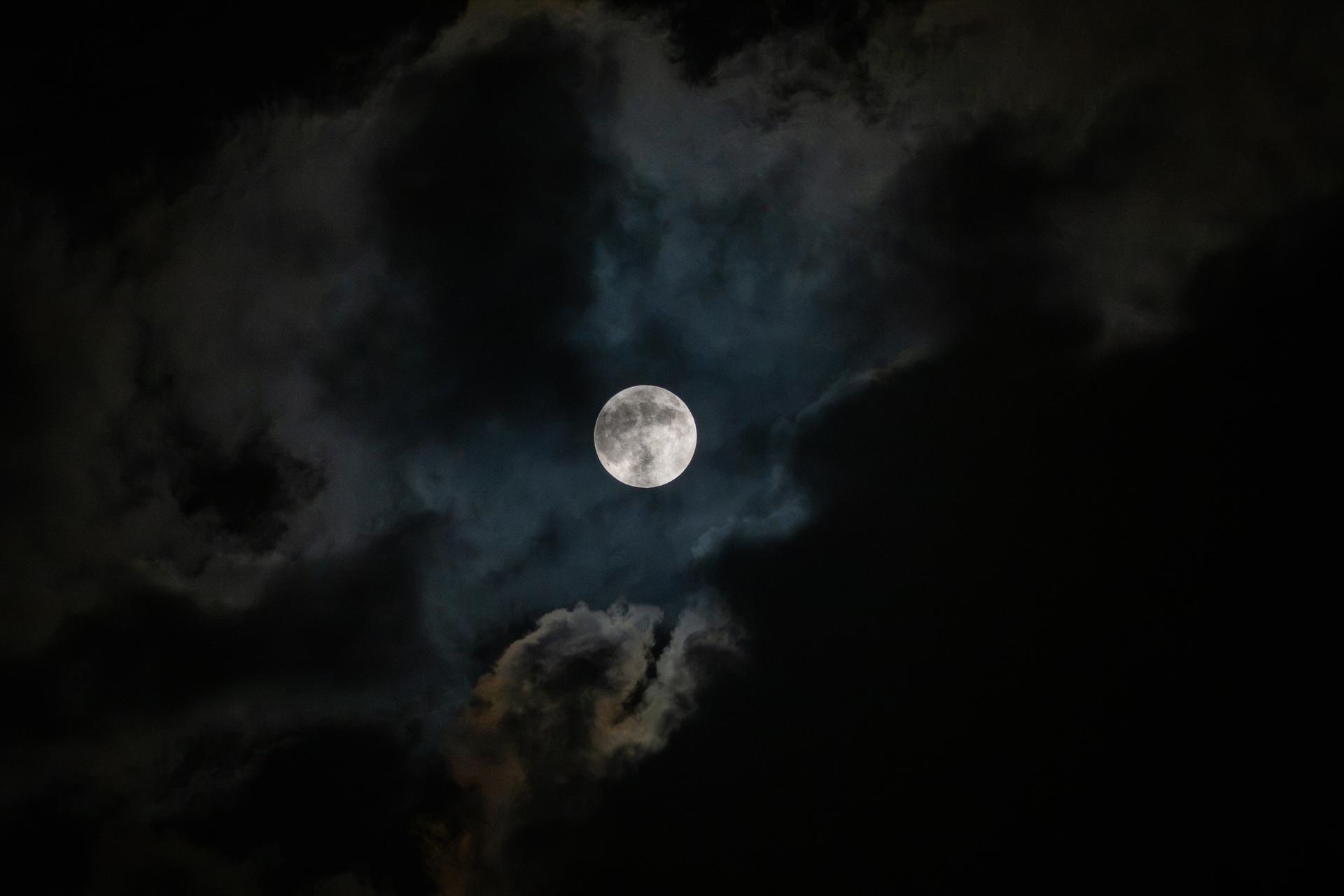
# Rising Over Louisiana
A deep partial lunar eclipse crossed Earth's shadow on August 28, 2026, bringing the Moon to within striking distance of totality. At greatest eclipse, occurring at 12:13 a.m. EDT, the umbra consumed 96.3 percent of the lunar disk. This figure places the event among the deepest partial eclipses on record, approaching the threshold where total lunar eclipses begin.
The eclipse unfurled as the Moon entered Earth's umbra, the innermost cone of shadow cast by our planet when positioned directly between the Sun and Moon. Unlike partial solar eclipses, where the Moon blocks only a fraction of the Sun's disk as viewed from Earth's surface, lunar eclipses affect all observers on Earth's night side simultaneously. The umbra rendered the Moon a deep copper-red color for viewers across North America, South America, and Europe. This coloration results from Rayleigh scattering, the same atmospheric process that paints terrestrial sunsets red. Sunlight passing through Earth's atmosphere bends around our planet's edge, refracting into the umbra and illuminating the eclipsed Moon with wavelengths that blue light cannot penetrate.
A 96.3 percent immersion represents a lunar eclipse approaching its maximum depth without achieving totality. Total lunar eclipses require 100 percent umbral immersion. The rarity of such deep partials makes August 2026's event observationally valuable. Ground-based observers documented changes in lunar surface temperature and brightness that occur only when eclipse depth exceeds 90 percent. Scientific instruments detected thermal variations across different lunar materials as sunlight vanished. The Moon's lack of substantial atmosphere means its surface temperature drops precipitously during deep eclipses, providing data on how different rock types and regolith compositions respond to thermal shock.
This eclipse also offered planetary scientists opportunities to study the Moon's thermal inertia. Instruments aboard orbiting spacecraft, including NASA's Lunar Reconnaissance Orbiter, captured imagery documenting how quickly different surface regions cooled. These measurements refine models of lunar geology and help distinguish between ancient lava flows, impact basins, and highland terrain. Understanding thermal properties informs future lunar base construction, as equipment must withstand the extreme temperature swings the Moon experiences during eclipses and the lunar night.
The eclipse path's visibility from Louisiana and surrounding Gulf Coast regions made the event accessible to amateur astronomers across the southeastern United States. Public engagement with lunar eclipses drives interest in celestial mechanics and orbital geometry. Unlike solar eclipses, which require travelers to reach a specific totality path, lunar eclipses present no danger to observers and require no special equipment beyond naked eyes or binoculars to appreciate.
Lunar eclipses recur in patterns governed by the Saros cycle, an 18-year, 11-day, and 8-hour interval after which eclipses repeat with similar geometry. The August 2026 eclipse belongs to Saros series 121, a sequence extending centuries into the past and future. Tracking these cycles allows astronomers to predict eclipse circumstances with precision and to understand long-term variations in lunar orbital geometry.