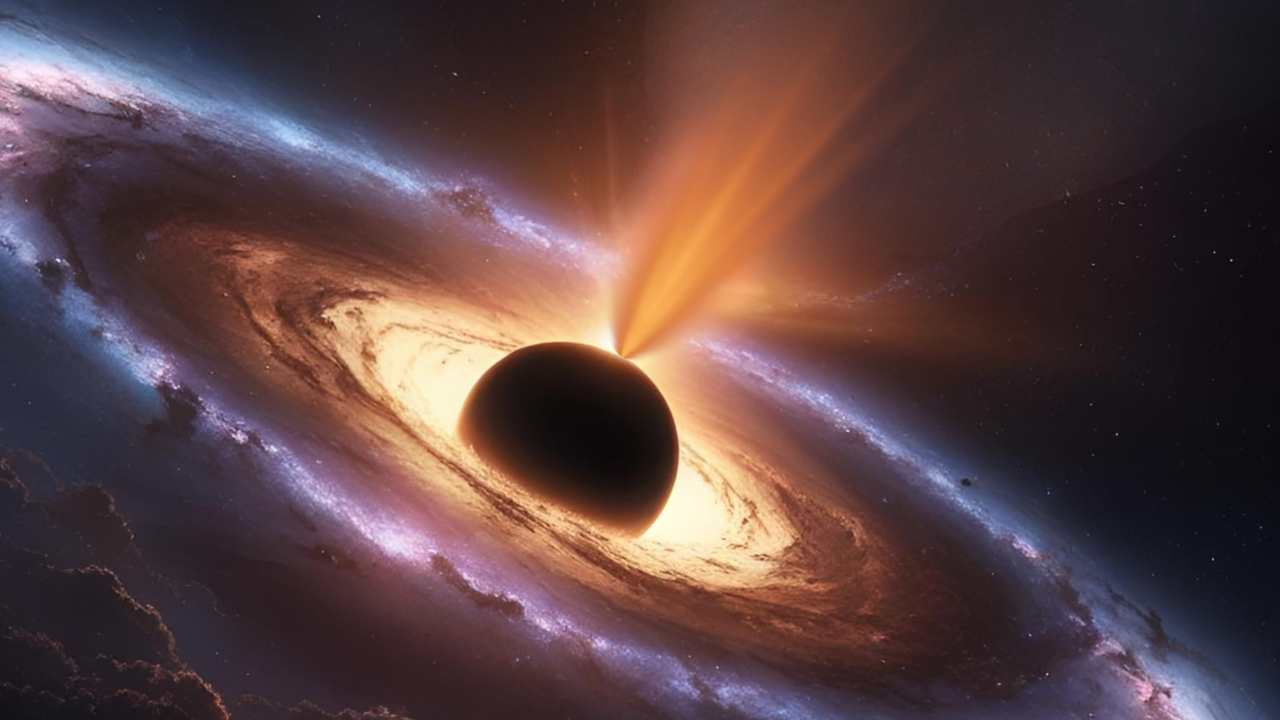
The James Webb Space Telescope has detected supermassive black holes in galaxies from the early universe that seem impossibly large for their age. Now, a new analysis suggests these objects may not be quite as enormous as initial measurements indicated.
When JWST first observed these early supermassive black holes, they presented a crisis for cosmology. The universe was only a few hundred million years old when these objects formed, yet they appeared to contain billions of solar masses. Standard models of black hole growth through accretion of material and mergers could not produce such behemoths in such a short timeframe. Theorists scrambled to propose exotic formation mechanisms, including direct collapse of primordial gas clouds and chains of intermediate-mass black hole mergers.
The new findings challenge whether this crisis even exists.
Researchers examining JWST data have identified potential issues with how astronomers measure the masses of these distant black holes. The primary method relies on observing the emission lines from gas spiraling into the black hole and using the velocity and width of these lines to infer gravitational influence. If the calculations misinterpret the geometry, orientation, or composition of the gas clouds, the derived masses become inflated.
One specific concern involves the assumption that observed emission lines directly trace the orbital motion of material around the black hole. Gas clouds may not orbit in simple, predictable patterns. Turbulence, outflows from the black hole itself, or radiation pressure from the accreting material can distort line profiles and push wavelengths to extreme values. When astronomers measure these shifted lines and apply standard mass-estimation formulas, they may overestimate black hole mass by factors of two, three, or more.
Additionally, dust extinction and other optical effects in the early universe could bias measurements. If a galaxy's dust configuration differs from nearby galaxies used to calibrate the technique, mass estimates can be systematically wrong.
The implications are substantial. If these black holes are genuinely less massive than previously reported, they fit much more comfortably into standard formation timescales. Seed black holes from stellar collapse could grow to the observed sizes through normal accretion over the available cosmic time. This would eliminate pressure to invoke untested physics or exotic scenarios.
JWST continues to observe high-redshift galaxies and their black holes with unprecedented resolution. Follow-up observations of these systems using different wavelengths and techniques offer ways to cross-check mass measurements. Radio observations with facilities like the Event Horizon Telescope could provide independent mass constraints. Detailed spectroscopic analysis with future instruments might reveal whether gas kinematics are simpler or more complex than current models assume.
This work highlights how transformative new observatories sometimes generate puzzles that reflect instrumental capability rather than genuine cosmic mysteries. JWST's power to detect these distant objects is revolutionary. Ensuring accurate interpretation of that data remains an ongoing challenge as astronomers refine their understanding of black hole formation in the infant universe.