# NASA's Hubble Captures the Turbulent Birth Chamber of Massive Stars
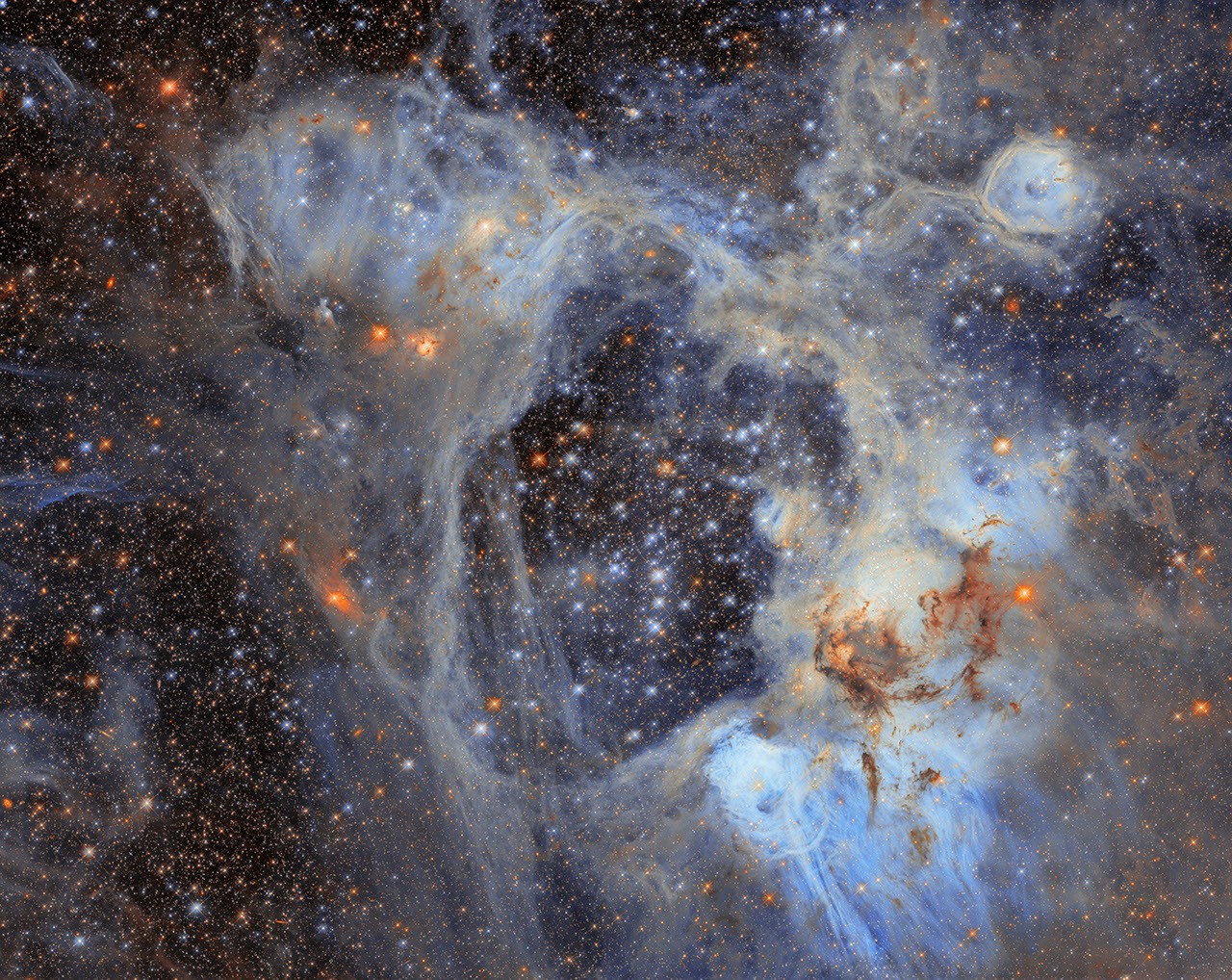
The Hubble Space Telescope has captured a new image of N44, a sprawling superbubble complex located within the Large Magellanic Cloud approximately 160,000 light-years from Earth. This cosmic structure reveals the violent processes that shape stellar birth and death across the universe.
N44 is not a single star or galaxy. It is a vast, hollow shell of gas and plasma created by intense radiation and powerful stellar winds emanating from a cluster of massive, young stars at its center. These stars, among the most luminous objects in existence, generate ultraviolet radiation so intense that it ionizes surrounding hydrogen gas, causing it to glow in distinctive red and blue hues visible in Hubble's observations.
The structure earned the designation "superbubble" because of its enormous scale and the extreme physical processes within it. Stellar winds from the central stars collide at velocities reaching millions of kilometers per hour. These collisions create shock waves that heat gas to millions of degrees Kelvin. Meanwhile, the ultraviolet photons streaming outward carve away at the surrounding nebula, creating the bubble's expanding shell.
Hubble's Wide Field Camera 3 instrument resolved intricate details within N44 that ground-based observatories cannot detect. The telescope captures the wispy filaments of gas at the bubble's periphery, dense knots of material where new stars may be forming, and the ionized gas glowing in multiple wavelengths. This multiwavelength view allows astronomers to map temperature variations and chemical composition across the structure.
The Large Magellanic Cloud itself serves as an ideal laboratory for understanding stellar processes. As a satellite galaxy of the Milky Way, it contains younger stellar populations than our own galaxy, and its distance is close enough for Hubble to resolve individual stars within star clusters. N44 exemplifies why the Large Magellanic Cloud ranks among the most observed targets in astronomy.
Understanding superbubbles like N44 addresses fundamental questions about star formation and feedback. Massive stars live fast and die young, exploding as supernovae after just a few million years. Before that explosion, their radiation and winds shape their local environment profoundly. This "stellar feedback" can trigger new star formation in compressed gas around the bubble's edges, or it can disperse material needed for star formation entirely. The balance between these competing effects determines how efficiently galaxies convert gas into stars.
Hubble continues this work as NASA prepares for the James Webb Space Telescope to provide complementary infrared observations of similar structures. Webb's ability to penetrate dust clouds will reveal star-forming regions hidden from optical telescopes. Together, these observatories build a comprehensive picture of how the universe manufactures stars and shapes the galaxies that contain them.