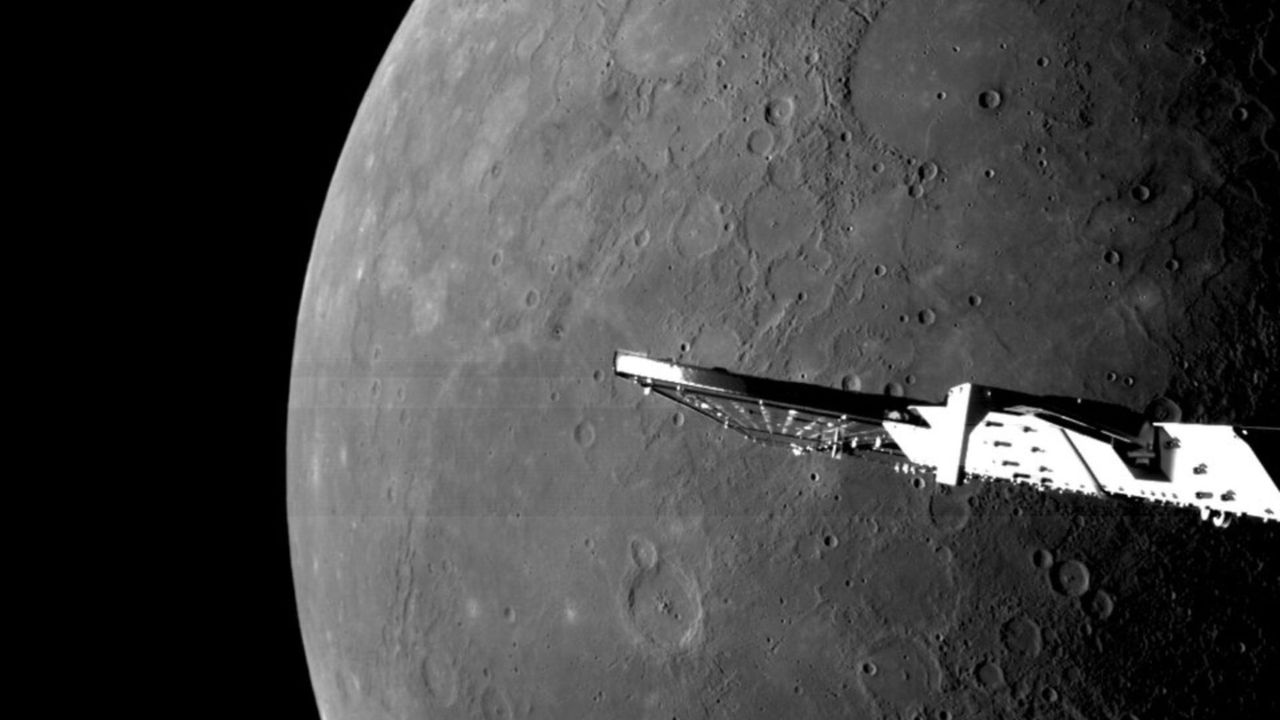
# BepiColombo's Twin Spacecraft Prepare for Mercury's Mysteries After Eight-Year Journey
The European-Japanese BepiColombo mission will soon complete its 8-year interplanetary voyage by separating into two distinct spacecraft designed to probe Mercury, the solar system's least-explored terrestrial world. This separation marks the transition from cruise phase to the primary science mission that will revolutionize understanding of the small, extreme planet closest to the Sun.
BepiColombo comprises two orbiters working in tandem. The Mercury Planetary Orbiter (MPO), built by the European Space Agency (ESA), will map Mercury's surface with unprecedented resolution and study its geology. The Mercury Magnetospheric Orbiter (MMO), developed by the Japan Aerospace Exploration Agency (JAXA) and renamed Mio, will investigate Mercury's magnetosphere and its interactions with the solar wind. This dual-spacecraft approach allows simultaneous observation of the planet's surface and its space environment, a capability no previous mission possessed.
Mercury remains enigmatic despite its proximity to Earth. The planet orbits just 58 million kilometers from the Sun, enduring surface temperatures exceeding 430 degrees Celsius on the day side and plummeting below minus 180 degrees Celsius at night. Its thin atmosphere, called an exosphere, consists of atoms stripped from the surface by solar wind bombardment. Mercury possesses an unusually large iron core relative to its size, creating a magnetic field roughly one percent as strong as Earth's, yet surprisingly complex in structure.
The BepiColombo mission will address fundamental questions about Mercury's composition, internal structure, and magnetic field generation. The MPO carries cameras, spectrometers, and radar instruments to examine surface features, including vast plains of frozen volcanic material and impact craters rimmed by bright rays of excavated material. Mio's instruments will measure the magnetic field and study how the solar wind interacts with Mercury's magnetosphere, revealing why this small planet generates such a strong magnetic field despite its slow rotation.
The spacecraft's eight-year journey involved multiple gravity assists from Earth, Venus, and Mercury itself to achieve the necessary trajectory. This indirect route proved essential because traveling directly to Mercury requires enormous velocity adjustments that would demand excessive fuel. The long cruise phase allowed mission teams to test systems and refine operational procedures before arriving at the destination.
Mercury's exploration history remains sparse compared to other inner planets. NASA's Mariner 10 conducted three flybys in 1974 and 1975, and NASA's MESSENGER orbited the planet from 2011 to 2015. BepiColombo will build on MESSENGER's discoveries with more sophisticated instruments and a longer mission duration, planned for at least one year of primary science operations with possible extension.
Understanding Mercury contributes to broader planetary science objectives. The planet represents an extreme case of planetary evolution where solar radiation, magnetic field generation, and core-mantle dynamics interact in ways fundamentally different from Earth. Data from BepiColombo will test models of planetary formation and early solar system history. The mission also prepares humanity for eventual human exploration of Mercury and advances knowledge applicable to exoplanet studies, where hot, dense worlds similar to Mercury orbit distant stars.