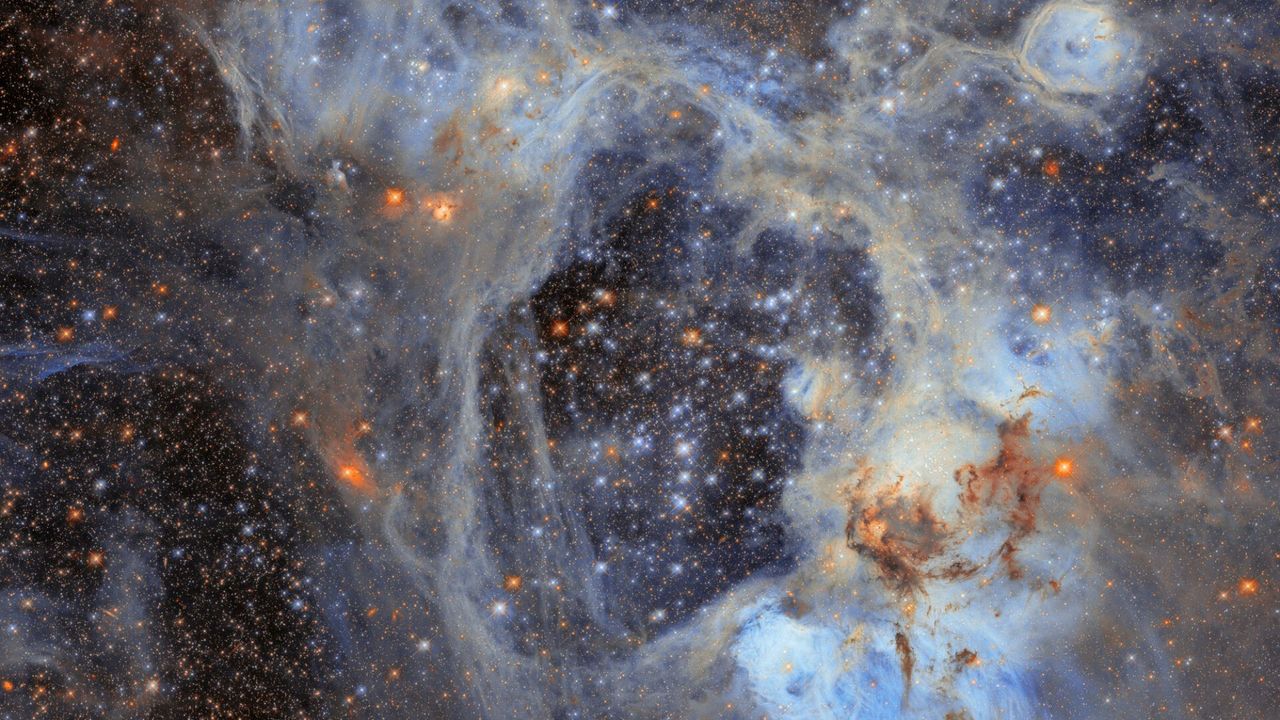
The Hubble Space Telescope has captured an extraordinary view of a "superbubble" in the Large Magellanic Cloud, the Milky Way's nearest galactic neighbor. This observation reveals one of the most energetic structures in the local universe, offering astronomers fresh insights into how massive stars reshape their surroundings.
Superbubbles form through the violent deaths and intense radiation of massive stars clustered together in star-forming regions. As these stellar giants exhaust their hydrogen fuel, they emit powerful stellar winds and eventually explode as supernovae. The combined energy from multiple explosions carves out enormous cavities in the surrounding gas and dust, creating bubbles that can span hundreds of light-years across. The Large Magellanic Cloud, located roughly 160,000 light-years away, hosts some of the most active star-forming regions in the local group of galaxies, making it an ideal laboratory for studying these cosmic phenomena.
Hubble's observations of this superbubble provide crucial data about the mechanics of stellar feedback, the process by which massive stars influence their galactic environments. The telescope's high-resolution imaging reveals the intricate structure of expanding gas shells and the hot ionized gas heating the bubble's interior. These details help astronomers understand how energy from young stellar populations propagates through galaxies and regulates the rate at which new stars form.
The Large Magellanic Cloud occupies a special place in astronomical research. As our galaxy's most prominent satellite galaxy, it remains close enough for detailed study yet distant enough to offer perspective on galactic processes occurring beyond the Milky Way. Hubble observations of the LMC have tracked stellar populations, measured distances to other galaxies through Cepheid variables, and documented the aftermath of the 1987A supernova. This superbubble discovery extends that legacy, adding to our understanding of how stellar explosions and winds sculpture interstellar environments.
Superbubbles differ from their smaller cousins, stellar bubbles, in both scale and energetics. A single supernova might create a bubble spanning tens of light-years, but a superbubble requires the coordinated blast waves from dozens or hundreds of stellar explosions working in concert. The result exceeds the sum of its parts, creating structures powerful enough to trigger gravitational collapse in surrounding gas clouds and spark the birth of new stars on the bubble's walls.
Hubble remains essential for this work despite its age. Launched in 1990, the observatory continues delivering unprecedented clarity in visible and ultraviolet wavelengths. Its Wide Field Camera 3 captures the emission lines from ionized oxygen, hydrogen, and sulfur that trace the bubble's geometry and temperature structure. Ground-based telescopes cannot match this resolution, making space-based observation irreplaceable for studying galactic substructure at such detail.
The discovery underscores the dynamic nature of galaxies. Superbubbles demonstrate that galaxies are not static systems but rather constantly evolving environments shaped by the most violent processes in the universe. Understanding these structures informs models of how galaxies assemble mass, distribute metals created in stellar furnaces, and regulate their own growth over cosmic time. Hubble's continuing survey of nearby galaxies ensures that astronomers capture the most energetic epochs of stellar activity before these bubbles fade and disperse into the galactic medium.