# Lunar Occultation of Venus Treats Skywatchers to Rare Daytime Alignment
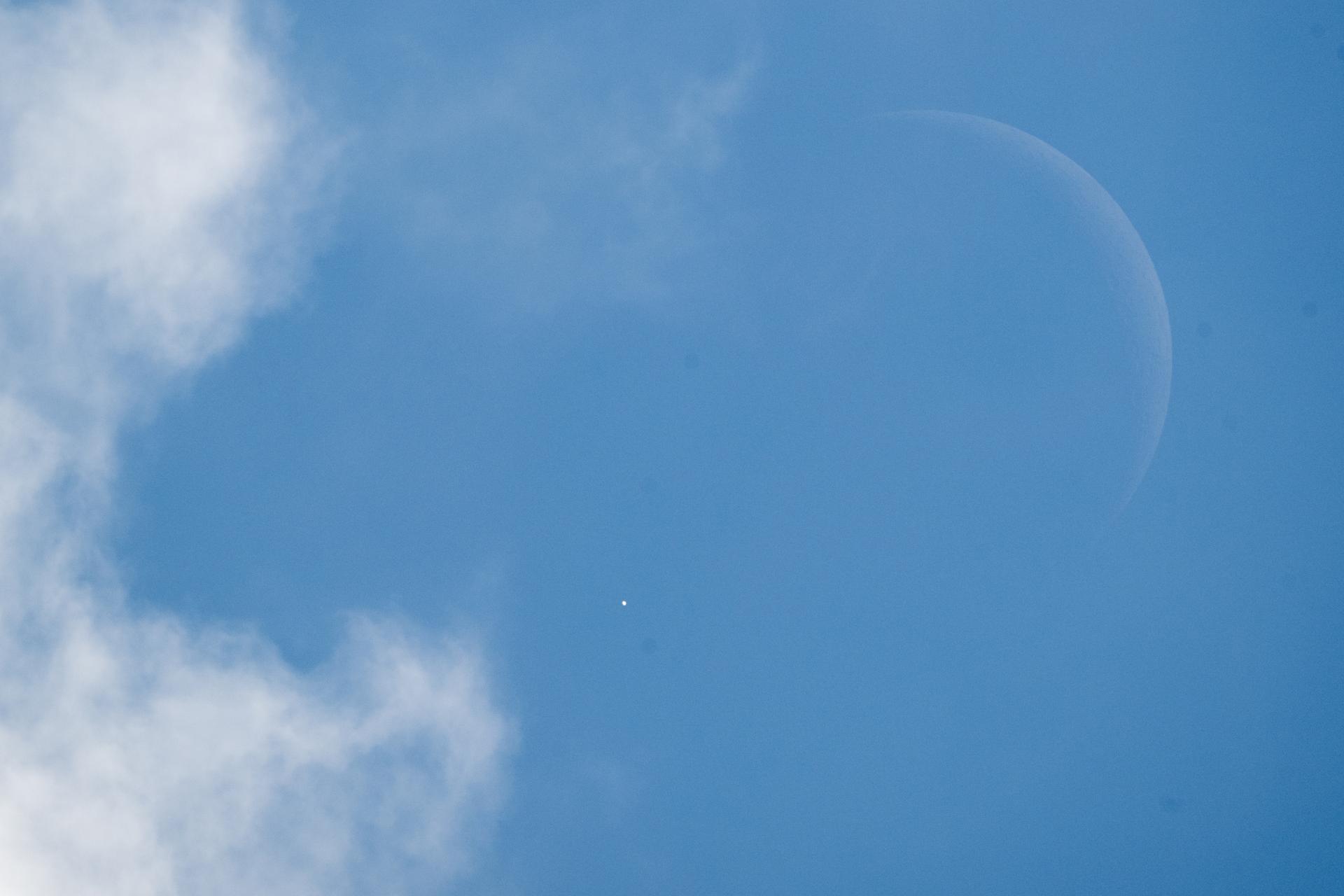
On June 17, observers across North America witnessed a lunar occultation of Venus, an alignment rare enough to draw astronomers and casual stargazers outdoors during daylight hours. The Moon passed directly between Earth and Venus, momentarily obscuring the brightest planet in our sky from view across the continental United States and parts of Canada.
Lunar occultations occur when the Moon's orbital path carries it in front of another celestial body as seen from Earth. While occultations of stars happen frequently, occultations of bright planets remain uncommon events. Venus presents a particular challenge for observation because its brilliance typically washes out against the blue daytime sky. The Moon's solid disk provides the necessary contrast to render the planet briefly invisible to the unaided eye, creating a dramatic moment for observers.
The geometry of this event involved precise orbital mechanics. Venus orbits the Sun at an average distance of 108 million kilometers, while the Moon orbits Earth at roughly 384,400 kilometers. From Earth's surface, the two objects must align nearly perfectly along our line of sight. The Moon's orbital inclination relative to Earth's orbit around the Sun, combined with Venus's orbital position, creates windows when such alignments become possible. These windows narrow further when the occultation occurs during daylight, requiring the Sun, Earth, Venus, and Moon to position themselves in a specific configuration.
Observers using optical aid saw the event with striking clarity. Through binoculars or telescopes, Venus appeared as a crescent or gibbous phase, while the dark limb of the Moon approached and then covered the planet. The reappearance of Venus from behind the Moon's bright limb proved equally dramatic. Experienced observers noted the planet's exact coordinates at ingress and egress, contributing data to ongoing tracking efforts by amateur and professional astronomers.
Occultations serve practical purposes beyond spectacle. They refine our understanding of the Moon's precise position and orbital parameters. When observers worldwide time occultations with precision, their measurements feed into models that predict future lunar positions. This data proves essential for lunar mission planning, spacecraft navigation, and maintaining accurate ephemerides that guide all deep space missions.
The June 17 occultation also reminded observers of Earth's place within a dynamic solar system. The Moon, orbiting at roughly one meter per second in its elliptical path, continuously creates new alignments with planets and stars. Venus, completing its orbit every 225 days, moves through regions where these meetings become inevitable. Observers who witnessed this event participated in a centuries-old tradition of recording celestial mechanics unfolding overhead.
Such events encourage public engagement with astronomy and space science. The rarity of daytime planetary occultations visible from populated regions like North America ensured strong turnout from both dedicated astronomers and curious observers. Professional astronomical organizations issued viewing guides, and social media filled with observation reports and imagery captured through telescopes and smartphones held to eyepieces.
The next comparable occultation of a bright planet visible from North America requires marking calendars years in advance. These rare alignments underscore how predictable yet remarkable planetary motions remain, offering moments when the mechanical precision of orbital mechanics translates into beauty observable from Earth's surface.