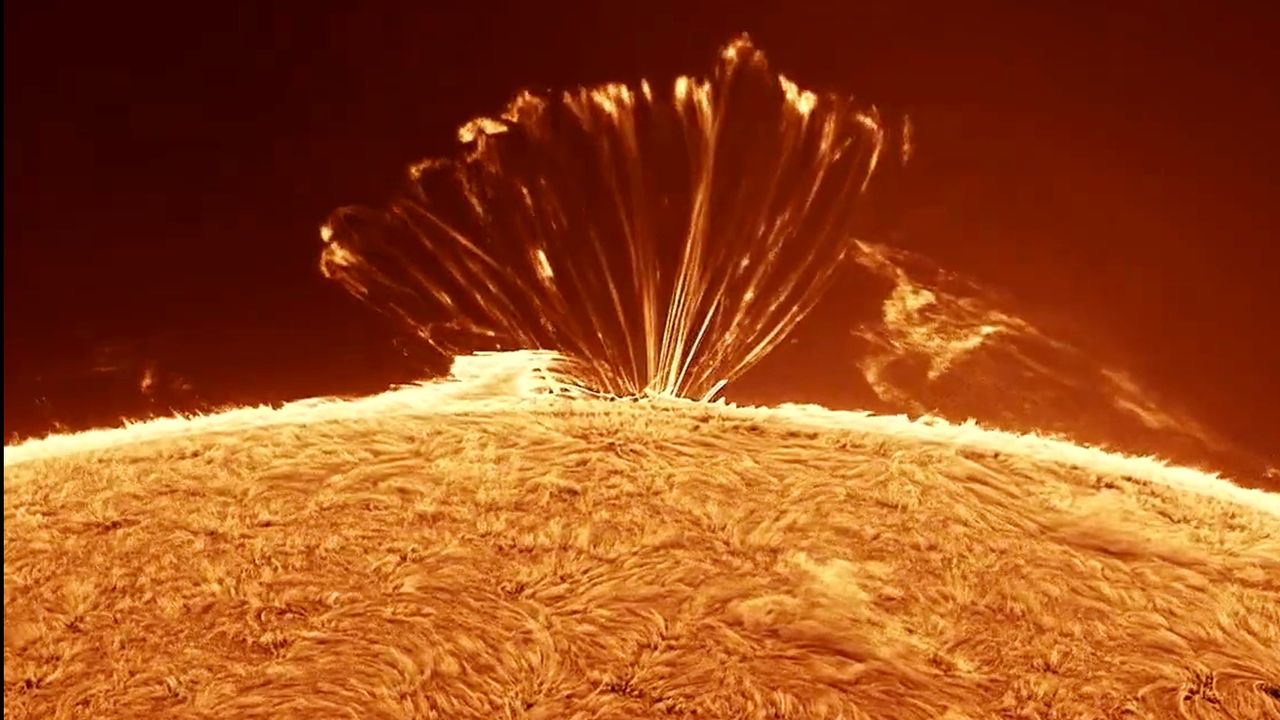
# Solar Plasma Loops Captured in Stunning Detail as Solar Maximum Approaches
A photographer has documented an extraordinary display of plasma loops arcing across the solar limb, capturing a rare alignment of timing, weather, and solar activity that occurs infrequently enough to merit celebration among solar observers. The image represents one of the more visually striking manifestations of solar dynamics now visible as the Sun approaches the peak of its 11-year activity cycle.
Solar prominences and plasma loops form when magnetized material erupts from the solar surface, traveling along magnetic field lines that loop back toward the photosphere. These structures contain plasma at temperatures between 60,000 and 80,000 Kelvin, dramatically cooler than the corona above, which reaches millions of degrees. The loops become visible at the solar limb when they project against the darkness of space, creating the silhouettes that captivated observers and imaging equipment alike on this particular September day.
The catch here involves three simultaneous requirements. First, the observer must have clear atmospheric conditions, free from the clouds and haze that plague ground-based solar observation. Second, the plasma structures must position themselves at the solar limb, the visible edge of the solar disk, rather than on the facing side where they blend against the bright photospheric background. Third, such dramatic loops must occur during times of active solar magnetism, which concentrate into peaks during the solar maximum phase of the Sun's activity cycle.
Solar maximum conditions have created ideal opportunities for this type of observation throughout 2026. The National Aeronautics and Space Administration's Solar Dynamics Observatory, which operates continuously from its vantage point above Earth's atmosphere, has documented thousands of such events. However, ground-based observers with suitable equipment face the additional constraint of weather and daylight availability. The photographer's successful capture reflects both preparation and fortune.
Understanding these plasma structures carries direct implications for space weather prediction and solar physics. The same magnetic instabilities that generate plasma loops also generate solar flares and coronal mass ejections, or CMEs. CMEs carry billions of tons of plasma across interplanetary space at speeds reaching 3,000 kilometers per second. When directed toward Earth, these events trigger geomagnetic storms that disrupt power grids, satellite communications, and navigation systems. The Solar Dynamics Observatory, the Solar and Heliospheric Observatory operated jointly by NASA and the European Space Agency, and instruments aboard NASA's Parker Solar Probe continuously monitor solar activity to provide advance warning of dangerous space weather events.
The visual drama of plasma loops reflects processes that shape the entire heliosphere, the bubble of solar wind and magnetic field that extends billions of kilometers into space. Solar physicists study these structures to decode the mechanisms of magnetic reconnection, energy release, and particle acceleration that remain incompletely understood despite decades of spacecraft and ground observations.
The timing of this observation coincides with heightened solar activity that will persist through 2026 and potentially into 2027. For ground-based observers and space weather forecasters alike, clear skies and active solar regions converge to create windows of opportunity to witness the Sun's most energetic and visually compelling phenomena.