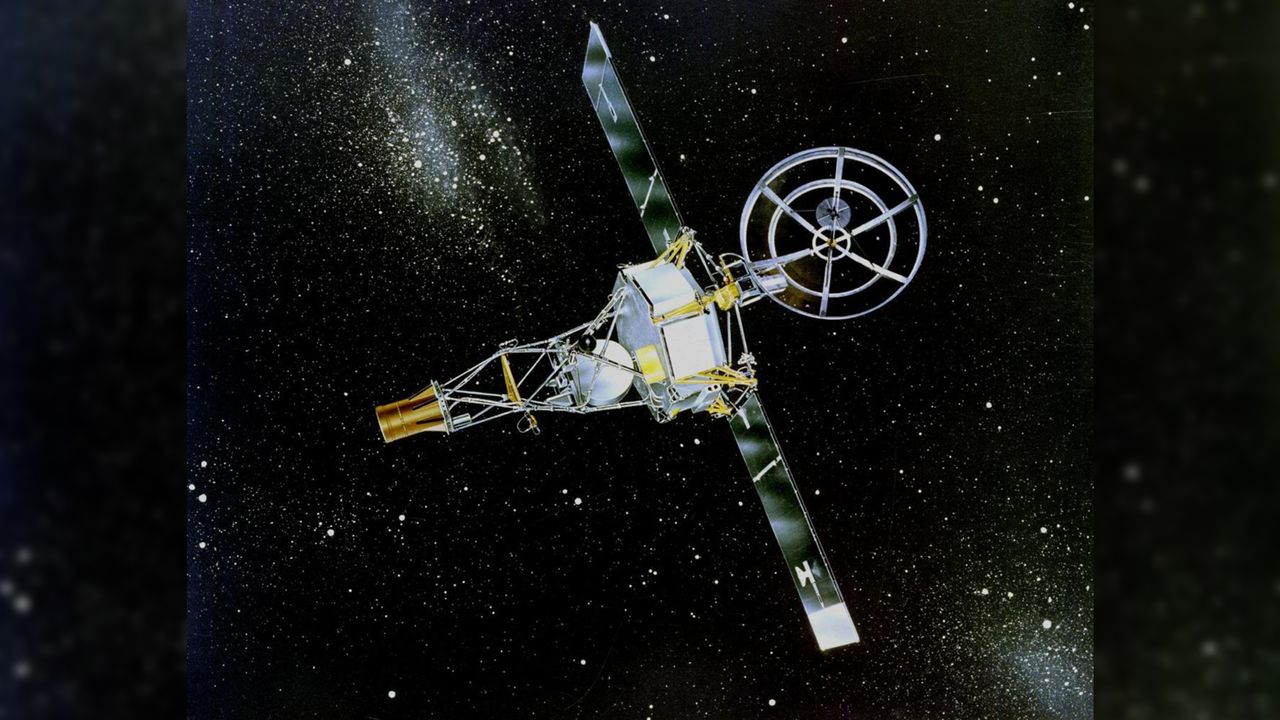
On September 4, 1962, NASA's Mariner 2 spacecraft executed a pivotal maneuver 5 million miles from Earth. The spacecraft fired its thrusters to adjust its trajectory toward Venus, marking the first time humanity had commanded a robotic probe to correct its course in deep space. This moment transformed spaceflight from a ballistic enterprise into one where distant machines could be steered and refined in real time.
Mariner 2 launched from Cape Canaveral on August 27, 1962, aboard an Atlas-Agena rocket. The mission's goal was straightforward but audacious: reach Venus and transmit data about the planet's atmosphere, temperature, and radiation environment. Venus remained largely a mystery. Early observations suggested a hellish world, but scientists hungered for direct measurements.
The mid-course correction on September 4 solved a fundamental problem. Rocket trajectories calculated on Earth never prove perfectly accurate. Solar gravity, thruster variations, and measurement uncertainties all introduce small errors that compound over millions of miles. Without correction capability, Mariner 2 would have missed Venus entirely.
Controllers at NASA's Jet Propulsion Laboratory in Pasadena, California, calculated the precise firing sequence. Mariner 2's hydrazine thrusters ignited for several seconds, altering the spacecraft's velocity by just 10 meters per second. This tiny adjustment proved decisive. The maneuver placed Mariner 2 on a collision course with Venus's vicinity, something impossible to achieve through launch precision alone.
The engineering significance cannot be overstated. This was not a simple course correction like adjusting a car's steering wheel. Controllers operated from Earth with radio signals traveling at light speed, creating a communication delay of several minutes round-trip. They had to command the maneuver blindly, trusting calculations performed by analog computers. If the burn duration was wrong by even a second, the entire mission could fail.
Mariner 2 continued its journey and reached Venus on December 14, 1962, becoming the first spacecraft to successfully encounter another planet. It passed within 21,600 miles of Venus and radioed back instrumental data confirming that Venus possesses a dense carbon dioxide atmosphere with surface temperatures exceeding 430 degrees Celsius. The planet's rotation proved retrograde, opposite to Earth's. Radio emissions suggested an intense magnetosphere or radiation belt.
The success of Mariner 2's mid-course correction opened a new era in planetary exploration. Future missions to Mars, Mercury, Jupiter, and beyond all depended on this capability. The maneuver demonstrated that spacecraft did not need to follow ballistic paths locked in at launch. Controllers could adapt, respond to tracking data, and steer probes toward their targets with precision.
Today, mid-course corrections are routine for every deep-space mission. Artemis lunar landers, Europa Clipper, Mars rovers, and James Webb Space Telescope all employ this technique. The practice began with Mariner 2's brief thruster burn in the vacuum six decades ago. That single maneuver fundamentally changed how humanity explores the solar system.