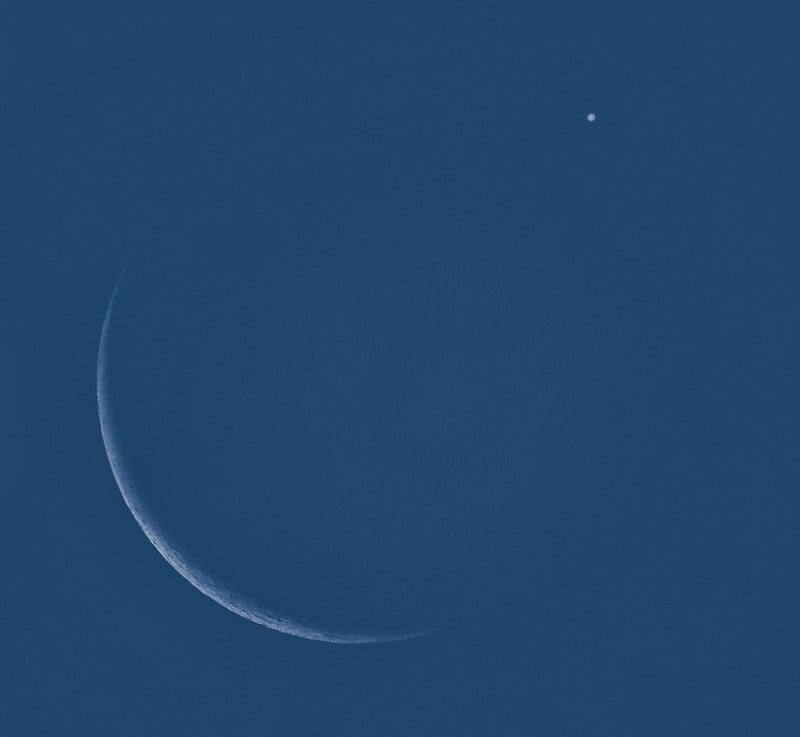
September brings a parade of lunar occultations across Earth's skies, with the Moon positioned to sweep in front of Jupiter, Venus, bright stars, and an open cluster as it tracks toward the Full Harvest Moon on September 26th.
Lunar occultations occur when the Moon passes directly in front of a distant celestial object, briefly blocking its light from view. These events depend heavily on observer location. A planet visible during an occultation from one continent may remain hidden by the daytime sky or beyond the Moon's path from another. The timing and visibility of each occultation shifts with geographic position, making these events a geographic lottery that rewards planners and patient skywatchers.
Jupiter ranks among the September targets. The gas giant, visible in the evening sky during this period, will slip behind the Moon's disk during several occultation windows spread across the month. Jupiter's brightness and relatively large angular size make these events straightforward to observe through binoculars or small telescopes, though naked-eye observation is possible in dark locations when the Moon approaches the planet.
Venus, Earth's brightest planetary neighbor, also enters the Moon's path during September. Occultations of Venus prove rarer than those of Jupiter, making September's event noteworthy for observers positioned along the right longitude and latitude bands. The planet's brilliance dominates evening skies, and watching it vanish behind the lunar limb represents a memorable observational moment. The reappearance of Venus from the Moon's opposite edge completes the spectacle.
Beyond planets, the Moon occults two bright stars and sweeps across an open cluster. These stellar occultations serve as precision timing events, allowing amateur astronomers to contribute data about stellar positions and lunar topography. Open cluster occultations display the Moon's ragged, mountainous edge as the cluster's member stars wink out sequentially behind lunar mountains and valleys.
The astronomical community anticipates these September occultations as accessible events that require no specialized equipment beyond binoculars or telescopes already owned by amateur astronomers. Professional observatories sometimes coordinate observations to refine data on lunar limb profiles and planetary positions. The events continue the momentum from August's eclipse season, when the Sun and Moon crossed each other's orbits. September's occultations demonstrate the Moon's ongoing dynamical interaction with planets and stars in our local sky.
Observers should consult detailed ephemerides and online calculators tailored to their specific location before attempting to observe any September occultation. Cloud cover and atmospheric conditions will determine success. The Full Harvest Moon itself on September 26th represents the month's culmination, marking the point when the Moon reaches maximum illumination while positioned near the autumnal equinox.
These events underscore why lunar occultations have captivated naked-eye observers for millennia and continue to engage modern amateur astronomers. The predictable, repeating cycles of lunar motion guarantee that future occultations will visit skies worldwide, offering accessible windows into the mechanical precision of celestial mechanics.