# How Stars Create the Chemical Building Blocks of Life
The origin of carbon in your bones, oxygen in your blood, and iron in your cells traces back to stellar furnaces billions of years ago. Astronomers are now converging on answers to one of physics' oldest riddles: how do stars manufacture the heavy elements that compose the universe, and how do cosmic explosions scatter those elements across space to seed new worlds?
This quest spans from the 1950s, when physicist Fred Hoyle proposed that stars generate elements heavier than helium through nuclear fusion. Hoyle's work laid the foundation for nuclear astrophysics, but the precise mechanisms remained elusive. Now, advances in telescope technology, computer modeling, and laboratory physics are closing the gaps in understanding stellar nucleosynthesis.
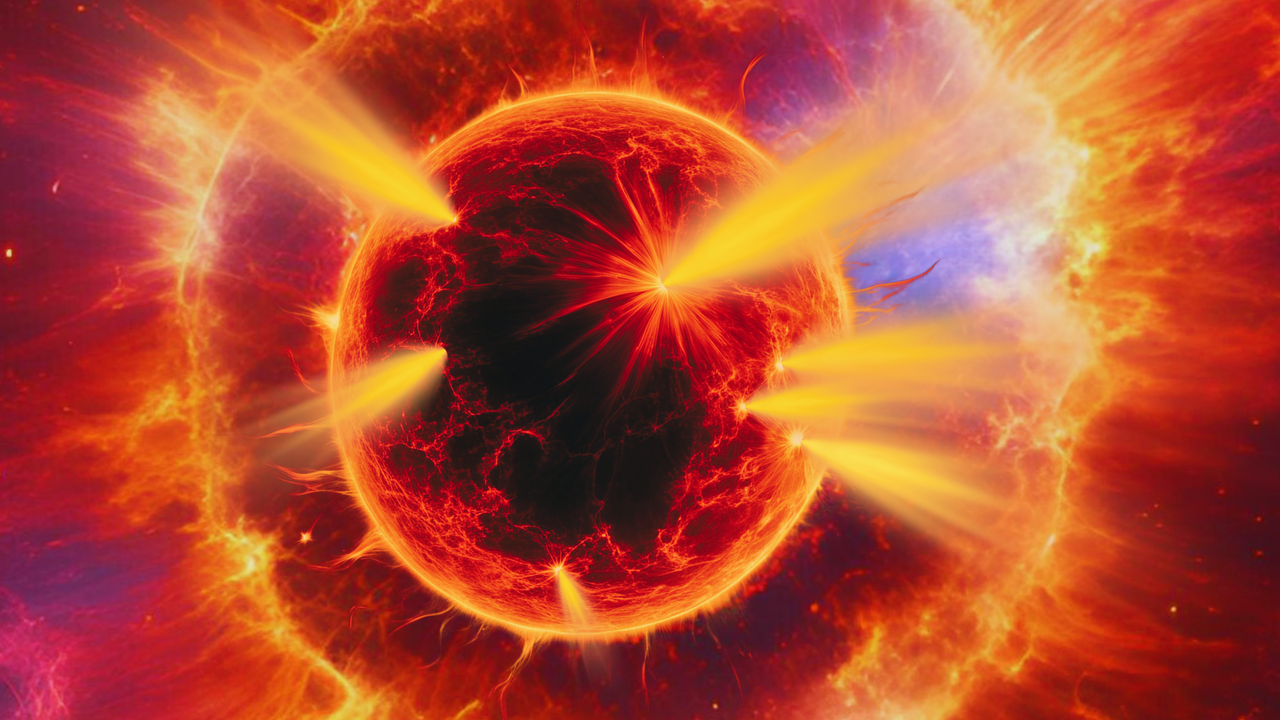
The process begins inside stars like our Sun. Hydrogen and helium fuse in stellar cores under extreme pressure and temperature, forging carbon, nitrogen, and oxygen. Massive stars take this further. In their final moments, they synthesize elements up to iron. The most violent stellar events, supernovae and neutron star collisions, create even heavier elements like gold and uranium. These explosions disperse everything across the interstellar medium, enriching gas clouds that collapse into new stars and planetary systems.
Modern observations from telescopes like the James Webb Space Telescope and ground-based facilities have captured the chemical fingerprints of ancient stars and dying stellar systems. Spectroscopy reveals what elements exist in distant galaxies and how their abundances have shifted over cosmic history. This data constrains theories about which explosion types produce which elements in what quantities.
Computer simulations have grown sophisticated enough to model the roiling dynamics inside collapsing massive stars seconds before they explode. Researchers at institutions including Lawrence Livermore National Laboratory and universities worldwide run supercomputer simulations that track how shock waves propagate through stellar material, how neutrinos escape, and how nuclei combine under extreme conditions. These models reveal which nuclear reactions dominate in which regions of the explosion.
Laboratory physics adds another layer of precision. Scientists at facilities like Oak Ridge National Laboratory use particle accelerators to measure the rates at which atomic nuclei collide and fuse. These measurements feed directly into nucleosynthesis calculations. A single reaction rate, measured to better accuracy, can shift predictions about how much of a particular element an explosion produces.
The convergence of observation, simulation, and experiment has moved the field from hypothesis to predictive science. Teams can now work backward from what we observe in the universe, trace those abundances through stellar processes, and check their work against laboratory data and telescope measurements. Discrepancies prompt refinements in understanding supernova physics or neutron star merger dynamics.
This knowledge matters beyond intellectual satisfaction. Understanding nucleosynthesis constrains how galaxies evolve, how stars form in different cosmic eras, and ultimately how habitable planets emerge. Every carbon atom in every living cell participated in this chain from stellar core to Earth. The story of elements is the story of where we come from.