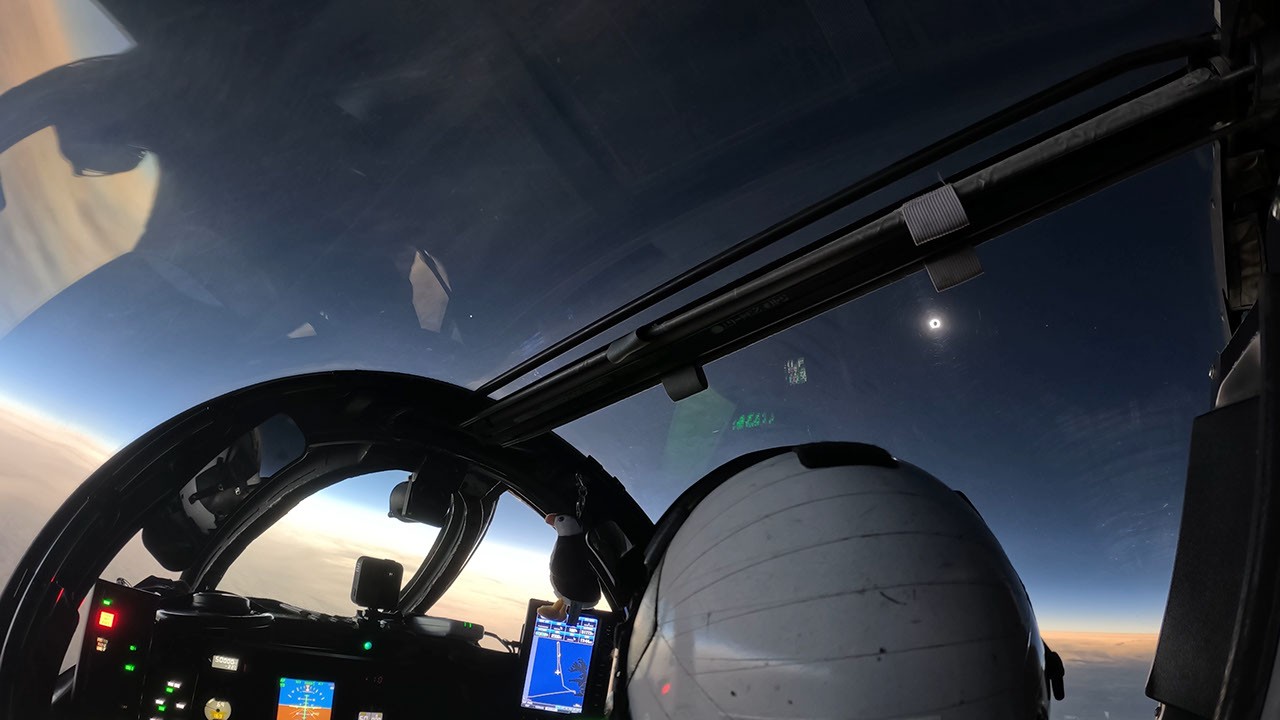
# Chasing the Moon's Shadow: NASA's Astronomy Picture of the Day Explores Solar Eclipse Mechanics
NASA's Astronomy Picture of the Day (APOD) featured imagery and analysis on September 5, 2026, examining the mechanics of solar eclipses and the Moon's shadow as it races across Earth's surface. The presentation highlights the geometric precision required for total solar eclipses to occur and the physics governing how the Moon blocks sunlight during these rare astronomical events.
Solar eclipses happen when the Moon passes directly between Earth and the Sun, casting a shadow on our planet's surface. The phenomenon relies on a remarkable cosmic coincidence. The Moon's angular size in Earth's sky nearly matches the Sun's angular diameter, despite the Sun being roughly 400 times larger. This alignment occurs because the Sun sits about 400 times farther away than the Moon. The result allows observers positioned along the eclipse path to experience totality, when the Moon completely obscures the solar disk.
The Moon's shadow travels across Earth at speeds exceeding 1,000 miles per hour in many cases, though this velocity varies depending on eclipse geometry and Earth's position in its orbit. The umbra, the Moon's darkest shadow where totality occurs, typically measures between 100 and 160 miles wide. This narrow corridor limits where observers can witness the total eclipse. Outside the path of totality, observers experience a partial eclipse as the Moon covers only a portion of the Sun's disk.
APOD, produced jointly by NASA and the Smithsonian Institution since 1995, delivers daily astronomical imagery paired with explanatory text from professional astronomers. The archive contains over 10,000 images spanning planetary science, stellar astronomy, cosmology, and Earth observation. Each day's selection aims to demonstrate how scientific instruments reveal the universe's structure and processes. APOD reaches millions of readers worldwide through its website and syndication partnerships.
Understanding eclipse mechanics contributes to broader solar physics research. During totality, scientists observe the solar corona, the Sun's outer atmosphere, which remains invisible during normal viewing conditions due to the Sun's brilliant photosphere. Coronal observations from eclipse expeditions have historically provided data on solar heating, magnetic field structure, and coronal mass ejection dynamics. Modern space-based solar observatories like the Solar Dynamics Observatory have expanded this work, but ground-based eclipse observations remain scientifically valuable for specific coronal phenomena.
The September 5, 2026 date referenced in this APOD featured a future eclipse event. Tracking eclipse predictions years in advance allows astronomers, educators, and eclipse chasers to plan observations. The NASA Eclipse website provides detailed maps showing eclipse paths, timing information, and safety guidelines for observers in any location.
APOD serves an educational function beyond professional astronomy. Teachers use daily images in classrooms to engage students with real observational data. The archive demonstrates how scientific visualization communicates complex physical processes to general audiences. Solar eclipses, among the most visually striking astronomical phenomena, exemplify this educational power. They connect abstract geometry and orbital mechanics to observable events that capture public imagination.
The presentation of eclipse mechanics through APOD reinforces how fundamental astronomical events serve multiple purposes simultaneously. Eclipses provide opportunities for scientific research, inspire public engagement with astronomy, and demonstrate the orderly mathematical relationships governing planetary motion.