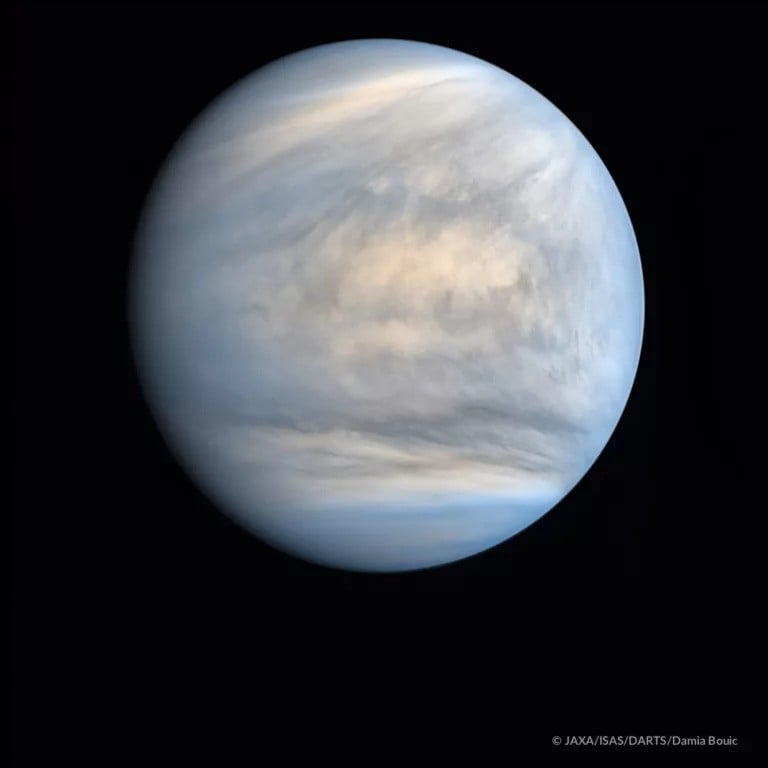
Researchers have discovered that peptides, the molecular building blocks of life, can survive in the sulfuric acid clouds of Venus. This finding reshapes the conversation about habitability beyond Earth and opens new avenues for understanding how life might adapt to extreme environments.
The experiment, conducted on peptides exposed to conditions simulating Venus's atmosphere, shows that these organic compounds remain structurally intact despite the planet's infamous acid environment. Venus's clouds contain sulfuric acid concentrations that would destroy most terrestrial organisms within seconds. Yet peptides demonstrated remarkable resilience, maintaining their molecular integrity under simulated Venusian conditions.
Venus presents a paradox in planetary science. The surface reaches temperatures around 465 degrees Celsius with atmospheric pressures 92 times greater than Earth's. These conditions make Venus's surface entirely inhospitable to known life forms. However, the upper atmosphere at altitudes between 50 and 60 kilometers offers temperatures and pressures closer to Earth-like conditions. Some researchers have theorized that microbial life might exist in these cloud layers, where the environment becomes almost temperate.
The peptide survival data provides experimental support for this decades-old hypothesis. Peptides serve as the fundamental units of proteins, which all known life depends upon. If peptides can withstand Venus's acidic clouds without degrading, then the chemical architecture for life remains theoretically possible in those layers.
This research connects directly to the astrobiological question of panspermia and life's chemical robustness. Peptides could theoretically form through chemical reactions in the Venusian atmosphere, or they could have arrived via meteoritic delivery from space. Either pathway becomes more plausible if these molecules can persist without rapid decomposition.
Japan's Akatsuki spacecraft, which arrived at Venus in 2015, has been studying the planet's atmospheric dynamics and chemistry. The mission provides crucial data about wind patterns, cloud composition, and temperature profiles. Akatsuki's observations support the theoretical models suggesting that Venus's upper atmosphere could harbor microbial ecosystems adapted to acidic conditions.
Future Venus missions will test these ideas more directly. NASA and ESA have proposed multiple Venus orbiters and potentially aerial platforms that could sample the upper atmosphere. These missions would search for biosignatures, chemical signatures that indicate biological activity, within the cloud layers. Detecting organic compounds or detecting metabolic byproducts would represent a revolutionary discovery in astrobiology.
The peptide stability findings also inform broader planetary exploration strategy. If life can adapt to Venus's acid clouds, it expands the range of potentially habitable worlds throughout the galaxy. Exoplanet researchers now consider that distant planets with thick acidic atmospheres might harbor life, fundamentally broadening where astrobiologists should focus attention.
Venus transitions from planetary pariah to scientific opportunity. Rather than a lifeless hellscape, Venus potentially represents a testing ground for understanding life's chemical extremes and adaptation mechanisms. The peptide experiments demonstrate that the barrier to Venusian life may be lower than previously assumed. Continued experimental and observational work will determine whether Venus's clouds host actual microbial communities or merely possess the theoretical capacity to do so.