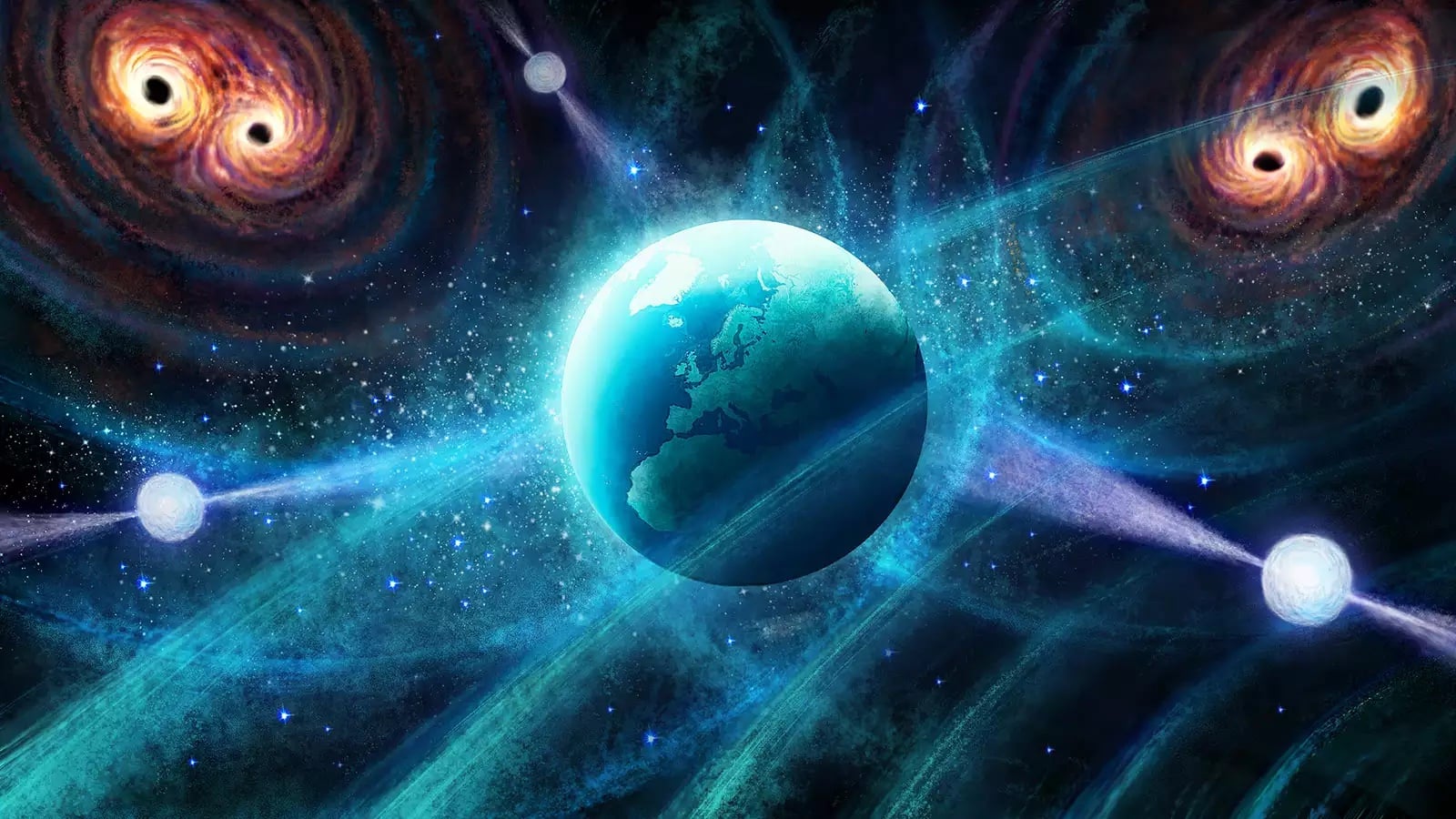
Pulsar timing arrays have detected a persistent gravitational wave background permeating our galaxy, and astronomers now propose that primordial dark matter stars could account for this signal. The discovery opens a new detection pathway for hypothetical objects that remain largely invisible to conventional telescopes.
Pulsar timing arrays work by monitoring the precise arrival times of radio pulses from millisecond pulsars scattered across the sky. These neutron stars spin hundreds of times per second, emitting beams of radiation with metronome-like regularity. When gravitational waves pass through space, they subtly distort spacetime itself, causing minuscule delays or advances in the pulses we receive. By comparing timing data from dozens of pulsars simultaneously, astronomers can fingerprint the gravitational wave background rippling through the galaxy.
The NANOGrav collaboration, operating the North American Nanohertz Observatory for Gravitational Waves, first reported compelling evidence of this background in 2023. Subsequent observations from the European Pulsar Timing Array and the International Pulsar Timing Array consortium confirmed the signal across multiple independent datasets. The origin of these low-frequency gravitational waves remains unresolved. Merging supermassive black holes represent the leading candidate, but the detected signal's characteristics don't perfectly match predictions from black hole mergers alone.
Dark stars enter the conversation as an alternative source. These theoretical objects form in the early universe when dark matter particles accumulate within collapsing protostars, providing outward pressure that prevents normal stellar collapse. The result would be enormous, dark matter-supported stars with masses potentially reaching millions of solar masses. They would radiate primarily through dark matter annihilation rather than fusion, making them effectively invisible to electromagnetic surveys. When dark stars collide and merge in the dense centers of early galaxies, they would generate strong gravitational wave emissions.
The new analysis demonstrates that dark stars merging throughout cosmic history could produce a gravitational wave background with frequencies and amplitudes matching NANOGrav observations. This represents the first concrete proposal linking pulsar timing array data to dark matter phenomena. The connection gains traction because dark stars remain theoretically viable yet observationally elusive, making gravitational waves potentially their only detectable signature.
This development shifts pulsar timing arrays into a new role within dark matter physics. Previously, these instruments focused on gravitational wave astronomy and tests of general relativity. Now they become tools for constraining the properties and abundance of dark stars across cosmic time. Future observations will refine the signal characteristics, potentially distinguishing dark star mergers from black hole mergers or other sources.
The ongoing expansion of pulsar timing array networks strengthens this capability. Additional pulsars enhance timing precision and increase sensitivity to lower-amplitude gravitational waves. The next generation of radio telescopes, including the Square Kilometre Array under construction, will expand pulsar discovery rates and timing accuracy dramatically.
Dark stars remain speculative, but gravitational wave detection provides a path to direct evidence. If pulsar timing arrays can isolate the dark star signature, they would illuminate a class of objects never before detected and open a window onto dark matter's role in early cosmic structure formation.