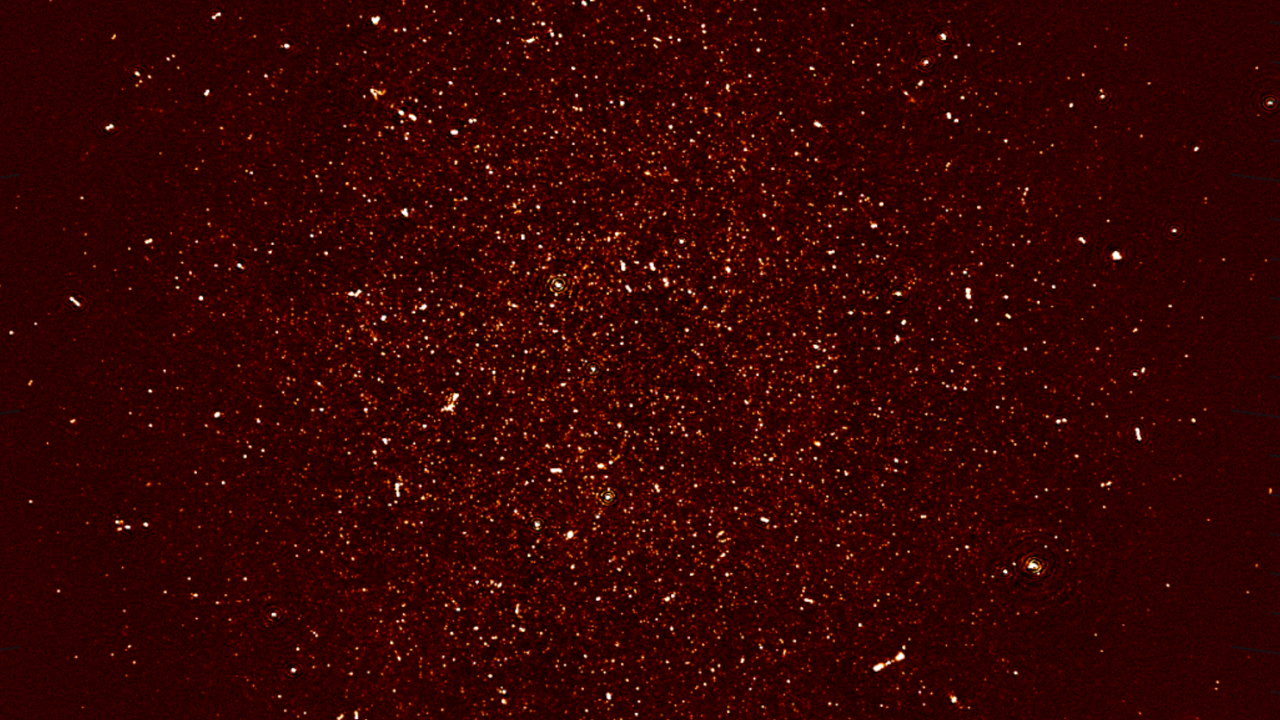
Astronomers working with the MeerKAT radio telescope in South Africa have detected neutral hydrogen signals from galaxies billions of light-years distant, peering back to an epoch when the universe was roughly half its current age. This detection marks a breakthrough in observational radio astronomy and opens a new window for mapping the large-scale structure of the cosmos across cosmic time.
The MeerKAT array, located in the Karoo desert, comprises 64 dishes working in concert to observe the radio universe. Its sensitivity and resolution allow it to detect the faint 21-centimeter emission line produced by neutral hydrogen atoms. This wavelength represents a fundamental tool in radio astronomy because hydrogen comprises roughly 75 percent of all baryonic matter in the universe, making it an ideal tracer for galactic distribution and evolution.
Detecting hydrogen at such distances proves technically demanding. The signals have traveled for billions of years through expanding space, arriving at Earth highly redshifted and weakened. The MeerKAT's engineering and the astronomers' observational strategy overcame these obstacles, enabling detection of hydrogen in distant galaxies during the universe's middle age, a period less studied than either the early universe or the present day.
This capability transforms how scientists map cosmic structure. Hydrogen emission traces galaxies and gas clouds across vast distances, revealing how matter clusters on the largest scales. Traditional optical telescopes observe light from stars and active galactic nuclei, but most of the universe's baryonic matter exists as neutral hydrogen between and within galaxies. Radio observations capture this invisible component, providing a more complete census of cosmic architecture.
The observations also inform our understanding of galaxy evolution and the cosmic web. Neutral hydrogen traces the fuel available for star formation in galaxies. By observing hydrogen across cosmic distances, astronomers measure how the universe's star-forming gas content has changed over billions of years. This directly addresses questions about when and why star formation peaked in the universe and how galaxies assembled their mass over time.
Future surveys using MeerKAT and other radio telescopes like the Square Kilometre Array will extend these measurements to larger cosmic volumes and greater distances. The SKA, under construction with sites in South Africa and Australia, will increase collecting area by an order of magnitude compared to current facilities. These instruments will map neutral hydrogen across the universe systematically, creating three-dimensional maps of cosmic structure spanning billions of years.
The detection also tests cosmological models. The observed hydrogen distribution can be compared against predictions from numerical simulations of cosmic structure formation driven by dark matter and dark energy. Discrepancies reveal where our models require refinement. Matches strengthen our understanding of the universe's composition and evolution.
Radio astronomy fills gaps left by optical and infrared telescopes. While space-based observatories like the James Webb Space Telescope excel at studying distant galaxies' starlight, MeerKAT and similar facilities reveal the gaseous scaffolding upon which galaxies form and evolve. Together, these approaches provide complementary views of cosmic history.
The MeerKAT detection represents steady progress in radio cosmology. Each observation pushes sensitivity limits further, enabling detection of fainter and more distant sources. This incremental advance in observational capability compounds over time, transforming radio astronomy from a specialized tool into a primary method for mapping the universe's large-scale structure and history.