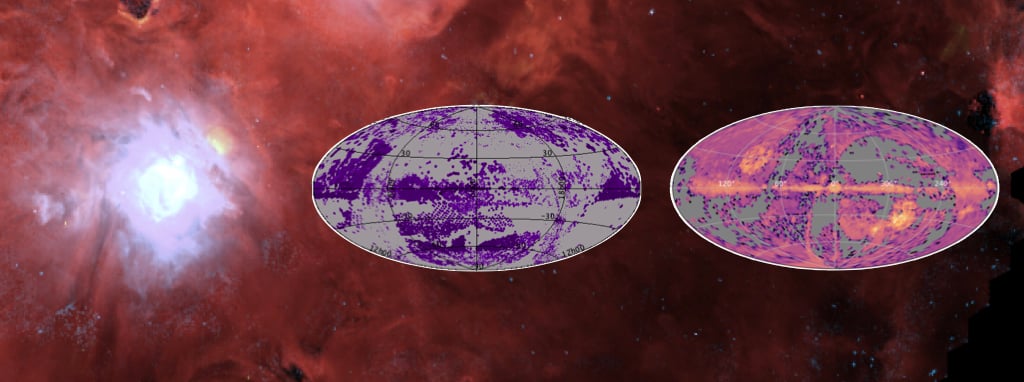
The Sloan Digital Sky Survey released its twentieth data package, marking two decades of continuous astronomical observation and analysis. DR20 consolidates data from multiple concurrent observation projects operating under the SDSS-V banner, the survey's current iteration launched in 2020.
SDSS functions as one of astronomy's most productive ground-based instruments. Since 1998, the 2.5-meter telescope at Apache Point Observatory in New Mexico has conducted systematic observations of the night sky, cataloging millions of celestial objects and measuring their properties with spectroscopic precision. Each data release represents a snapshot of accumulated observations, processed through standardized pipelines and made freely available to the global research community.
DR20 incorporates results from three distinct mapper components within SDSS-V. The Milky Way Mapper tracks stellar populations across our galaxy, measuring distances, compositions, and motions of individual stars. The Black Hole Mapper conducts targeted observations of supermassive black holes and their immediate environments, studying accretion processes and relativistic physics. The Local Volume Mapper produces detailed spectroscopic surveys of nearby galaxies, revealing star formation patterns and chemical abundances across galactic structures.
The scale of this dataset defies easy comprehension. SDSS has measured spectra for over four million objects across its operational lifetime. Each spectrum contains wavelength-resolved light information that astronomers use to determine elemental composition, temperature, rotation rates, and recession velocities. This spectroscopic foundation enables research spanning stellar evolution, galactic structure, extragalactic astronomy, and cosmology itself.
Data releases serve as pivotal infrastructure for modern astronomy. Rather than individual researchers operating isolated telescopes, SDSS established a model where thousands of scientists worldwide leverage shared datasets. A single discovery in DR20 might answer questions posed by researchers across continents. This democratized access accelerated the pace of discovery across multiple subfields simultaneously.
The twentieth release reflects accumulated instrumental refinements and observational strategies refined across more than a quarter-century. Improved detector calibrations, advanced data processing algorithms, and corrected systematic uncertainties distinguish DR20 from earlier releases. Archival data from previous observations receive reanalysis with contemporary techniques, sometimes yielding new discoveries from previously released datasets.
SDSS continues addressing fundamental questions about cosmic structure and composition. The survey tracks how galaxies evolved from the early universe to the present day. It measures the large-scale distribution of matter, constraining dark energy and inflation models. It documents stellar death processes, identifying white dwarfs, neutron stars, and black holes across the Galactic plane.
The survey operates through consortium membership, with institutional contributions supporting telescope operations and computational infrastructure. This model sustained SDSS operations through multiple phases, each introducing new scientific capabilities and extended survey reach. SDSS-V, the current phase, pursues enhanced spectroscopic coverage compared to earlier iterations, targeting previously inaccessible regions and object classes.
Researchers access DR20 through public databases and archive systems managed by Johns Hopkins University. Documentation accompanying each data release includes detailed descriptions of observation procedures, quality flags indicating data reliability, and example scientific applications. This transparency enables confident reuse of archival data for purposes sometimes unanticipated by original observers.
The release cycle continues. SDSS observations proceed continuously at Apache Point, with future data releases planned as observation campaigns conclude and processing pipelines deliver refined calibrations. Each release expands humanity's mapped knowledge of the observable universe.