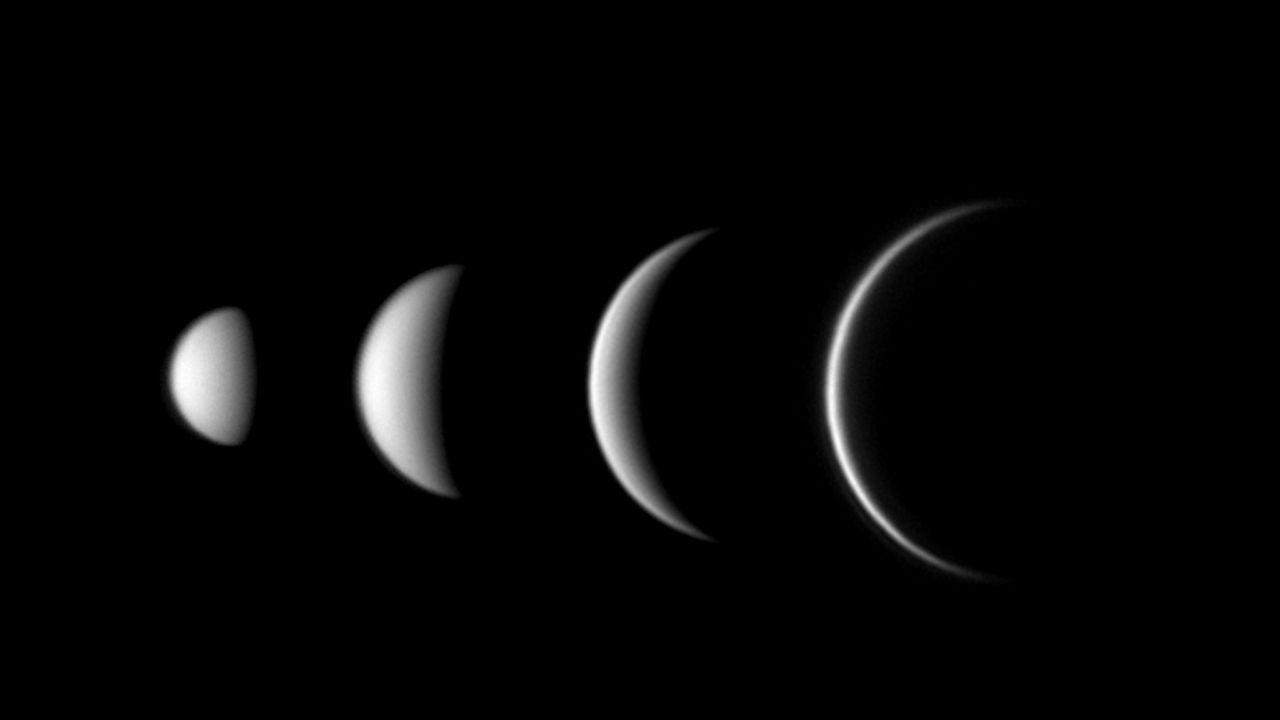
Venus reaches its most dramatic phase this week, narrowing into a thin crescent visible through even modest telescopes. The planet passes between Earth and the Sun in what astronomers call inferior conjunction, an alignment that transforms Venus from an evening star into a phenomenon that mirrors the lunar phases Galileo first observed four centuries ago.
This geometric dance traces back to basic orbital mechanics. Venus orbits closer to the Sun than Earth does, completing its circuit every 225 days. When Venus swings between our planet and the Sun, the sunlit portion we see shrinks from a full disk to a sliver. Over the coming weeks, Venus transitions from a gibbous phase resembling the Moon three-quarters full to a crescent so thin it appears as little more than a hairline of light.
The timing matters for observers. Venus now sinks into the twilight glow of dusk, fading from prominence in the evening sky. A telescope with even 20x magnification reveals the crescent structure plainly. Naked-eye observers cannot perceive this phase change because Venus never strays more than 47 degrees from the Sun in Earth's sky, keeping it bathed in solar glare during daylight hours when its crescent form would be most visible.
Galileo's telescopic observations of Venus's phases in 1610 and 1611 provided the first observational evidence supporting heliocentrism. The Catholic Church had rejected Copernicus's sun-centered model, but Venus could not display these phases if the Ptolemaic geocentric system held true. A planet orbiting Earth could never move behind the Sun from our perspective, ruling out the crescent phase entirely. Galileo's discovery demolished that objection, though it took the scientific establishment another century to fully embrace the heliocentric framework.
Today's observers possess advantages Galileo lacked. Modern telescopes reveal cloud structure and atmospheric detail impossible for his primitive optical tube to capture. High-resolution imaging from spacecraft like NASA's Parker Solar Probe and various orbital platforms captures Venus's thick sulfuric acid clouds and roiling atmospheric circulation. Yet the basic geometry remains unchanged. Venus still performs its celestial dance, still proves heliocentrism with every crescent it presents to telescopes across Earth.
The inferior conjunction of Venus occurs roughly every 584 days, the synodic period governing how frequently Earth and Venus align. After this inferior conjunction passes, Venus will begin its climb into the morning sky, appearing as a crescent in the pre-dawn hours before gradually fattening into a gibbous shape over the following months.
For amateur astronomers, this represents one of the year's premier observing opportunities. The window remains narrow. By early February, Venus will have passed between Earth and the Sun completely, beginning its transition back toward morning visibility. The crescent phase peaks this week, offering naked-eye observers in twilight a glimpse of the brightest object in our night sky transforming into something almost unrecognizable, and offering telescopic observers the chance to witness the same phenomenon that shattered medieval astronomy five centuries ago.