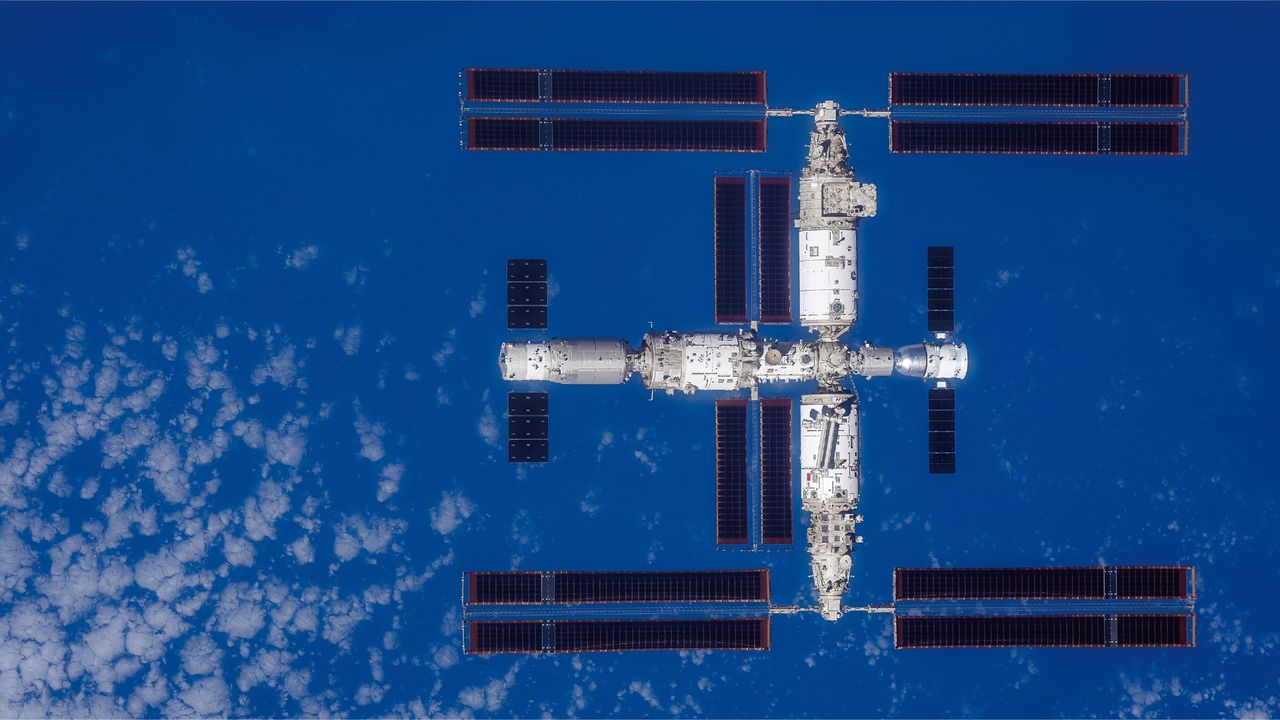
China's Tiangong space station will make several naked-eye passes over the United States this week, offering observers a rare chance to spot the orbital outpost without optical aid. The station shines brightly enough to rival Venus in the evening sky, making it visible to anyone with clear skies and patience.
Tiangong orbits at an inclination of approximately 41.5 degrees, which limits its visibility to observers north of that latitude. Viewers in the northern United States, Canada, and much of the northern hemisphere fall within the viewing zone. The station appears as a steady, brilliant point of light moving silently across the heavens, noticeably brighter than most stars and typically brighter than the International Space Station at its dimmest passes.
The visibility windows depend on the geometry between the station's orbital path, Earth's rotation, and the observer's location. Tiangong becomes visible only during specific hours, typically in the hour after sunset or the hour before sunrise. During these twilight periods, the station remains illuminated by the sun while the ground falls into darkness. The station travels at approximately 17,500 miles per hour, completing an orbit around Earth every 90 minutes.
To observe Tiangong, first consult dedicated tracking apps like Heavens-Above or N2YO, which provide precise pass times and visibility predictions for your specific location. Input your zip code or latitude and longitude into these applications to generate a customized forecast. The apps predict not only when the station will pass overhead but also its brightness magnitude and the direction from which it will appear.
Observers should find a location away from light pollution, though Tiangong's brilliance means urban or suburban viewing remains possible under many conditions. Binoculars are not necessary, though some observers report being able to discern the station's solar panel arrays through optical aid during particularly bright passes. The unaided eye tracks the station more easily than any telescope, allowing viewers to follow its entire path across the sky.
Tiangong represents a significant milestone in China's spaceflight program. The station became operational in 2022 after China launched its core module, Tianhe, in April 2021. Subsequent missions delivered the Wentian and Mengtian laboratory modules, completing the basic structure. The station hosts Chinese astronauts for multi-month missions and conducts microgravity experiments in materials science, combustion dynamics, and biological processes.
Unlike the International Space Station, which operates as a collaborative venture among NASA, Roscosmos, ESA, and other space agencies, Tiangong operates under exclusively Chinese direction. The station orbits at a lower altitude than the ISS, approximately 250 miles above Earth's surface, which contributes to its apparent brightness.
This week's passes offer observers an accessible window into China's expanding role in human spaceflight and orbital infrastructure. Clear skies and correctly timed observations can yield a memorable view of humanity's latest foothold in space.