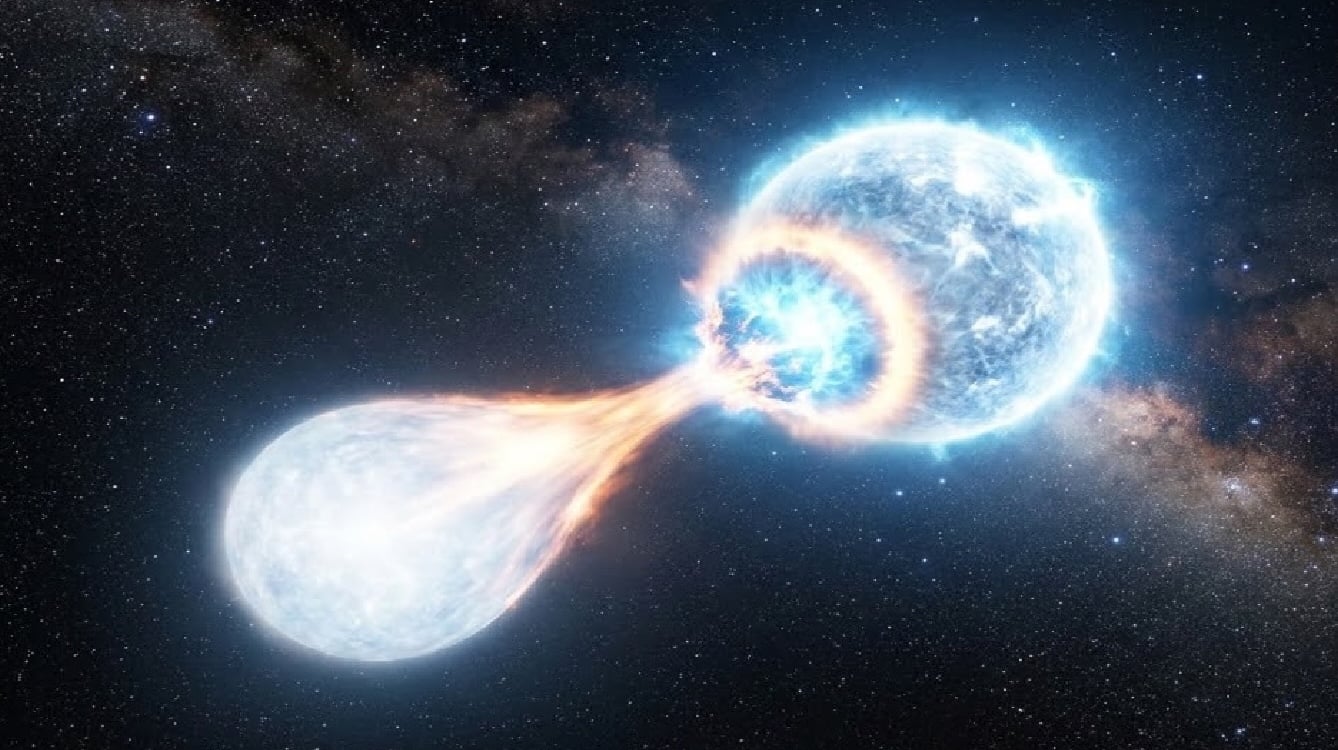
Astronomers have identified a binary white dwarf system with extraordinary orbital mechanics that positions it as a prime candidate for detection by next-generation gravitational wave observatories. The system, designated eRASSU J0608, consists of two white dwarfs in a remarkably tight embrace, completing an orbit every six minutes.
This discovery carries profound implications for gravitational wave astronomy. Current detectors like LIGO and Virgo detect gravitational waves from cataclysmic events such as neutron star mergers or black hole collisions. The waves from binary white dwarfs operate at frequencies that ground-based detectors cannot yet resolve. Future space-based observatories, particularly the Laser Interferometer Space Antenna (LISA), will shift the detection band to lower frequencies where systems like eRASSU J0608 emit their gravitational signatures continuously.
White dwarfs are stellar remnants left behind when stars like our Sun exhaust their fuel. They pack roughly a solar mass into a volume comparable to Earth. When two white dwarfs orbit close enough, tidal forces gradually compress them into increasingly eccentric paths. eRASSU J0608's six-minute orbital period places it among the most compact known binary systems of this type.
The discovery emerged from data collected by the eROSITA X-ray telescope, which scans the entire sky. The system's X-ray emissions revealed the presence of two orbiting bodies so close together that they transfer material between one another. This mass transfer generates the energetic radiation that made the system visible to eROSITA's instruments. The researchers at the Inter-University Centre for Astronomy and Astrophysics and collaborating institutions analyzed the orbital dynamics and concluded that gravitational wave emission dominates the system's orbital evolution.
The orbital decay is relentless. Over millions of years, eRASSU J0608 will spiral inward. Eventually the two white dwarfs will merge. Depending on the combined mass, the merger could create a neutron star, trigger a thermonuclear explosion, or form a more massive white dwarf. LISA will detect the gravitational wave signal throughout this process, observing the frequency increase as the orbital period shrinks.
Why eRASSU J0608 matters extends beyond its individual properties. Binary white dwarfs represent the future of gravitational wave science. Thousands of such systems likely populate the galaxy, but only the closest and most compact will generate detectable signals. Finding them now allows astronomers to prioritize targets for LISA observations once the space-based detector launches, currently scheduled for the early 2030s.
The six-minute orbit also serves as a testing ground for relativity predictions. General relativity precisely predicts how binary systems lose energy to gravitational radiation and how orbital periods should shrink. eRASSU J0608 provides an opportunity to measure these predictions with unprecedented precision once LISA begins observing.
This system exemplifies how modern sky surveys are revolutionizing gravitational wave astronomy. Rather than waiting for catastrophic events, astronomers now systematically search X-ray data for compact binaries emitting gravitational waves continuously. Each discovery brings the field closer to routine observations of spacetime ripples, transforming gravitational waves from rare curiosities into standard astronomical tools.