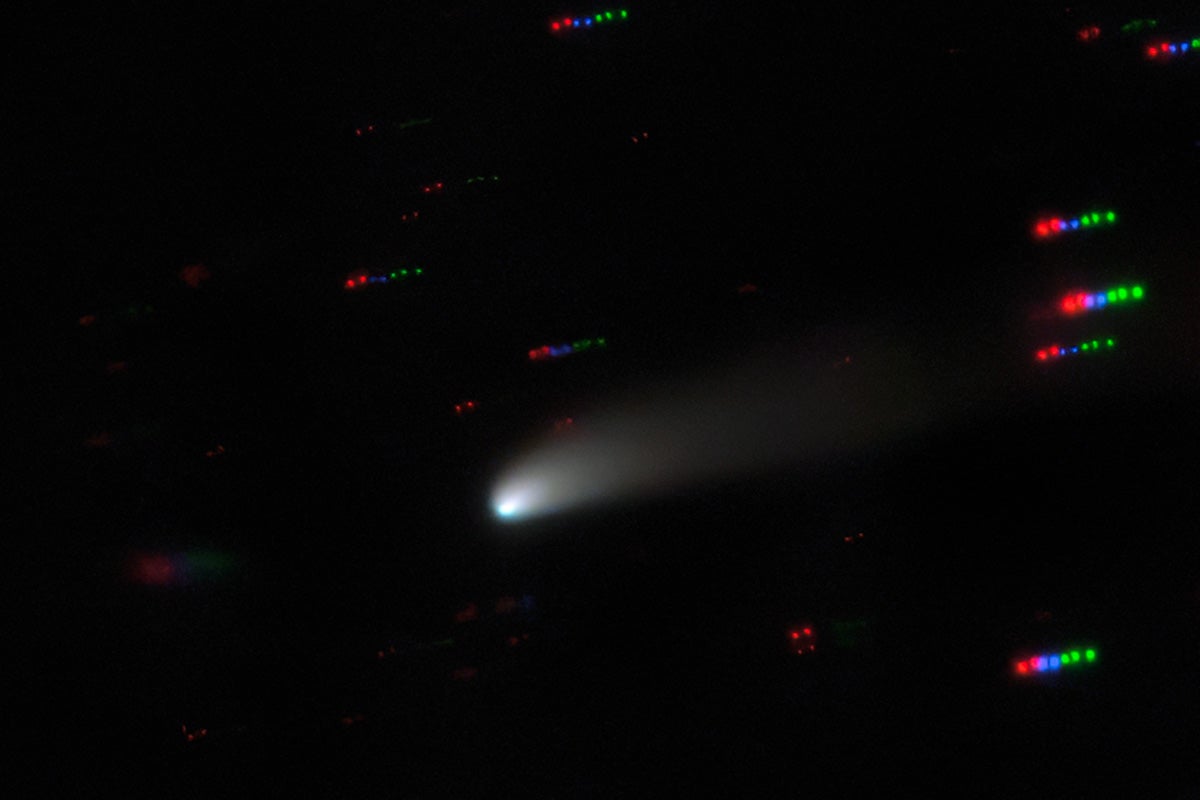
Saturn's gravitational pull in 1992 fundamentally altered the trajectory of a small icy body cataloged as 450P/LONEOS. The Centaur object, a class of icy bodies that orbit between Jupiter and Neptune, crossed into the inner solar system after the encounter. Astronomers now monitor this transformation in real time, watching a Centaur become a comet.
The shift proves pivotal for understanding planetary migration and the long-term evolution of icy bodies. Before 1992, 450P/LONEOS traveled in a stable orbit among the outer planets, cold and dormant. Saturn's gravity bent its path dramatically. The new orbit brought the object much closer to the Sun's heat. This proximity triggers sublimation, the direct conversion of frozen volatiles into gas. What was once a quiet Centaur now displays the telltale coma and tail that define comets.
Astronomers recognize the moment as rare. Close gravitational encounters between large planets and small bodies occur infrequently. When they do occur, the resulting orbital shift typically takes decades to produce observable cometary activity. 450P/LONEOS compressed that timeline. Within three decades of Saturn's interaction, the object exhibited clear cometary behavior. This acceleration creates a natural laboratory for studying transformation processes that normally unfold over centuries or millennia.
The International Gemini Observatory, operating under NOIRLab and the National Science Foundation, captured detailed images of the Centaur mid-transformation. Ground-based observations tracked the brightening object as solar radiation penetrated deeper into its icy crust. Spectroscopic data revealed the composition of sublimated material, showing water ice, carbon dioxide, and organic compounds. These measurements provide a chemical snapshot of the object's interior, information normally locked away in the outer solar system.
The science extends beyond mere observation. Understanding how Centaurs transition into comets illuminates the solar system's early history. Many scientists theorize that the solar system's structure resulted from significant planetary migration. Objects knocked inward by this migration populated the comet families we observe today. 450P/LONEOS demonstrates this process in action. By studying its outgassing patterns and structural changes, astronomers refine models of how such interactions reshape small bodies and redistribute them throughout the solar system.
The transformation also carries implications for planetary defense. A Centaur suddenly perturbed into an Earth-crossing orbit could pose hazard concerns decades after the interaction. Monitoring how quickly such objects become active helps predict their visibility and behavior. Astronomers tracking 450P/LONEOS gather data applicable to risk assessment for future discoveries.
Saturn's 1992 encounter with this anonymous Centaur object transformed it from a forgotten chunk of ice in the outer solar system into a visible comet under scrutiny. The timing allows current instruments and observing techniques to capture details that observers decades ago could never have resolved. Astronomers continue monitoring 450P/LONEOS as it moves along its new path, each observation adding chapters to the story of planetary interaction and the restless migration of icy bodies throughout our cosmic neighborhood.