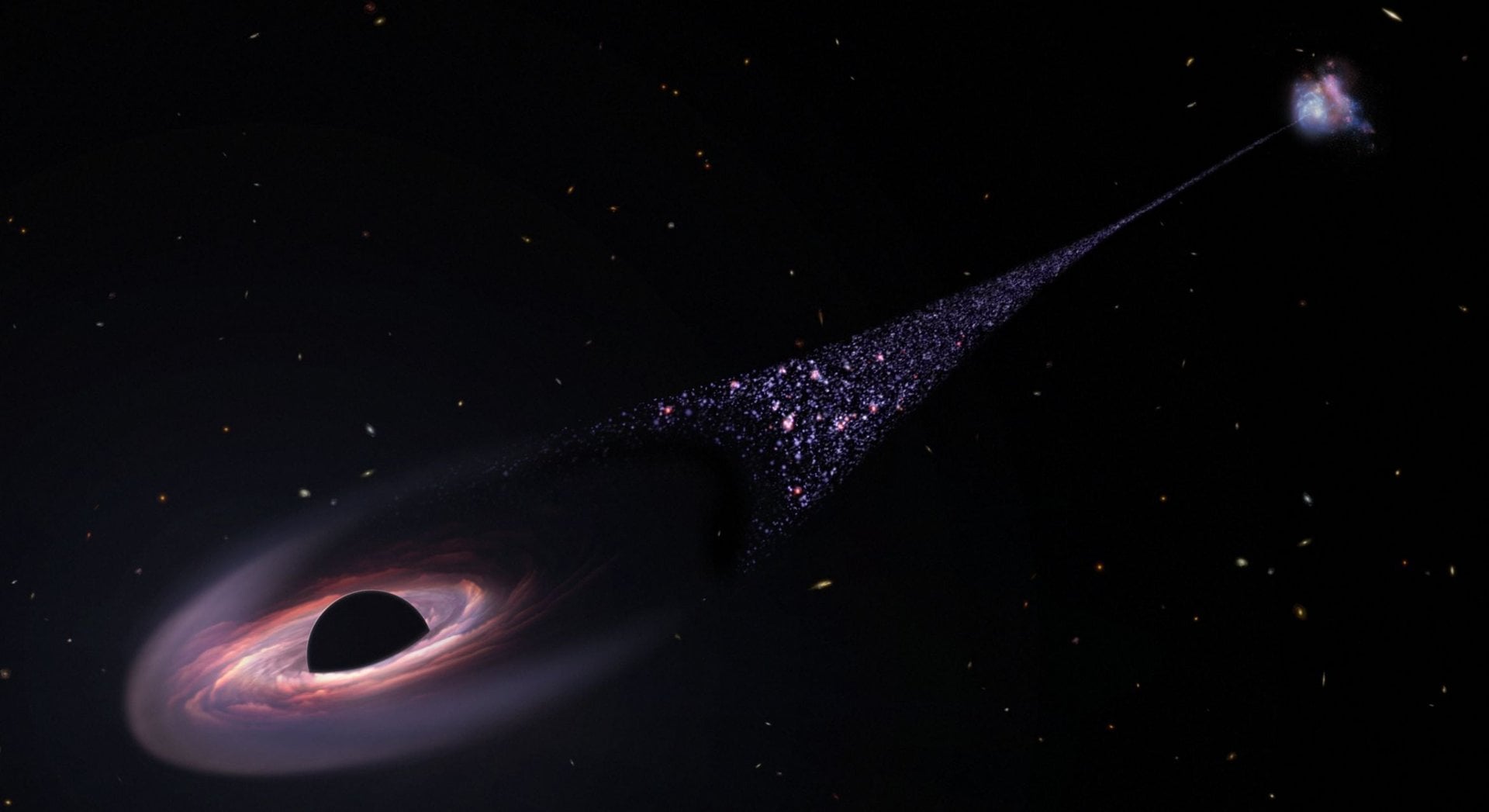
Physicists have solved the mystery of a runaway supermassive black hole ejected from its host galaxy, with researchers from UC Santa Barbara and University of Texas at Austin pinpointing a galactic merger as the cause.
The black hole, observed at a distance corresponding to when the universe was roughly half its current age, traveled through intergalactic space at tremendous velocity. As it moved, it compressed gas in its wake, creating a distinctive "contrail" of young, blue stars spanning thousands of light-years. This trail provided the observational evidence that allowed astronomers to track the black hole's trajectory and reconstruct the physics behind its ejection.
Supermassive black holes normally reside at the centers of galaxies, anchored by gravity and the surrounding stellar mass. Their sudden ejection requires an extraordinary event. The research team determined that when two galaxies collided and merged, the recoil from asymmetric gravitational radiation during the merger process kicked the black hole out of the merged system's center. This gravitational slingshot effect, predicted by general relativity, had never been conclusively observed before.
The mechanism works as follows: when black holes from two merging galaxies approach each other and eventually collide, they release gravitational waves that radiate energy asymmetrically. If those waves carry away more momentum in one direction than another, the resulting black hole receives a "kick" in the opposite direction, much like a rocket experiencing thrust. Depending on the masses, spins, and orbital configurations of the original black holes, this kick can reach velocities of thousands of kilometers per second, sufficient to escape the merger's gravitational well entirely.
The discovery carries profound implications for understanding galaxy evolution and black hole dynamics. Supermassive black holes influence the growth and structure of their host galaxies through jets and radiation that regulate star formation. When a merger ejects a black hole, it disrupts this feedback loop entirely. The orphaned black hole continues wandering the intergalactic medium, while its former host galaxy loses the black hole that would normally shape its future development.
This finding also validates decades of theoretical predictions about gravitational recoil from merging black holes. Previous simulations suggested such events should be common in the early universe, when galaxy mergers happened more frequently. Observing this particular runaway black hole, roughly seven billion light-years from Earth, confirms that the universe's most violent collisions produce exactly the dynamical effects that Einstein's equations predict.
The star trail trailing behind the black hole offers a unique natural experiment. As the black hole plows through intergalactic gas and dust at high velocity, it creates a shock front that compresses material and triggers star formation. These young, hot stars emit blue light that makes the trail visible to space telescopes. By studying this trail's properties, astronomers can measure the black hole's current velocity and trajectory, working backward to constrain the initial merger dynamics.
Future observations with instruments like the James Webb Space Telescope may reveal additional runaway black holes, allowing researchers to build a statistical sample. This would help determine how frequently such ejections occur and whether they significantly impact the distribution of black holes throughout the universe. The discovery demonstrates that even in the cosmos's most extreme environments, precision physics remains discoverable through careful observation and rigorous analysis.