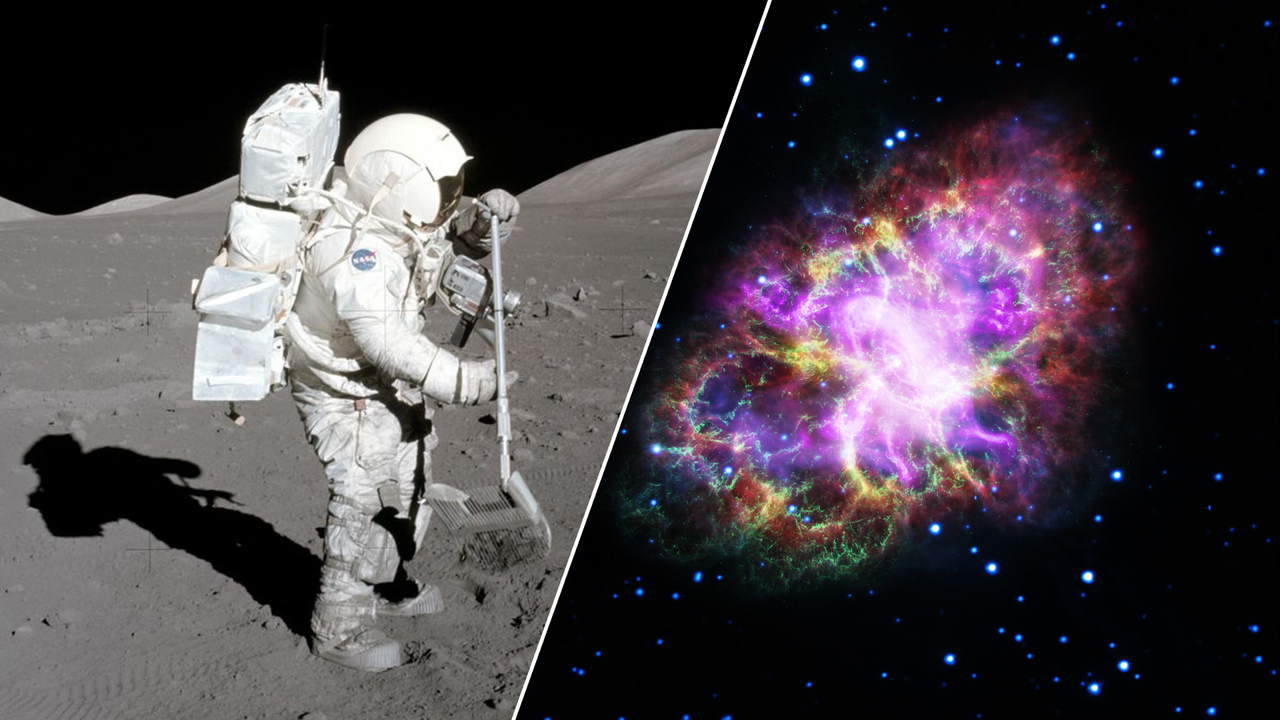
Scientists have recovered a record of ancient supernova explosions embedded in lunar regolith. Researchers extracted radioactive isotopes from moon dust collected during NASA's Apollo missions, then analyzed their isotopic ratios to reconstruct the timeline of stellar detonations that occurred relatively close to our solar system over the past several million years.
The discovery works like a cosmic time capsule. When a supernova explodes, it releases a shower of high-energy particles and radiation across space. Some of these particles reach Earth and the Moon, where they interact with atoms in soil and rock, producing radioactive isotopes that accumulate over time. By measuring the concentrations of these isotopes in pristine lunar samples, scientists can determine when supernovae occurred and how frequently they struck our region of the galaxy.
The Moon offers a superior archive compared to Earth. Our planet's atmosphere shields the surface from many incoming cosmic particles, and erosion rapidly destroys geological records. The Moon lacks an atmosphere and experiences minimal weathering. Its regolith preserves the radioactive fingerprints of ancient events for billions of years, creating an unbroken geological chronicle.
Researchers focused on isotopes like iron-60 and beryllium-10, which form exclusively through cosmic ray interactions. These elements do not occur naturally from radioactive decay or other processes. Their presence in lunar dust points directly to supernova-generated radiation. By measuring the depth of these isotopes in different layers of moon dust and accounting for their radioactive decay rates, scientists constructed a timeline of supernova activity.
The findings reveal that supernovae have detonated in our cosmic neighborhood more regularly than previously suspected. Some explosions occurred close enough to potentially affect Earth's climate and atmosphere. The data suggests a cluster of supernova events roughly 8 to 10 million years ago, followed by a quieter period. Understanding this pattern helps astronomers model the distribution of stellar explosions throughout the Milky Way and refine estimates of how often nearby stars end their lives catastrophically.
This research builds on earlier work that identified iron-60 in deep ocean sediments and Antarctic ice cores, deposits that hint at supernova activity. The lunar measurements provide independent confirmation and extend the timeline. Apollo 16 and Apollo 17 astronauts collected the samples used in this study, giving new scientific value to material gathered during the 1970s lunar missions. Modern isotopic analysis techniques, unavailable during the Apollo era, now unlock these ancient secrets.
The findings have implications for astrobiology and planetary protection. Nearby supernovae could have bathed the early solar system in radiation intense enough to strip away planetary atmospheres or damage biological molecules. Understanding the frequency and intensity of these cosmic events informs models of habitability and the conditions Earth experienced during its formative years.
Future lunar missions will collect fresh samples from different regions and depths of the lunar surface. This expanded dataset will sharpen the timeline of supernova activity and potentially reveal regional variations in cosmic ray exposure. The Moon continues serving as humanity's best instrument for reading the violent history of our galactic neighborhood.