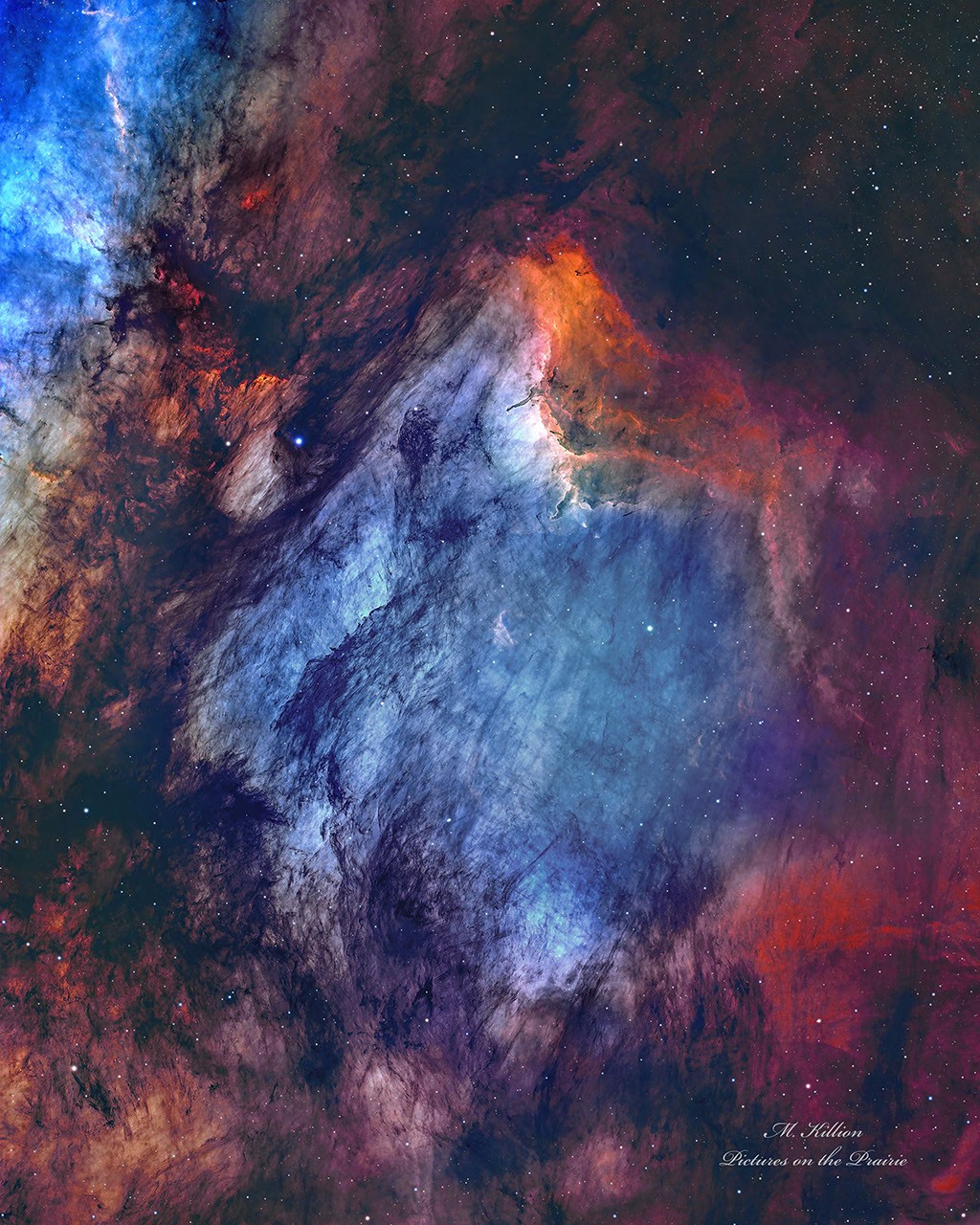
# A Closer Look at the Pelican Nebula's Stellar Nursery
The Pelican Nebula stands as one of the most visually arresting regions of star formation in our galaxy. Located approximately 1,800 light-years from Earth in the constellation Cygnus, this nebula spans roughly 30 light-years across and represents an active stellar factory where new stars continue to ignite from collapsing clouds of gas and dust.
The nebula's distinctive appearance emerges from its shape, which resembles a pelican in profile. The "head" of this cosmic bird contains dense concentrations of dust and ionized gas. Radiation from hot, young stars within and around the nebula illuminates the surrounding material, creating the glowing appearance that telescopes capture. The darker regions represent thick dust lanes that obscure starlight behind them, while brighter areas mark where ultraviolet radiation from massive stars excites hydrogen atoms and causes them to emit visible light.
The Pelican Nebula sits adjacent to the North America Nebula, another prominent star-forming region in the same region of the sky. Together, they form part of a larger complex of stellar nurseries that astronomers have studied extensively. The nebula contains multiple star clusters in various stages of formation. Some stars have already ignited nuclear fusion and begun their main sequence lives. Others remain embedded in cocoons of dust, still accumulating mass before reaching the threshold needed to become true stars.
Observations from ground-based telescopes and space-based instruments like the Hubble Space Telescope reveal the intricate structure of the Pelican Nebula. The Spitzer Space Telescope provided infrared data that penetrates the dust and reveals protostars hidden from visible light observation. These infrared observations exposed young stellar objects still in their earliest phases, surrounded by accretion disks from which planets may eventually form.
The physics governing the Pelican Nebula's structure involves a delicate balance between gravitational collapse and the outward pressure from stellar radiation and stellar winds. When massive young stars reach sufficient brightness, they begin to photoevaporate the surrounding nebula, creating expanding bubbles of ionized gas. This process shapes the nebula's morphology and can either trigger or inhibit star formation in nearby regions, depending on local conditions.
The composition of the Pelican Nebula consists primarily of hydrogen and helium, with traces of heavier elements forged in previous stellar generations. These heavy elements, including carbon, nitrogen, oxygen, and iron, came from supernovae explosions and planetary nebulae ejected by dying stars. Over millions of years, these materials collected into clouds that eventually collapsed to form the nebula we observe today.
Studying the Pelican Nebula contributes directly to understanding how stars form in our galaxy. The nebula offers astronomers a laboratory for testing models of stellar birth and the mechanisms that determine stellar mass distributions. These observations inform our understanding of planet formation as well, since young stellar systems emerging from nebulae like Pelican often develop planetary systems around their nascent stars.
The Pelican Nebula demonstrates the universe's creative power. Within the swirling clouds of gas and dust lies the genesis of worlds and suns that may harbor future civilizations. Every atom in our bodies once passed through nebulae like this one.