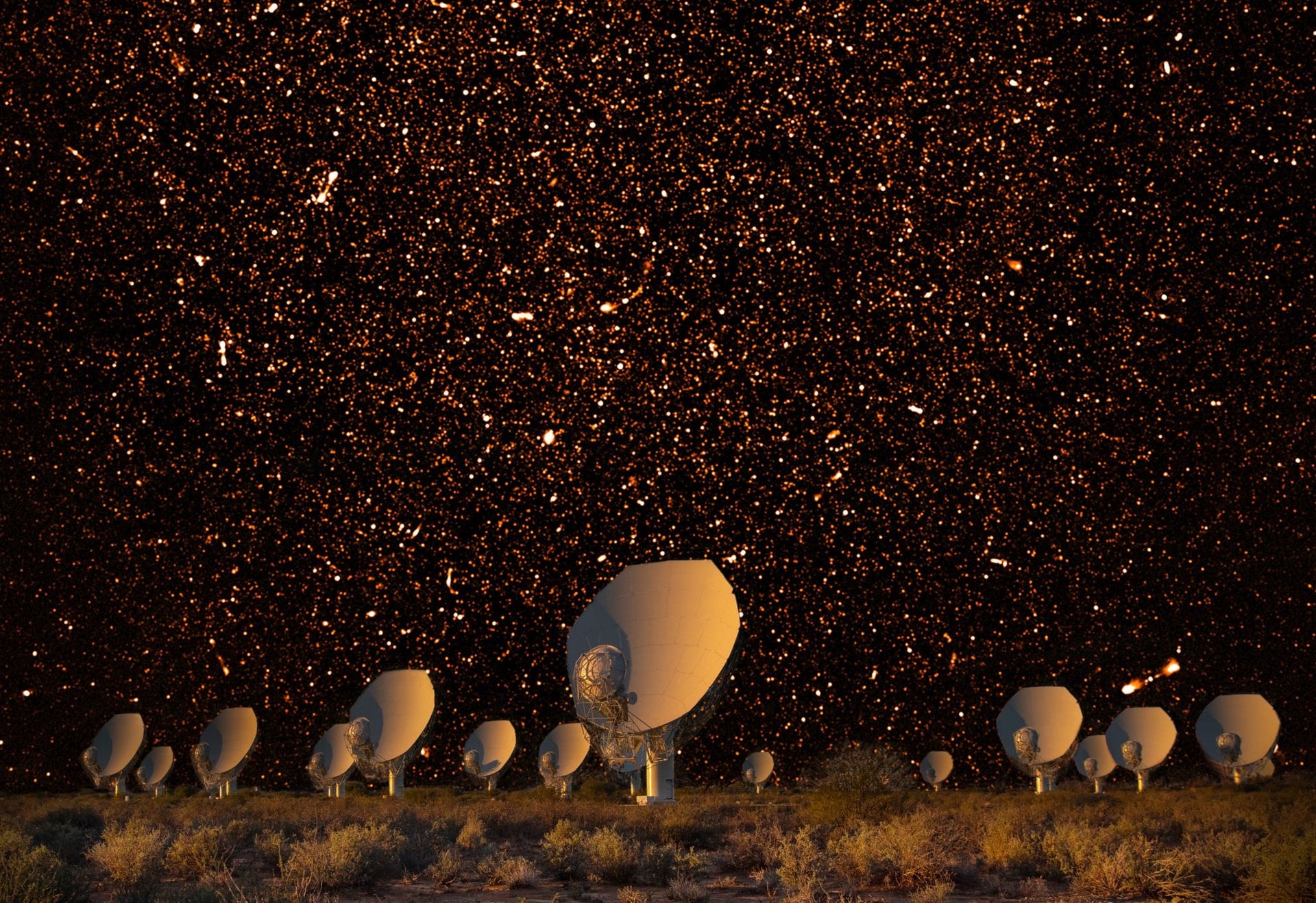
South Africa's MeerKAT radio telescope array has achieved the first direct detection of neutral hydrogen emission from galaxies at cosmic distances, opening a new observational window into the universe's structure billions of years in the past.
The detection represents a watershed moment for radio astronomy. Neutral hydrogen, the most abundant element in the universe, emits radiation at a frequency of 1.42 gigahertz. This signal travels across billions of light-years largely unobstructed, carrying information about galaxies as they existed in the early universe. Previous observations required indirect methods or targeted nearby systems. MeerKAT's sensitivity now permits astronomers to observe the faint hydrogen whispers directly.
MeerKAT comprises 64 dish antennas spread across the South African savanna near Carnarvon. The array's configuration and receiver technology deliver unprecedented sensitivity for detecting weak radio signals across large sky surveys. The South African Radio Astronomy Observatory (SARAO) operates the facility as part of the larger Square Kilometre Array (SKA) project, a multinational endeavor to build the world's most capable radio telescope.
This breakthrough enables astronomers to map the large-scale structure of the universe at epochs when galaxies were still forming actively. Neutral hydrogen traces the cosmic web, the scaffolding of matter connecting galaxies across space. By measuring the hydrogen signal's intensity and how it shifts due to cosmic expansion, researchers can determine distances and velocities of distant galaxies without relying on optical surveys alone.
The implications extend beyond cataloging. Radio observations of neutral hydrogen provide constraints on dark matter distribution, test models of galaxy formation, and reveal how galaxies evolve over cosmic time. Radio waves penetrate dust clouds that obscure optical light, exposing star-forming regions hidden from telescopes like Hubble. The technique also avoids the systematic biases inherent in optical surveys, which preferentially detect bright, massive galaxies.
MeerKAT's achievement validates the SKA collaboration's approach. The full SKA, scheduled for deployment across South Africa and Australia over the next decade, will deploy thousands of dishes and antennas. If MeerKAT can detect hydrogen from billions of light-years away, SKA's vastly larger collecting area will map hydrogen across entire cosmic volumes, revolutionizing our census of the universe.
This detection also advances the search for fast radio bursts and other transient phenomena. MeerKAT's real-time processing capabilities enable surveys that catch rare, fleeting events. The array has already contributed discoveries of unusual magnetars and pulsar behaviors that constrain neutron star physics.
The challenge moving forward centers on data processing. Each observation generates terabytes of information. Converting raw signals into meaningful maps requires sophisticated algorithms and computational infrastructure. Teams at SARAO and partner institutions have developed pipelines to handle this data deluge, establishing templates for SKA operations.
Astronomers expect MeerKAT observations to deepen understanding of the epoch of reionization, when the first stars ignited and ionized the primordial hydrogen fog. They can trace how galaxies clustered in the early universe and measure the expansion rate at different epochs, constraining dark energy models.
MeerKAT's faint hydrogen detections demonstrate that radio astronomy has entered a new era. Where optical surveys map bright beacons, radio telescopes now sense the universe's invisible backbone. This capability transforms how astronomers reconstruct cosmic history and test fundamental physics.