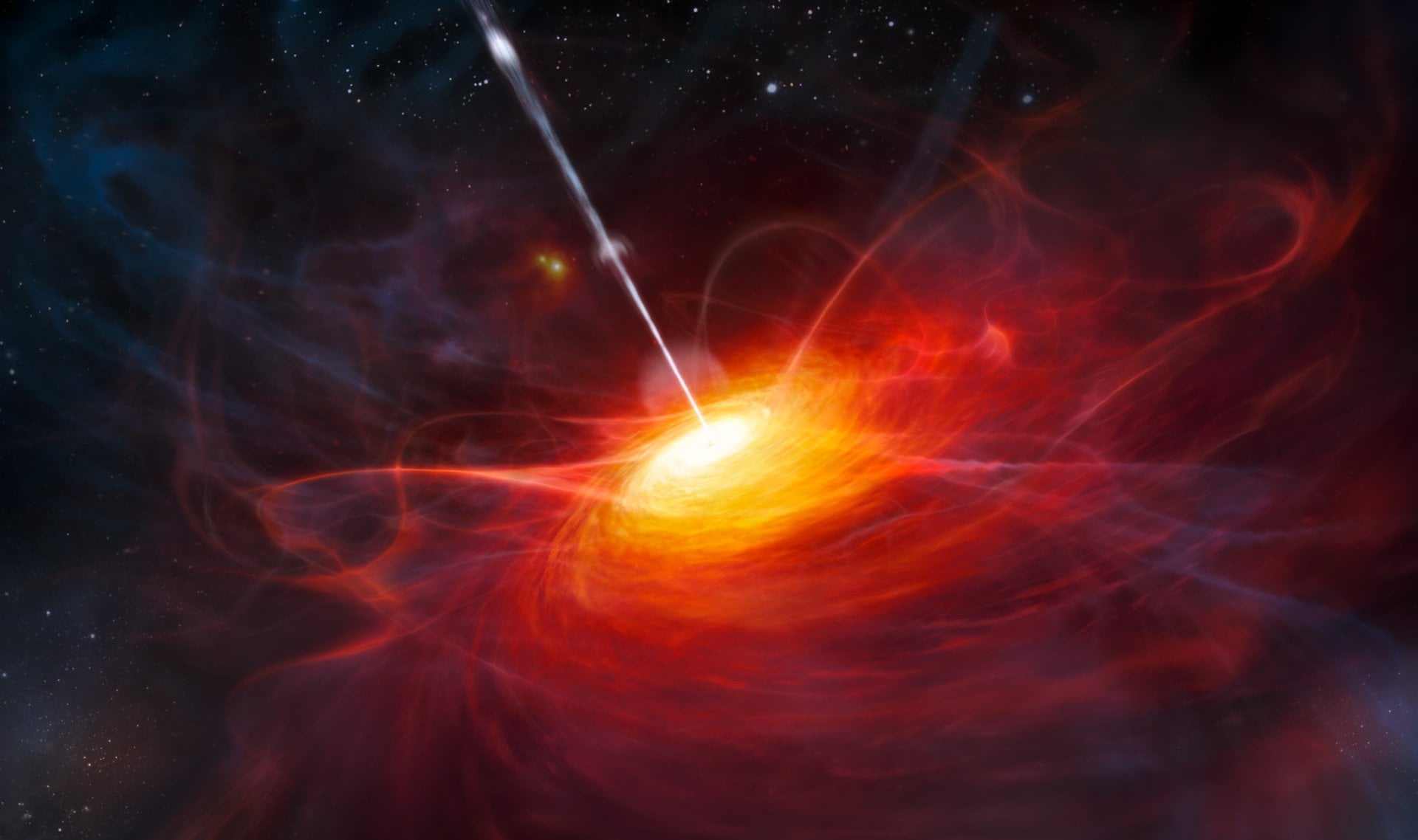
Astronomers have discovered that extreme quasars in the early universe hold the key to understanding how supermassive black holes formed in the first few hundred million years after the Big Bang. This discovery addresses one of cosmology's deepest puzzles: how black holes billions of times the mass of our Sun grew so rapidly in the universe's infancy.
The research centers on objects like ULAS J1120+0641, a distant quasar powered by a supermassive black hole. These extreme quasars emit tremendous energy as material spirals into their black holes at extraordinary rates. By studying the accretion discs surrounding these objects, astrophysicists extract clues about the black holes' masses, growth rates, and the environments in which they formed.
The problem these quasars solve is straightforward yet vexing. When the James Webb Space Telescope and ground-based observatories detect supermassive black holes in galaxies less than a billion years old, those black holes often contain hundreds of millions or billions of solar masses. Standard formation models cannot account for such rapid growth. A black hole formed from stellar collapse in the early universe simply lacks enough time to accrete material and reach those masses through normal channels.
Extreme quasars provide a window into the answer. Their intense luminosity reveals black holes actively feeding at maximal rates, consuming material at the fastest possible pace set by physics. When astronomers measure how efficiently these quasars convert infalling matter into radiation, they determine the black hole masses and accretion rates with greater precision than other methods allow.
The data suggests multiple formation pathways. Some supermassive black holes may have grown from intermediate-mass seeds, themselves formed from the direct collapse of massive gas clouds in the early universe. Others might have merged repeatedly with smaller black holes. The accretion rates observed in extreme quasars tell astrophysicists which scenario dominated at different cosmic epochs.
ESO (European Southern Observatory) instruments have played a crucial role in this research, particularly spectroscopic studies that measure light absorption and emission from the accretion discs. Infrared observations penetrate the dust surrounding these distant quasars, revealing details invisible at optical wavelengths. Combined with data from X-ray observatories and radio telescopes, a three-dimensional picture emerges of how black holes fed in the universe's first billion years.
The implications extend beyond black hole formation. Extreme quasars also reveal the state of their host galaxies during cosmic dawn. The radiation pressure from feeding black holes shapes their surroundings, triggering outflows that heat gas and regulate star formation. Understanding these feedback mechanisms explains why the most massive galaxies today contain correspondingly massive black holes.
Future observations with the James Webb Space Telescope will identify even more distant and younger extreme quasars, pushing closer to the moment of first light in the universe. Each discovery narrows the window on when and how supermassive black holes ignited, refining theories of how structure formed in the cosmos.