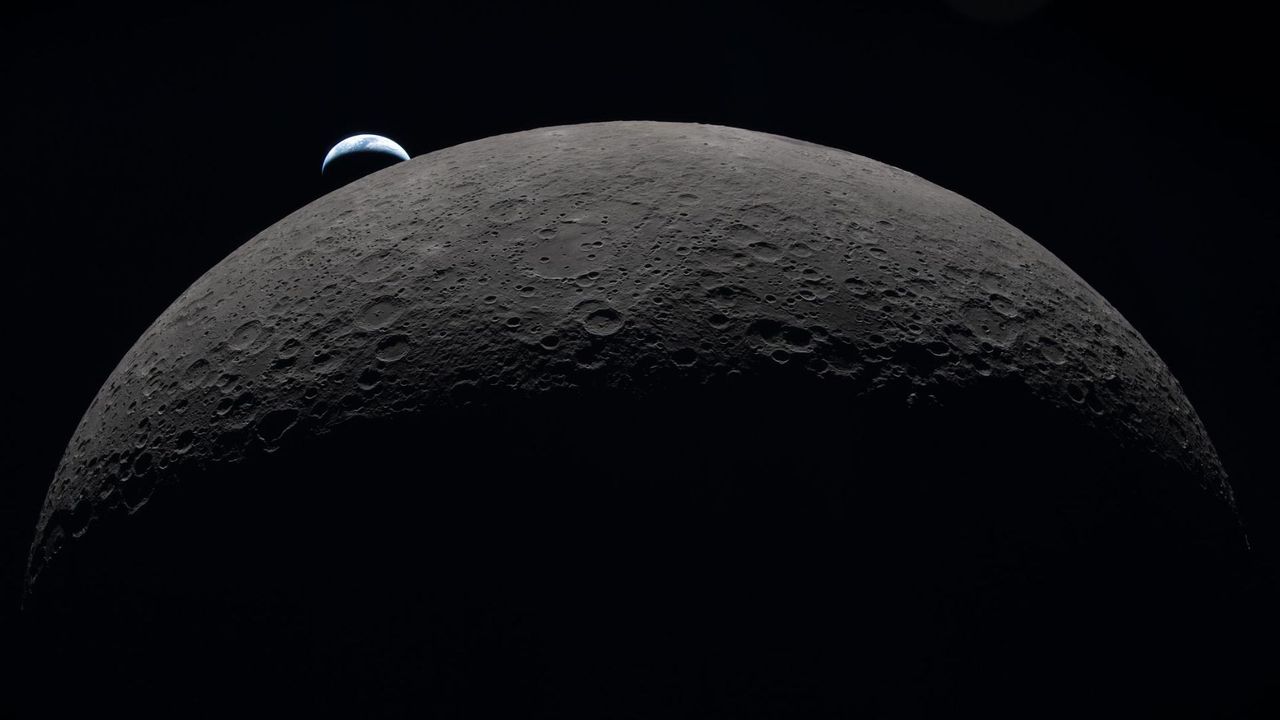
Scientists working from updated models of planetary formation now propose that Earth's moon coalesced in a shockingly brief window following the giant impact hypothesis event that fundamentally shaped our planet's history.
The prevailing theory for lunar origin, the giant impact hypothesis, posits that a Mars-sized body called Theia collided with the proto-Earth roughly 4.5 billion years ago. This collision vaporized much of both bodies and ejected massive amounts of material into orbit around Earth. Conventional models suggested that the moon took weeks or even months to accrete from this debris disk. New research telescopes that timeline down to approximately five hours, fundamentally altering how scientists understand the moon's rapid birth.
The revised calculations emerge from improved computational models that better account for the physics of how material coalesces under extreme gravitational conditions. When a massive collision ejects debris into orbit, that material does not simply float around waiting to gradually clump together. Instead, gravitational interactions between particles accelerate aggregation dramatically. The denser the disk of ejected material and the closer particles orbit to Earth, the faster they merge into larger bodies. Researchers found that under the specific density and velocity conditions created by a Theia impact, the assembly process completes with remarkable speed.
This five-hour formation scenario carries substantial implications for the moon's composition and internal structure. A rapidly accreted body experiences different thermal and structural evolution than one forming over weeks. Fast accretion concentrates gravitational heating into a compressed timeframe, potentially leaving the nascent moon hotter and more thoroughly melted than models assuming slower growth predicted. The chemical composition of lunar material would also freeze in place more quickly, potentially preserving a different chemical signature from what slower accretion would produce.
The timing matters equally for understanding Earth's subsequent evolution. A moon forming within hours rather than over extended periods would have immediately begun exerting tidal forces on the young Earth. These gravitational interactions influenced Earth's rotation rate, axial tilt, and long-term climate stability. The moon's presence dampened chaotic variations in Earth's axial tilt that could have rendered the planet uninhabitable. If the moon formed rapidly, these stabilizing effects commenced sooner than scientists previously thought, potentially affecting the timeline for when Earth became hospitable to life.
Researchers tested their models against existing lunar samples and orbital data collected by NASA's Lunar Reconnaissance Orbiter and other spacecraft. The rapid formation scenario aligns with observed constraints on the moon's density, composition, and orbital mechanics. The work also reconciles with evidence from Apollo lunar samples, which indicate the moon formed from material that had experienced extreme heating consistent with fast, violent accretion.
The findings stem from advanced computer simulations now capable of modeling particle interactions across billions of objects simultaneously. These tools allow scientists to simulate planetary collisions with unprecedented fidelity. As computational power continues expanding, the resolution of planetary formation models will only improve, potentially revealing additional surprises about how our moon came to exist and what role it played in Earth's journey toward habitability.