# Galaxies Tangled in Science and Spirit
The intersection of rigorous astronomical observation and human wonder defines how we understand the cosmos. A new Space.com feature exploring this duality reminds us that the practice of studying galaxies operates on two parallel tracks simultaneously: the empirical methodology of physics and the profound emotional response to scale and beauty that transcends data.
Modern astronomy relies on instruments of extraordinary precision. The James Webb Space Telescope captures infrared light from galaxies formed less than a billion years after the Big Bang. Ground-based observatories like the Very Large Array in New Mexico map radio emissions across vast distances. Spectroscopy reveals chemical composition. Gravitational lensing acts as a cosmic magnifying glass. Every observation feeds into models, hypotheses, and peer-reviewed papers that advance our knowledge of galactic formation, dark matter distribution, and the universe's ultimate fate.
Yet the act of directing a telescope skyward carries weight beyond measurement. Humans have tracked celestial bodies for millennia, and that impulse persists. When astronomers observe a barred spiral galaxy or witness the collision of two galactic disks, they encounter something that quantitative analysis alone cannot fully capture. The scale registers viscerally. The light traveling across millions of years to reach Earth carries temporal depth that equations represent but cannot fully express.
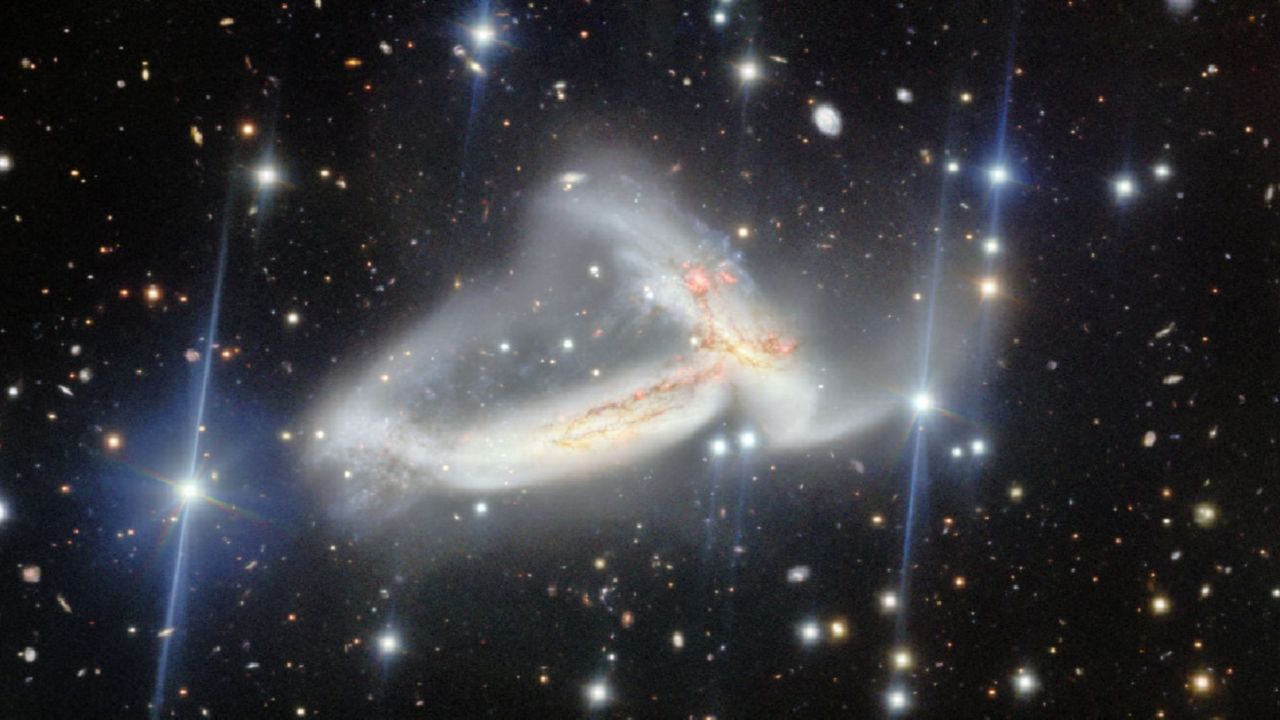
This September 2026 photo of the day from Space.com illustrates this duality. Whether the image shows a collision between galaxies, a star-forming region caught mid-transformation, or some other deep-sky phenomenon, it functions on both levels simultaneously. A scientist reading the image extracts data about stellar populations, dust lanes, gravitational interactions, and energy output. A viewer simply encountering the photograph experiences awe at the sheer complexity and beauty rendered in light and shadow.
The distinction matters for how we conduct astronomy going forward. Funding agencies require scientific justification for space missions. Peer review demands rigorous methodology. Yet public engagement with astronomy depends partly on emotional resonance. Images from Hubble, JWST, and ground-based observatories inspire future scientists precisely because they combine visual power with scientific substance. They make the abstract concrete. They answer both the question "what is this?" and the question "what does this mean?"
Professional astronomers navigate this balance constantly. They publish data-heavy papers and create visualizations for general audiences. They train successors in measurement and analysis while acknowledging the wonder that first drew them to the field. This dual nature strengthens astronomy rather than weakening it. The spirit sustains commitment through years of graduate study and difficult observing runs. The science ensures that commitment produces reliable knowledge.
Galaxies themselves remain sites of profound mystery despite centuries of study. Dark matter comprises most galactic mass, yet remains directly undetected. The mechanisms that regulate star formation operate at multiple scales. The behavior of supermassive black holes at galactic centers continues to surprise observers. Every answer generates new questions. This perpetual frontier keeps astronomy vital, attracts talent, and justifies continued investment in instruments and infrastructure.
The September 2026 image, whatever its specific subject, testifies to this enduring synthesis. It demonstrates what happens when human curiosity meets technological capability and confronts the universe on its own terms. Neither pure science nor pure spirit suffices alone. Together, they create understanding that extends beyond data into meaning, beyond observation into connection.