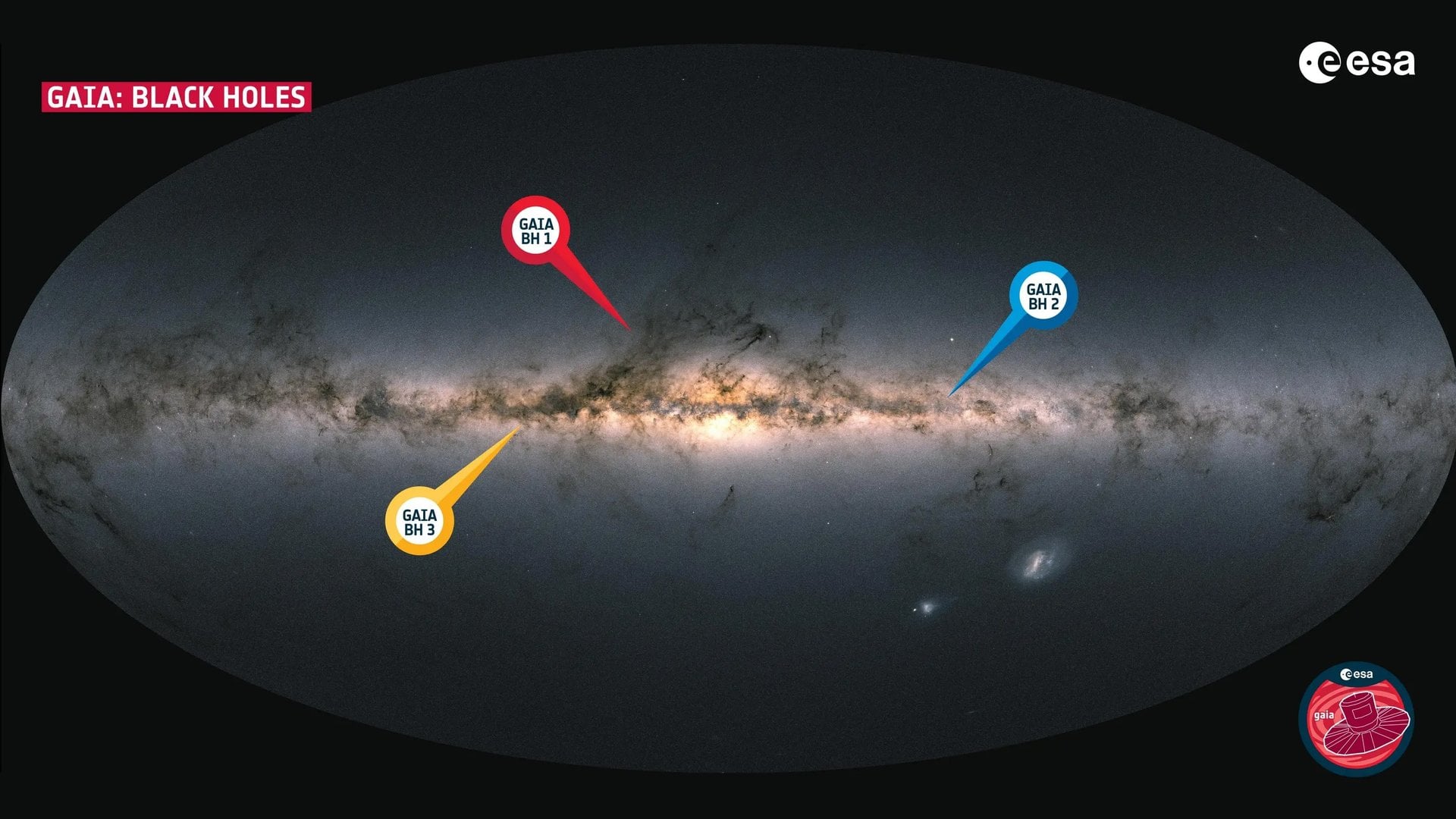
The European Space Agency's Gaia space telescope has identified three stellar mass black holes, each paired with a companion star, in a discovery that challenges current models of how such binary systems assemble. Two of the systems display orbital configurations that deviate from theoretical predictions, suggesting black hole formation pathways that astronomers have not fully accounted for.
Gaia detects celestial objects through precise astrometry, measuring tiny shifts in star positions caused by gravitational effects. When a black hole orbits with a companion star, the stellar object's apparent motion reveals the black hole's presence even when it emits no radiation. This method fills a critical gap in black hole surveys. Most known black holes were detected through X-ray emissions generated as material from companion stars spirals into the black hole's event horizon. Gaia's approach identifies quieter systems where minimal material transfers between objects.
The three newly discovered black holes reside within the Milky Way. Two systems present a puzzle. Their companion stars orbit closer to their black hole partners than standard formation theory predicts. In conventional scenarios, black holes form when massive stars collapse at the ends of their lives. The resulting supernova explosion imparts momentum that should separate the binary pair. Companions orbiting at tighter distances than models allow suggest either different formation channels or physical processes that current theory overlooks.
Several mechanisms could explain these unexpected configurations. One possibility involves common-envelope evolution, a phase where binary companions share an outer atmospheric layer. This process dissipates orbital energy and draws companions inward. Another scenario involves formation in dense stellar environments where black holes capture stellar companions through gravitational interactions rather than forming alongside them. A third mechanism concerns angular momentum transfer during supernova explosions that, under certain conditions, might retain binaries in closer configurations than standard predictions.
The third system matches existing theoretical expectations, providing a control point for comparison. This consistency strengthens the puzzle presented by its two counterparts. The deviation in two cases suggests these discoveries are not statistical outliers but represent a population scientists have systematically missed.
Gaia's catalog of black holes continues expanding. The mission's data releases identify objects through their gravitational influence on nearby stars, complementing traditional detection methods. This approach finds black holes in their quiet phases, offering a more complete inventory of stellar remnants. Such completeness proves essential for understanding stellar evolution across cosmic time.
These discoveries carry implications for gravitational wave astronomy. The Advanced Laser Interferometer Gravitational-Wave Observatory (LIGO) and Virgo detectors identify merging compact objects by sensing spacetime distortions. Understanding how black hole binaries form and evolve predicts which systems might eventually merge and produce detectable gravitational waves. Unexpected formation pathways could indicate hidden populations of binary black holes on collision courses.
Follow-up observations from ground-based telescopes will measure radial velocities and refined orbital parameters for these systems. Spectroscopic analysis may reveal stellar temperatures, masses, and composition details. Such measurements constrain formation scenarios and test theoretical models against observational reality.
Gaia's capacity to find quiescent black holes transforms black hole demographics from X-ray selected samples into populations discovered through direct gravitational signatures. This shift reveals the full diversity of black hole binary systems inhabiting the galaxy.