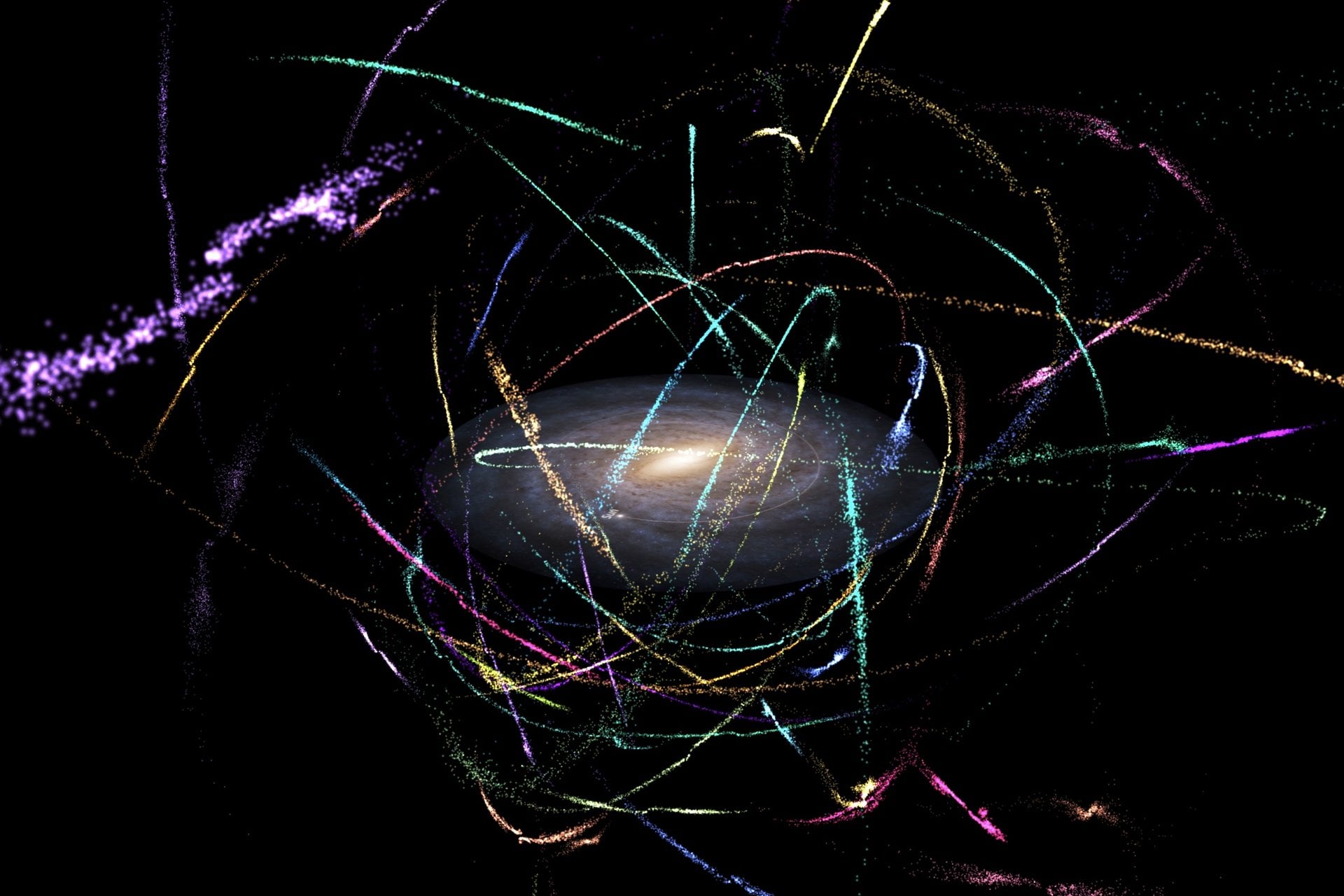
Astronomers have overturned a leading explanation for the twisted shapes observed in stellar streams orbiting the Milky Way, using detailed simulations to show that dark matter clumps do not cause the kinks that appear in these cosmic structures.
Stellar streams form when dwarf galaxies or star clusters venture too close to the Milky Way's gravity well. The galactic tide stretches these objects into elongated trails of stars that wrap around our galaxy like ribbons. Over the past decade, observatories including Gaia have detected numerous kinks and discontinuities within these streams, raising questions about what creates such disturbances.
A popular hypothesis held that dense clumps of dark matter within the Milky Way's halo collide with passing stellar streams, warping their paths and producing the observed kinks. This idea carried major implications. Finding evidence of dark matter substructure through stellar stream distortions would provide independent confirmation of dark matter's abundance and distribution around galaxies. It would also support specific predictions from cold dark matter models.
The new research, conducted by researchers including Adrian Price-Whelan at Princeton University, challenges this picture directly. Using N-body simulations that track the movements of millions of particles, the team modeled how stellar streams respond to various gravitational influences. Their simulations included effects from the Milky Way's stellar disk, bulge, and halo, plus interactions with known satellite galaxies like the Large and Small Magellanic Clouds.
The results show that kinks and clumps within stellar streams emerge naturally from interactions with the Milky Way's ordinary matter and known satellite galaxies. The galactic disk alone produces sufficient perturbations to explain the observed stream morphologies without invoking dark matter substructure. Previous studies underestimated the role of the Milky Way's disk in sculpting stream shapes.
This finding does not eliminate dark matter. Rather, it redirects how astronomers should interpret stream observations. The detection of kinks in stellar streams no longer serves as a straightforward diagnostic for dark matter clumpiness. Instead, astronomers must account for the complex gravitational architecture of the Milky Way itself.
The implications reshape ongoing searches for dark matter evidence. Experiments seeking evidence of dark matter substructure through stellar streams must now employ more sophisticated modeling to isolate genuine dark matter signatures from effects produced by ordinary galactic components. Some observed kinks will emerge from known physics. Identifying which kinks require dark matter explanations requires careful matching between simulations and observations.
This work uses data from the Gaia mission, the space telescope that has revolutionized stellar cartography by measuring positions and motions for nearly two billion stars. The precision of Gaia's parallax measurements and proper motion data enables astronomers to trace stellar streams with unprecedented clarity, revealing subtle features that models must now explain.
The research demonstrates how computational astrophysics reshapes understanding of observational puzzles. What appeared to point directly toward dark matter's presence reflects instead the subtle but measurable gravitational effects of the Milky Way's disk and known satellite galaxies. Future dark matter searches using stellar streams will benefit from this refined understanding of baseline galactic dynamics.