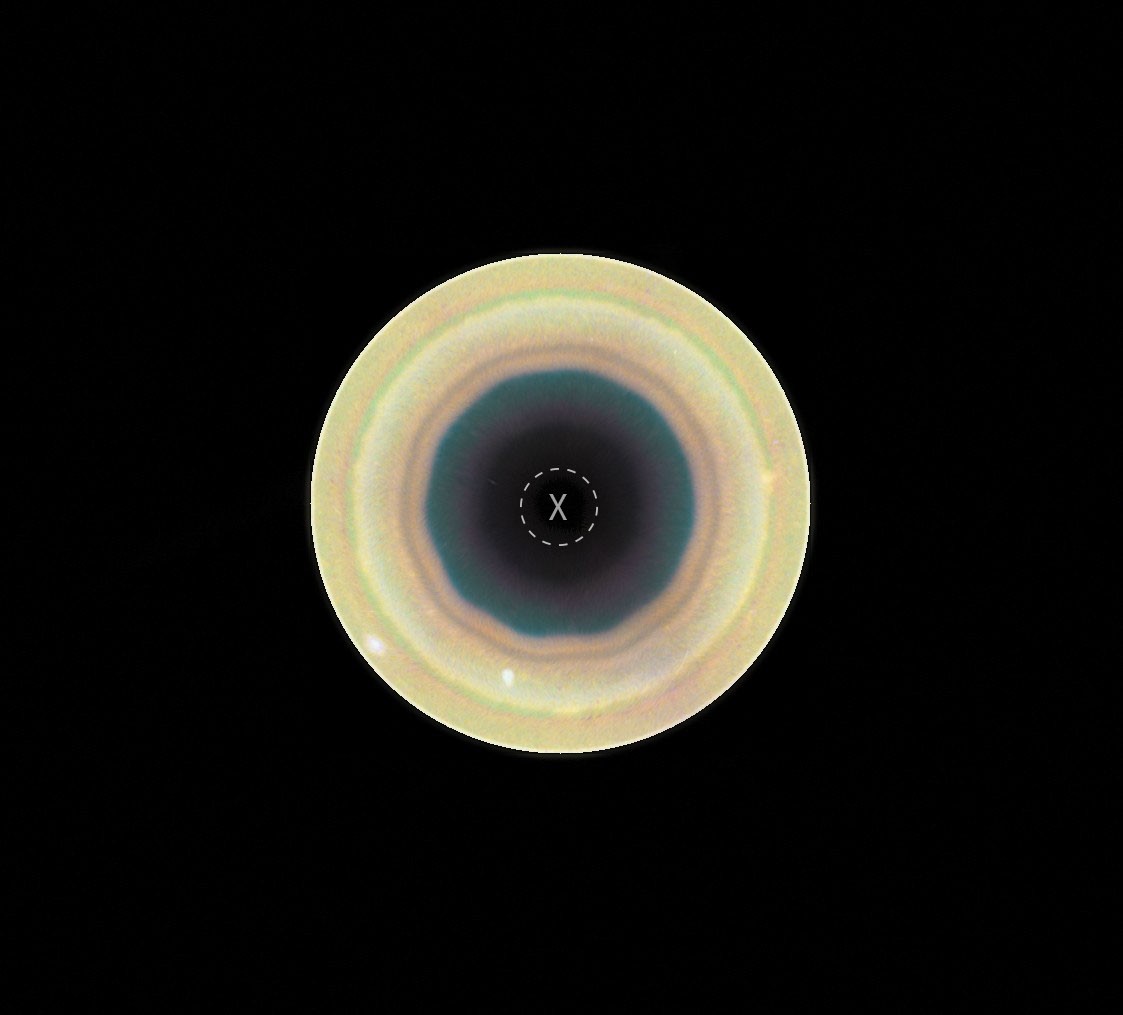
# Hubble Captures Ten-Sided Geometric Storm at Saturn's South Pole
The Hubble Space Telescope has photographed a striking decagonal structure circling Saturn's south pole, revealing one of the gas giant's most unusual atmospheric phenomena. This ten-sided geometric formation represents a rare and stable weather pattern in Saturn's turbulent atmosphere, captured during routine observations by NASA's orbiting observatory.
Saturn's polar regions host extreme wind systems and jet streams that collide at varying latitudes, creating distinct atmospheric bands. The decagon persists as a persistent feature near the south pole, maintaining its geometric shape across multiple observation cycles. Unlike Jupiter's Great Red Spot or other planetary storms that gradually degrade over years or decades, this structure demonstrates remarkable stability for reasons atmospheric scientists continue to investigate.
The Hubble Space Telescope, launched in 1990, operates in orbit around Earth approximately 380 miles above the surface. Its imaging capabilities detect visible and ultraviolet light, making it ideal for studying planetary atmospheres and capturing fine atmospheric details across the solar system. Saturn, positioned approximately 886 million miles from Earth at its closest approach, presents a challenging target for detailed observation, yet Hubble's 2.4-meter primary mirror resolves features at the scale of hundreds of miles.
Saturn's south polar region has proven particularly dynamic in recent years. The planet rotates rapidly, completing one rotation every 10 hours and 42 minutes. This fast rotation, combined with internal heat radiating from Saturn's interior, drives powerful convection in the atmosphere. Wind speeds at Saturn's equator exceed 1,100 miles per hour, among the fastest winds recorded in the solar system.
The decagonal storm geometry raises questions about the fundamental physics governing planetary atmospheres. Atmospheric models traditionally predict hexagonal or other polygonal patterns at gas giant poles through the interaction of multiple atmospheric layers and Coriolis forces. Saturn's hexagon at its north pole, discovered by the Cassini mission and confirmed by Hubble, represents another example of this polygon-forming process. The south polar decagon may result from similar forces producing a different geometric outcome.
The Cassini-Huygens mission operated in Saturn's system from 2004 to 2017, providing unprecedented data about the planet's atmosphere, rings, and magnetosphere. Hubble observations complemented Cassini's findings and continue to monitor Saturn's atmosphere following Cassini's controlled plunge into Saturn's atmosphere in September 2017. These ongoing Hubble observations establish baseline data for understanding long-term changes in Saturn's weather patterns.
Understanding Saturn's atmospheric dynamics holds broader implications for planetary science. The extreme conditions on Saturn serve as a natural laboratory for testing atmospheric models applicable to exoplanets orbiting distant stars. Observations of gas giant atmospheres within our solar system inform predictions about planetary atmospheres light-years away, detected by instruments like the James Webb Space Telescope.
Future missions to Saturn remain under consideration by NASA and the European Space Agency. A dedicated orbiter or entry probe could provide unprecedented resolution of these atmospheric features. Until such a mission launches, Hubble continues as humanity's primary tool for monitoring Saturn's rapidly changing atmosphere and the geometric structures that form within it.