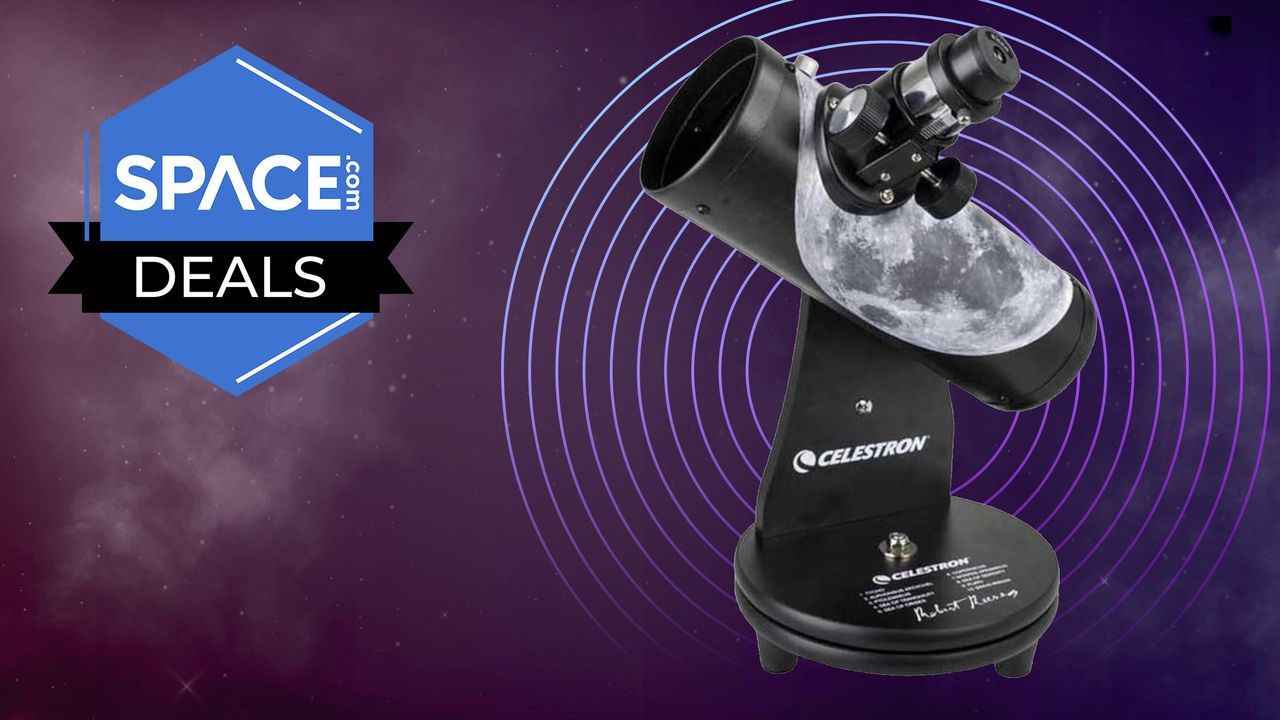
# Celestron FirstScope Offers Accessible Entry Point to Amateur Astronomy at Reduced Price
The Celestron FirstScope remains one of the most practical instruments for introducing newcomers to observational astronomy, and current Amazon pricing underscores its value proposition in the crowded consumer telescope market. At a 20 percent discount, the FirstScope delivers optical performance and portability without the investment barriers that typically deter casual stargazers from purchasing their first instrument.
The FirstScope employs a 76-millimeter Newtonian reflector design, a proven optical architecture that balances aperture size with manageable weight and cost. This configuration gathers sufficient light to resolve lunar craters, Jupiter's cloud bands, Saturn's ring system, and hundreds of deep-sky objects including star clusters and nebulae. The reflector design avoids the chromatic aberration that can plague entry-level refractors, delivering cleaner views across the entire field of eyepiece.
Portability distinguishes the FirstScope from bulkier alternatives. The telescope breaks down into compact components that fit into a backpack, making spontaneous observing sessions feasible from suburban locations without extensive transportation logistics. For urban observers contending with light pollution, this mobility enables migration to darker sites where atmospheric conditions and sky darkness improve visibility.
The altazimuth mount provides intuitive up-down and left-right tracking without requiring equatorial setup procedures that frustrate beginners. This simplified mechanical system reduces the learning curve for users unfamiliar with celestial mechanics or coordinate systems. The tabletop-compatible design eliminates expensive tripod purchases, as observers can rest the mount on standard furniture or portable platforms.
Optical quality benefits from multicoated glass elements that maximize light transmission. The included eyepieces provide 25x and 75x magnification ranges suitable for locating targets and examining fine detail. Higher magnifications remain possible through supplementary eyepiece purchases, allowing observers to upgrade capabilities incrementally as experience accumulates.
Celestron engineered the FirstScope explicitly for educational markets and family-oriented astronomy. Schools and youth astronomy clubs have deployed thousands of these instruments in programs introducing students to observational methodology. The straightforward assembly procedure and intuitive operation accommodate users ranging from seven years old to adult newcomers without technical background.
Current pricing reflects Celestron's positioning within the mass-market consumer telescope segment. Traditional retail channels struggle against online discount competition, particularly during promotional periods. Amazon's current reduction eliminates price friction that otherwise deters impulse purchases from potential hobbyists wavering between investment and skepticism about sustained interest.
The FirstScope occupies a distinct niche between toy binoculars and serious amateur equipment. Budget-conscious consumers often default to smartphone telescope adapters or low-cost mall-stand instruments, both producing frustrating optical performance that discourages further astronomy engagement. The FirstScope prevents this discouragement by delivering legitimately useful views of celestial objects while remaining affordable enough that initial commitment feels manageable.
Limitations exist. The 76-millimeter aperture cannot resolve globular cluster detail or reveal faint galaxies visible through eight-inch amateur reflectors. Atmospheric turbulence limits practical magnification considerably below theoretical maximums. Extended observing sessions from uncomfortable positions test patience and back muscles without proper support equipment. These constraints prove inconsequential for beginners establishing observational skills and determining whether astronomy merits deeper investment.
Observers seeking first-telescope recommendations increasingly consult online astronomy communities rather than retail staff. The FirstScope consistently appears in these discussions as the optimal balance between capability, cost, and user-friendliness. The current discount amplifies this recommendation's practical relevance.