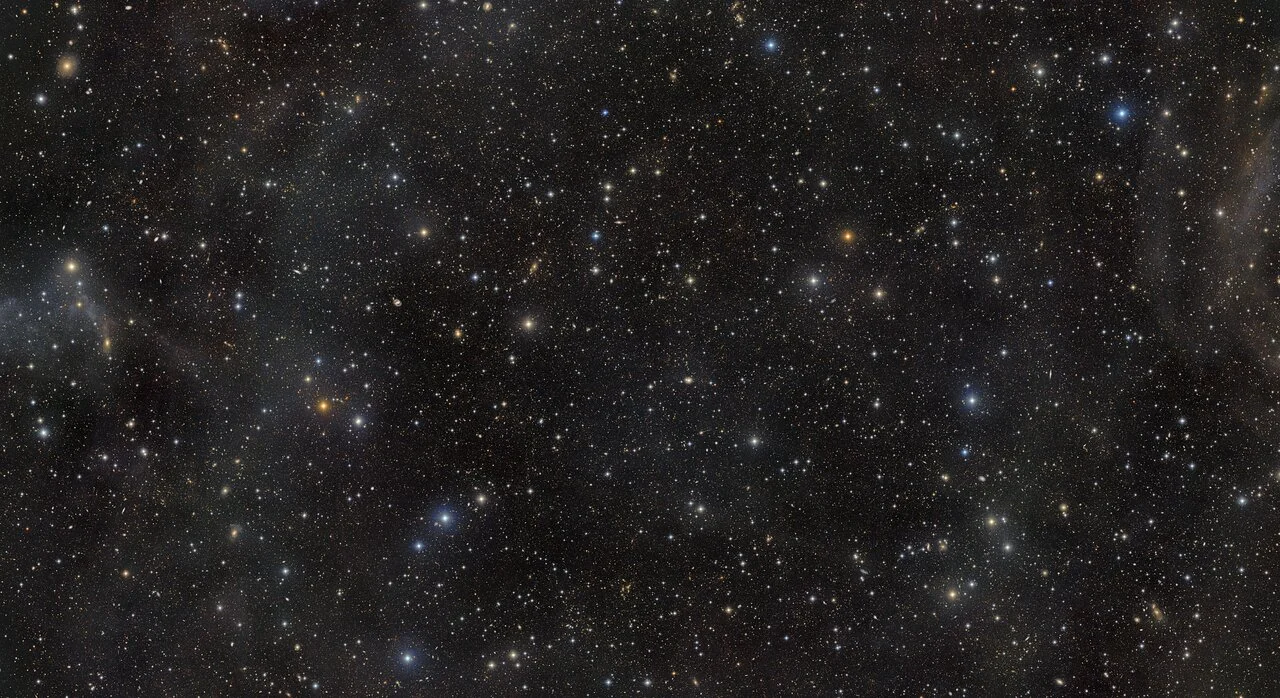
The NSF-DOE Vera C. Rubin Observatory has captured an exceptionally deep image of the COSMOS field, one of astronomy's most studied regions of sky located in the constellation Sextans. This observation demonstrates the observatory's capability to reveal previously unseen structures across enormous cosmic distances.
The COSMOS field holds special significance in observational astronomy. Since the early 2000s, it has served as a primary target for deep-field surveys, accumulating observations from multiple space and ground-based telescopes including the Hubble Space Telescope, Spitzer Space Telescope, and Chandra X-ray Observatory. The field spans roughly 2 square degrees of sky and contains hundreds of thousands of galaxies at varying distances, making it essential for understanding galaxy evolution, structure formation, and the universe's composition across billions of years.
Rubin Observatory, located in Chile's Atacama Desert and operated by NOIRLab under the National Science Foundation and Department of Energy, brings unprecedented survey capability to the COSMOS field. The observatory's 8.4-meter primary mirror and wide field of view allow it to image vast areas of sky in extraordinary detail. The Legacy Survey of Space and Time (LSST), the observatory's primary survey program, will eventually map billions of galaxies across the entire southern sky.
This new image showcases the observatory's technical prowess. The exceptional depth reveals galaxies at redshifts indicating they existed billions of years ago, capturing the universe as it appeared when it was much younger. The clarity and depth of this observation surpass many previous COSMOS field images, allowing astronomers to study fainter and more distant objects than ever before.
For the astronomical community, fresh Rubin Observatory data on the COSMOS field enables new research avenues. Cosmologists can refine measurements of dark matter distribution, study galaxy clusters and their evolution, and investigate active galactic nuclei populations. The multiwavelength data already collected on the COSMOS field combines with Rubin's observations to create unprecedented scientific context. Researchers can correlate optical images with radio, infrared, and X-ray data previously collected, building comprehensive portraits of individual galaxies and large-scale cosmic structure.
The timing of this release reflects Rubin's ongoing commissioning phase. The observatory continues testing and optimizing its systems before launching the full LSST survey, which will scan the entire southern hemisphere repeatedly over a decade. The COSMOS field serves as a natural testing ground because of its existing scientific infrastructure and years of accumulated observations from other facilities.
This observation also illustrates the collaborative nature of modern astronomy. NOIRLab, SLAC National Accelerator Laboratory, and AURA partnered to develop and operate Rubin. The image represents not just new data but a continuation of decades-long scientific investment in understanding this particular slice of universe.
As Rubin Observatory ramps toward full operations, its periodic releases of deep-field observations help validate the system's performance while advancing science. Each image of the COSMOS field adds to humanity's understanding of how galaxies form, evolve, and interact across cosmic time. The observatory promises to revolutionize wide-field astronomy, and this latest image demonstrates it has already begun delivering on that promise.