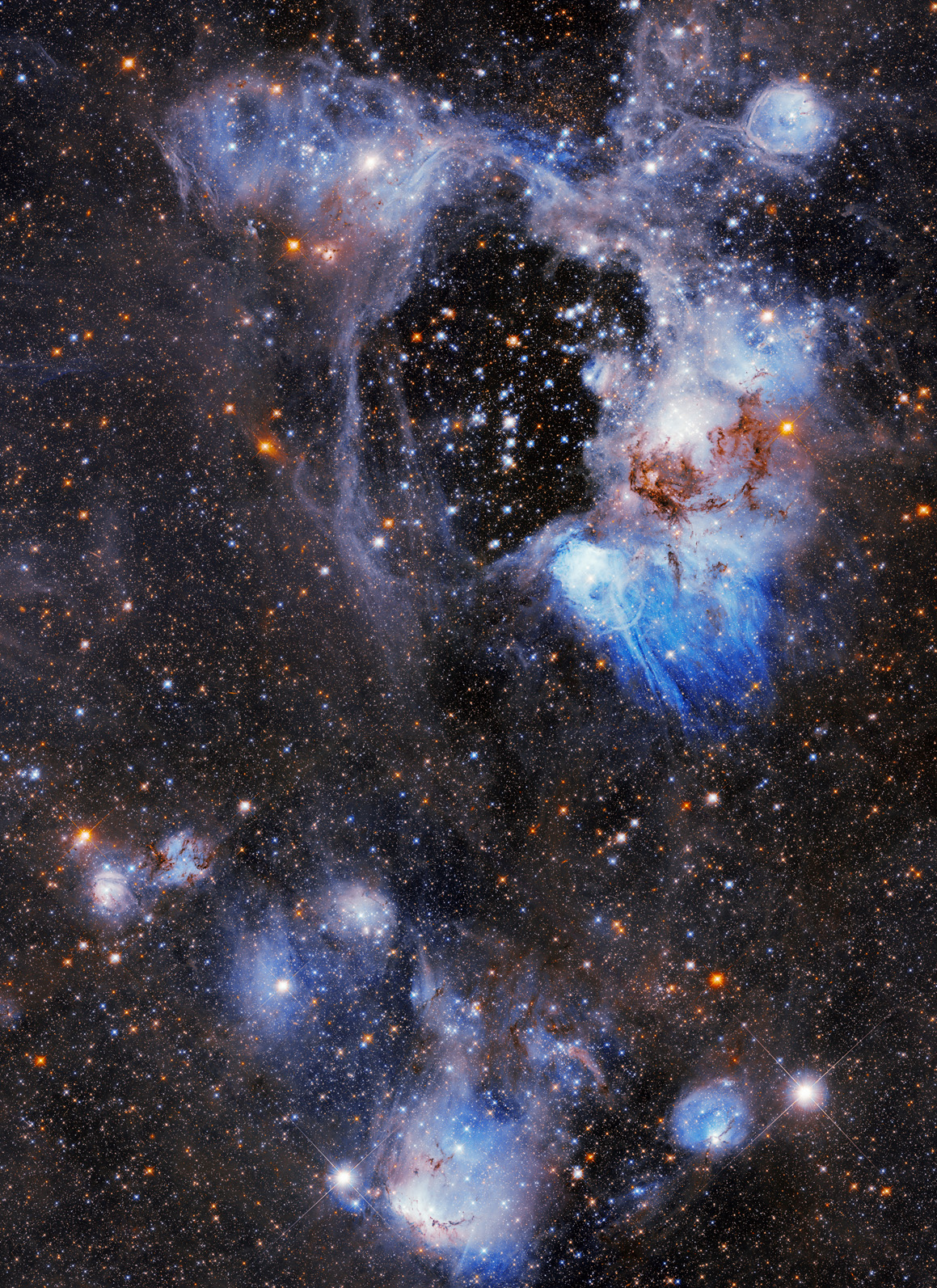
NASA's Hubble Space Telescope has captured a rare portrait of N44, a colossal superbubble carved into the Large Magellanic Cloud, our galaxy's nearest satellite system. The image, released from observations in September 2026, reveals one of the most expansive voids in the stellar neighborhood, a cavity spanning approximately 210 by 140 light-years across.
Superbubbles form through violent cosmic processes. Massive stars cluster together and exhaust their fuel in rapid succession, exploding as supernovae. These explosions blast outward in waves, compressing and ejecting surrounding gas and dust. Over millions of years, the accumulated force of multiple detonations hollows out enormous cavities. N44 represents this process at monumental scale, with its central void ringed by a dense shell of gas and dust that glows under intense radiation from embedded hot stars.
The Large Magellanic Cloud orbits the Milky Way at a distance of roughly 160,000 light-years. As a satellite galaxy containing several billion stars, it serves as a laboratory for studying stellar evolution and galactic dynamics without the visual confusion of our own galactic disk. Objects within it appear against the dark background of space, offering clearer observation than similarly distant phenomena embedded within the Milky Way's structure.
Hubble's imaging capabilities proved essential for resolving N44's architecture. The telescope's Wide Field Camera captured the region's fine detail, distinguishing individual stars from nebular structure. The glittering stars visible within and surrounding the superbubble represent multiple stellar populations, from the massive young stars that created the void to older stars that predate its formation. This stellar census tells the history of the region's star-formation activity.
The shell structure surrounding N44's central void concentrates hydrogen gas and dust into denser clouds. These compressed materials become breeding grounds for new star formation. The intense ultraviolet radiation from the superbubble's central massive stars ionizes the surrounding hydrogen, causing it to emit the characteristic reddish glow visible in Hubble imagery. Shock waves propagating through the shell can trigger gravitational collapse, initiating the birth of the next generation of stars.
N44 demonstrates how stellar explosions reshape galaxies across cosmic time. Each superbubble represents a localized episode of energy release that alters its environment for millions of years. The superbubble expands, compresses surrounding material, triggers new star formation, and eventually dissipates as gas disperses into the broader interstellar medium. This cycle repeats throughout galaxies, driving galactic evolution.
The Large Magellanic Cloud's relative proximity makes it ideal for studying these processes in detail. Objects that appear as mere smudges in distant galaxies reveal themselves as complex structures when viewed within our galactic neighbor. Hubble observations of N44 and similar structures contribute essential data about how massive stars die, how shocks interact with interstellar gas, and how radiation feeds the cycle of stellar birth and death.