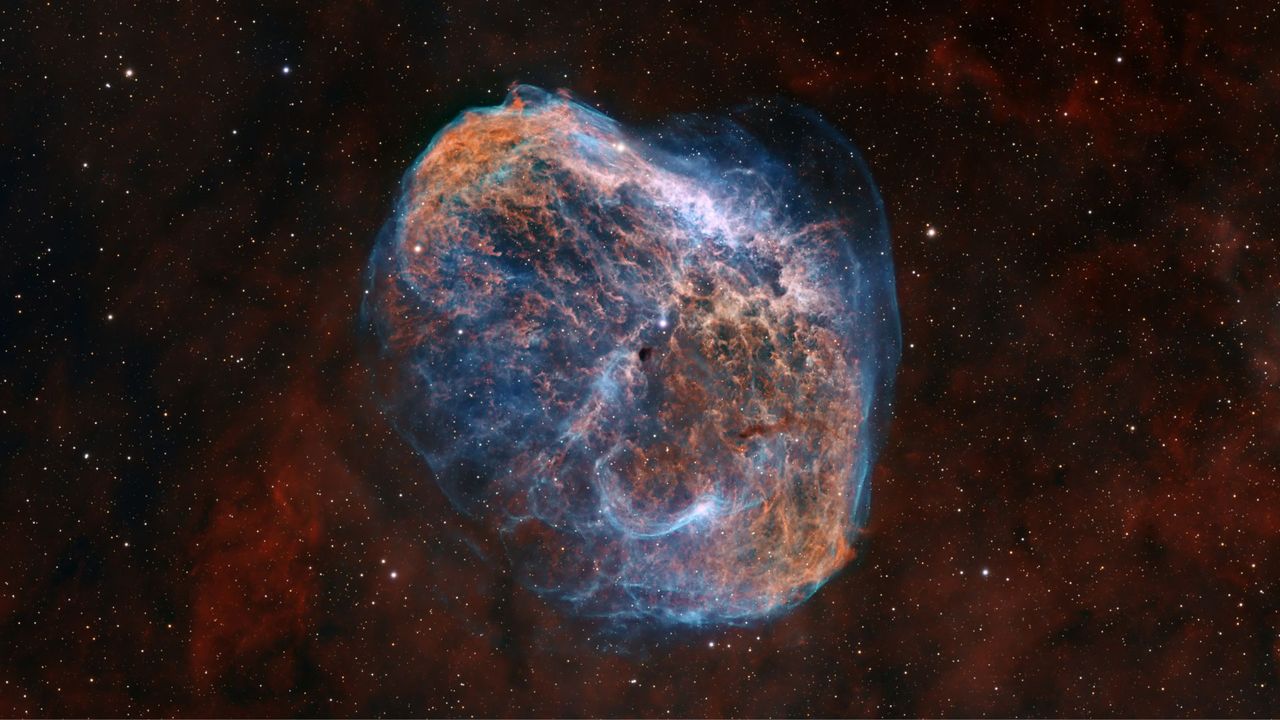
Kevin Boardman, an astrophotographer, invested over 16 hours of observation and imaging to capture an exceptionally detailed view of the Crescent Nebula, revealing the structure's delicate filamentary networks. The nebula, also designated NGC 6888, sits roughly 4,700 light-years from Earth in the constellation Cygnus and remains one of the most visually complex emission nebulae accessible to amateur and professional imaging equipment.
The Crescent Nebula formed from material ejected by the Wolf-Rayet star WR 136, a rare and massive stellar object in its late evolutionary stage. These stars shed their outer atmospheres at velocities exceeding 1,500 kilometers per second, creating expanding shells of gas and dust that glow when energized by ultraviolet radiation from nearby hot stars. The resulting crescent shape emerges from the geometry of this expanding shell as viewed from Earth, combined with dust extinction that obscures portions of the nebula.
Boardman's extended imaging session required multiple nights of data collection, stacking numerous individual exposures to accumulate sufficient light for revealing the filamentary structure that characterizes this object. Amateur astrophotography at this level demands precision equipment, including tracking telescopes capable of following celestial targets with sub-arcsecond accuracy, specialized cameras with low thermal noise, and carefully selected narrow-band filters that isolate specific emission wavelengths from hydrogen, oxygen, and sulfur ions within the nebula.
The Crescent Nebula holds particular interest for researchers studying stellar winds and nebular dynamics. The structure's intricate filaments trace the interfaces between fast-moving stellar winds and slower-moving ambient gas, creating instabilities and shock waves. These regions produce characteristic emission signatures that reveal physical conditions within the nebula, including electron density, temperature, and chemical composition. Professional observatories using instruments like the Hubble Space Telescope and ground-based spectroscopic facilities have mapped these properties in detail.
Amateur astrophotographers like Boardman contribute valuable documentation of these objects across multiple wavelengths and observing conditions. Long-baseline imaging campaigns conducted by distributed networks of amateur observers can track changes in nebular brightness and structure over years or decades, complementing occasional professional observations. This participatory approach to astronomy has produced discoveries in variable stars, minor planets, and supernovae, demonstrating the enduring scientific value of patient observation.
The Crescent Nebula remains accessible to observers with moderate-sized telescopes and dedicated imaging systems throughout northern hemisphere locations during summer months. Its prominence in amateur astrophotography reflects both its inherent visual complexity and its suitability for narrow-band imaging techniques that have revolutionized deep-sky observation over the past two decades. High-quality images like Boardman's serve dual purposes: advancing scientific documentation while inspiring public engagement with the cosmos and stellar physics.