Venus stands as our solar system's most paradoxical world. It shares Earth's size and mass, yet harbors a surface hot enough to melt lead and an atmosphere 92 times denser than Earth's. Now astronomers propose a startling explanation for one of Venus's most glaring absences: a natural satellite.
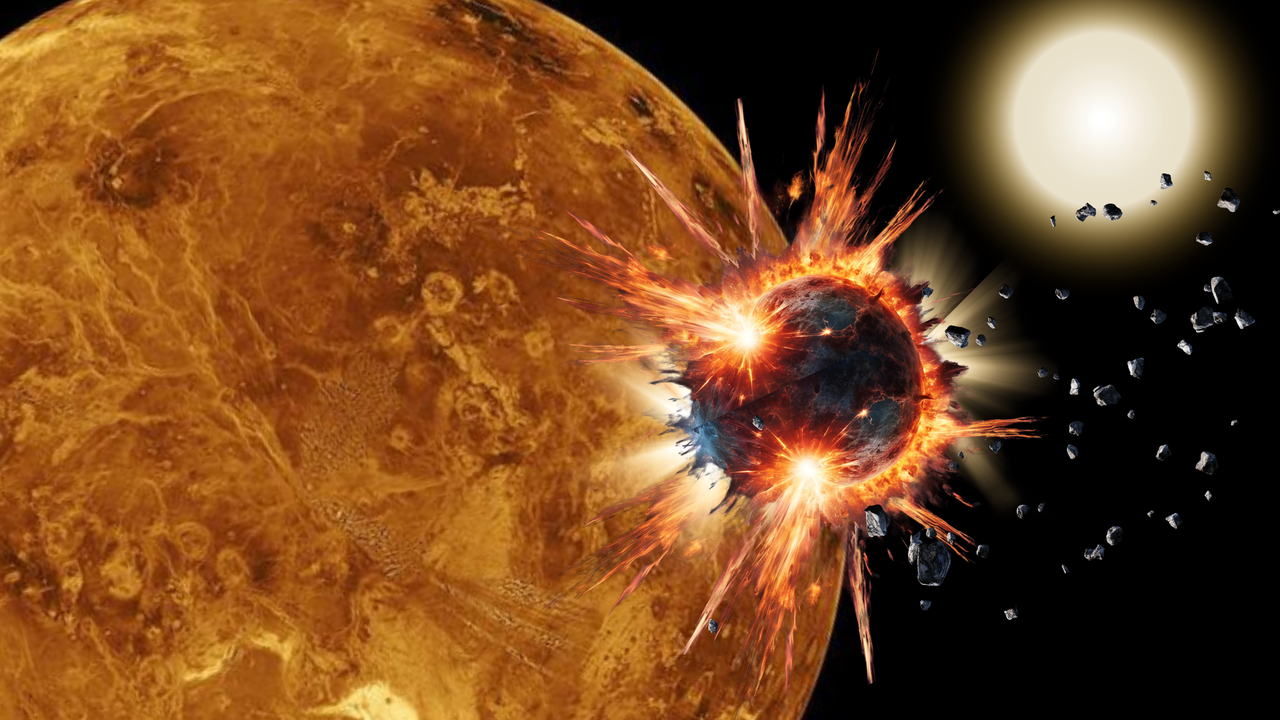
A research team working with computational models has determined that Venus likely captured and eventually absorbed a moon billions of years ago. This would explain why Venus remains the only terrestrial planet without a permanent lunar companion. Mercury has none because it orbits too close to the sun. Mars retained its two small moons. Earth possesses our familiar Moon. But Venus, positioned between Mercury and Earth, should theoretically have acquired a moon during the solar system's violent early history when planetary collisions and gravitational captures occurred regularly.
The mechanism behind Venus's lunar cannibalism centers on orbital decay. According to the models, Venus initially acquired a moon through gravitational capture, as planets do. However, Venus's extreme heat radiates energy into space, and this thermal radiation exerts a subtle but relentless force on orbiting bodies. Scientists call this the Yarkovsky effect when applied to asteroids, but the principle operates differently for larger bodies in orbit. Venus's intense thermal emissions created a drag that pulled the moon progressively closer over tens of millions of years.
Eventually, the moon spiraled inward beyond the Roche limit, the distance at which tidal forces overwhelm an object's own gravity. At that point, Venus's gravity literally tore the moon apart. The fragments either fell into Venus's atmosphere, where they burned up, or crashed into the planet's surface. Over time, Venus consumed every trace of its satellite.
This scenario resolves a long-standing puzzle in planetary science. Researchers had observed that Venus should have acquired a moon based on current models of planetary formation and orbital mechanics. The absence demanded explanation. The thermal drag hypothesis provides that explanation without requiring exceptional circumstances or special pleading.
The finding relies heavily on sophisticated N-body simulations that track gravitational interactions and thermophysical forces over billions of years. Scientists input Venus's current properties, including its surface temperature exceeding 460 degrees Celsius, and traced the probable evolutionary paths backward through time. The models consistently showed that captured moons could not maintain stable orbits around Venus for extended periods.
This research carries implications beyond Venus itself. It refines our understanding of how planetary systems evolve, particularly around worlds in close orbits around their stars. Exoplanet hunters rely on such models to predict where moons might exist around distant worlds. A Venus with a moon would appear detectably different in our instruments than a Venus without one. Understanding how hot planets lose moons helps astronomers interpret data from thousands of confirmed exoplanet systems.
The study also underscores how thoroughly environment shapes planetary characteristics. Venus's hellish conditions did not merely create an inhospitable surface; they fundamentally altered its orbital neighborhood by eliminating potential satellites. What we observe today reflects a planet shaped by extreme processes operating across cosmic timescales.