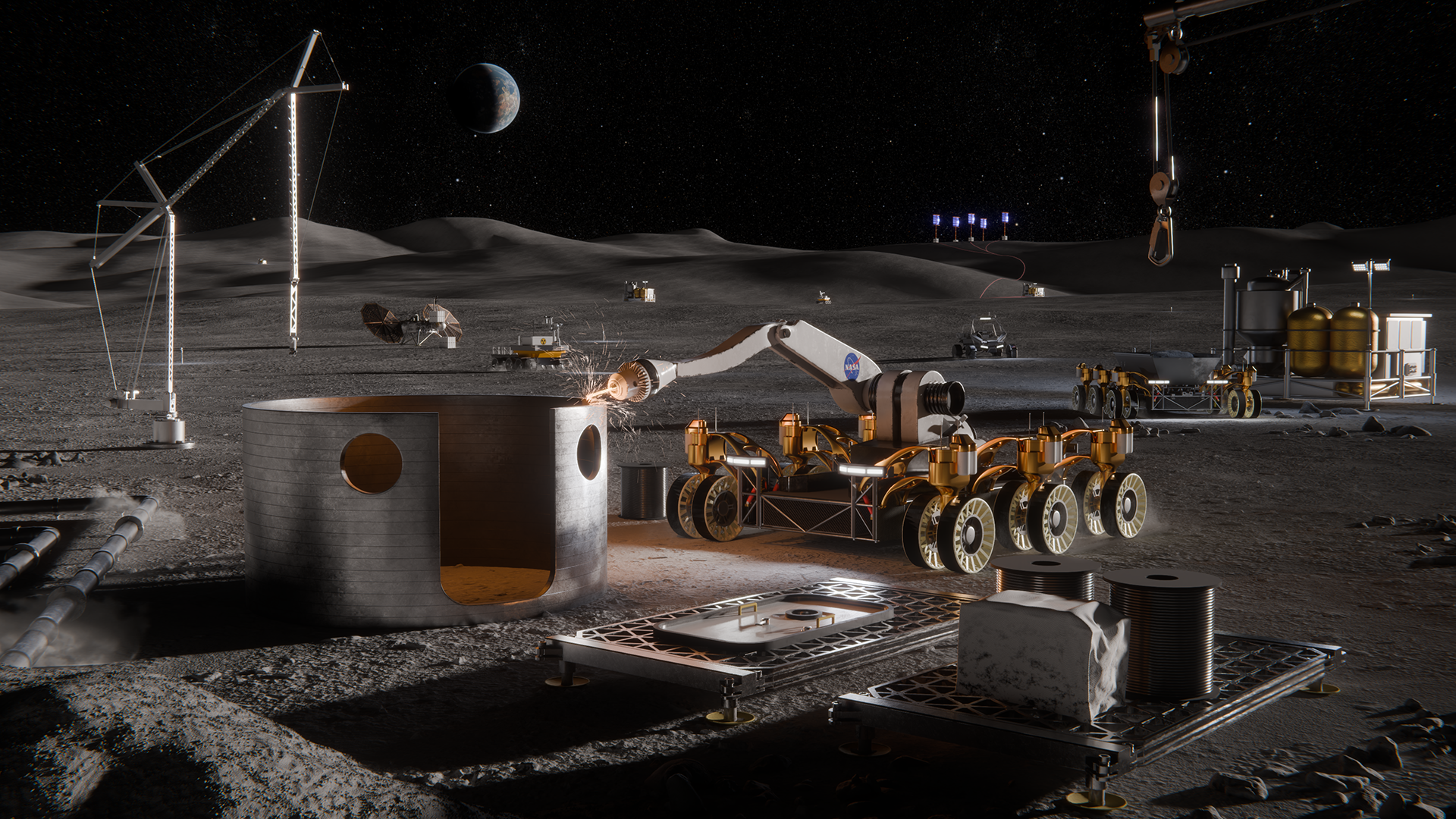
NASA opened a competition Tuesday to accelerate development of technologies essential for sustained lunar operations. The solicitation targets specific capability gaps that stand between current capabilities and the infrastructure needed to establish a permanent Moon Base in the lunar South Pole region.
The agency identified three primary technology domains requiring breakthrough advances. Power generation systems must deliver reliable energy in the harsh lunar environment, where temperatures plummet to minus 170 degrees Celsius in shadow and solar access remains inconsistent. Oxygen extraction from lunar regolith represents another focus area. Water ice exists in abundance at the lunar poles, locked in permanently shadowed craters, but converting that resource into breathable oxygen and rocket propellant requires proven technologies at scale. In-situ resource utilization (ISRU) for producing construction materials from lunar soil would enable NASA to build structures, roads, and habitats without hauling everything from Earth.
This solicitation represents a deliberate shift in lunar exploration strategy. Rather than relying exclusively on NASA centers and traditional aerospace contractors, the agency invites proposals from universities, private companies, research institutions, and startups. The competition model accelerates innovation cycles. It also distributes risk across multiple technical approaches, increasing the probability that at least one solution reaches maturity before planned lunar surface operations.
The South Pole focus reflects both scientific and practical realities. Permanently shadowed craters near the lunar south pole contain water ice deposits that have accumulated for billions of years. That ice serves triple duty: it provides water for drinking and oxygen production, it shields against radiation when stored in habitats, and it yields hydrogen for rocket fuel. The region also experiences longer periods of continuous sunlight on surrounding peaks compared to the equator, making solar power more viable.
These technology gaps directly support NASA's Artemis program objectives. Artemis III missions will land human crews on the Moon by the mid-2020s, while follow-up missions will establish the sustained presence required for long-term scientific research and resource development. Current lunar landers and rovers lack the power systems and payload capacity to operate extended missions in the South Pole region. Existing oxygen extraction equipment exists only at laboratory scales. Materials processing for construction has never been attempted on the lunar surface.
The timeline matters. NASA plans to execute these landings within the current decade. Technologies selected through this solicitation must progress from prototype demonstrations to flight-ready systems within roughly five years. The accelerated schedule demands parallel development paths and increased funding for winning proposals.
Success hinges on engineering solutions that operate reliably in lunar conditions without constant Earth-based intervention. The Moon lacks Earth's atmosphere to dissipate heat, its magnetic field to shield from solar radiation, or its supply chains to deliver replacement parts. Every technology must be self-contained, maintainable by astronauts in spacesuits, and redundant enough to tolerate the inevitable failures that accompany frontier exploration.
This solicitation represents NASA's recognition that government laboratories alone cannot generate the complete solutions portfolio needed for lunar base establishment. The open call invites fresh approaches and unconventional thinking. Winners will shape the infrastructure supporting human exploration beyond Earth orbit for decades to come.