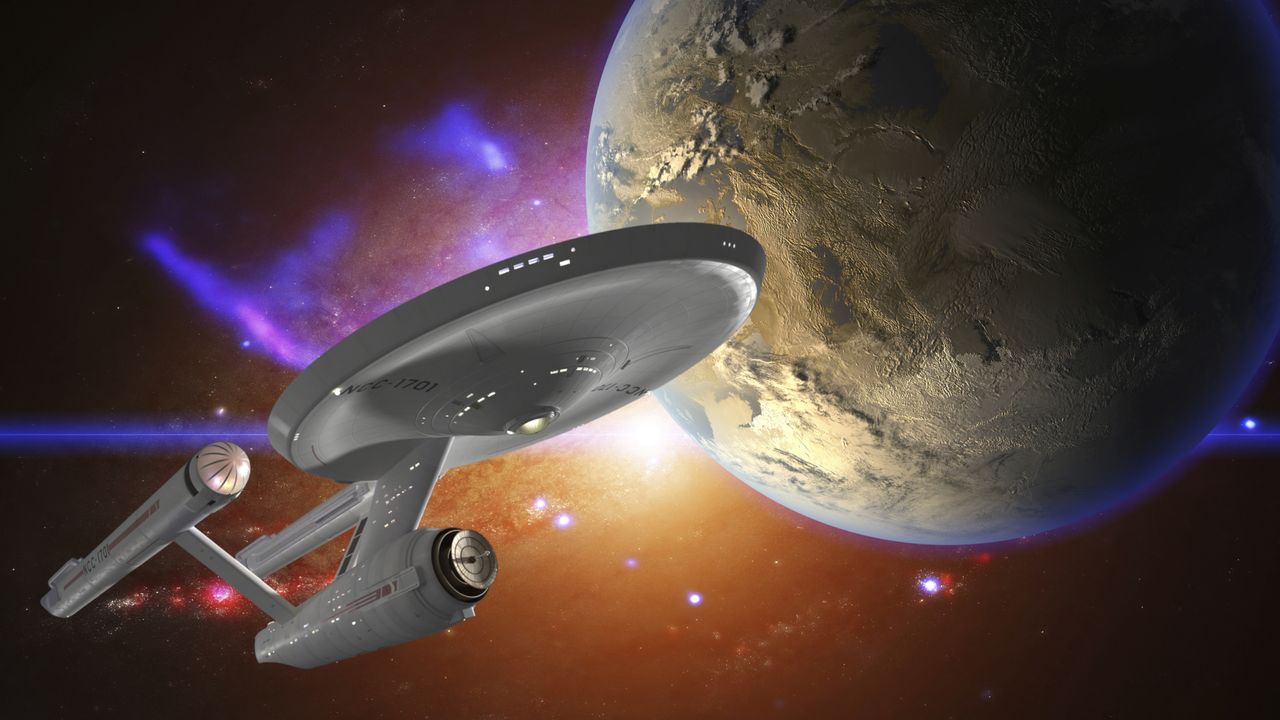
# Beyond the Prime Directive: What Real Exoplanets Reveal About Strange New Worlds
When Gene Roddenberry penned Star Trek's opening monologue six decades ago, the show's vision of exploration seemed pure fiction. No exoplanet had ever been confirmed. The technology to find them did not exist. Today, astronomers have catalogued over 5,700 confirmed exoplanets, and the reality of these distant worlds often surpasses the imagination of 1960s television writers.
The exoplanet revolution began in 1995 when Swiss astronomers Michel Mayor and Didier Queloz discovered 51 Pegasi b, a gas giant orbiting its star every 4.2 days at a distance closer than Mercury sits to our Sun. This finding shattered assumptions about planetary architecture. Science fiction had assumed worlds like Earth, orbiting at comfortable distances. Nature had other ideas.
Subsequent discoveries pushed strangeness to extremes. WASP-12b orbits so close to its host star that tidal forces stretch the planet into an egg shape, and stellar radiation boils its atmosphere away. TOI-1338b exists in a binary star system, experiencing double sunsets that would make Tatooine from Star Wars look mundane. Kepler-452b orbits in its star's habitable zone at a distance and with properties remarkably similar to Earth, yet it circles a star 1.5 billion years older than our Sun, placing it in a zone where any evolving life would have had vastly more time to develop.
Venus-sized planets orbit in habitable zones around red dwarfs, their surfaces potentially scorched by intense stellar flares. Super-Earths and mini-Neptunes, categories of planets that do not exist in our solar system, outnumber Earth-sized worlds in the exoplanet census. K2-18b, a sub-Neptune, shows spectroscopic evidence of dimethyl sulfide, a compound associated with life on Earth, though confirmation requires far more data.
The James Webb Space Telescope, launched in December 2021, now analyzes exoplanet atmospheres with unprecedented precision. JWST has detected carbon dioxide, methane, and water vapor in distant worlds. Its successor observations will reveal biosignatures or the chemical signatures of photosynthesis in exoplanet atmospheres within the next decade.
Star Trek imagined exploration as a moral endeavor, with starship crews seeking peaceful contact and scientific knowledge. Real exoplanet discovery operates differently. Astronomers cannot visit these worlds. They cannot beam down landing parties. Instead, they measure the minute dimming of starlight as planets transit their suns. They detect gravitational wobbles in stellar motion. They analyze spectra for atmospheric composition.
Yet the underlying drive remains identical to Roddenberry's vision. Humans seek to understand our place in the cosmos. We want to know if we are alone. The discovery that thousands of worlds orbit distant stars, each with unique properties and potentially habitable conditions, answers one question while raising others far more profound.
Exoplanet science has transformed exploration from science fiction speculation into observational reality. The strange new worlds are real. We have already begun to seek them out. And we are only at the beginning.