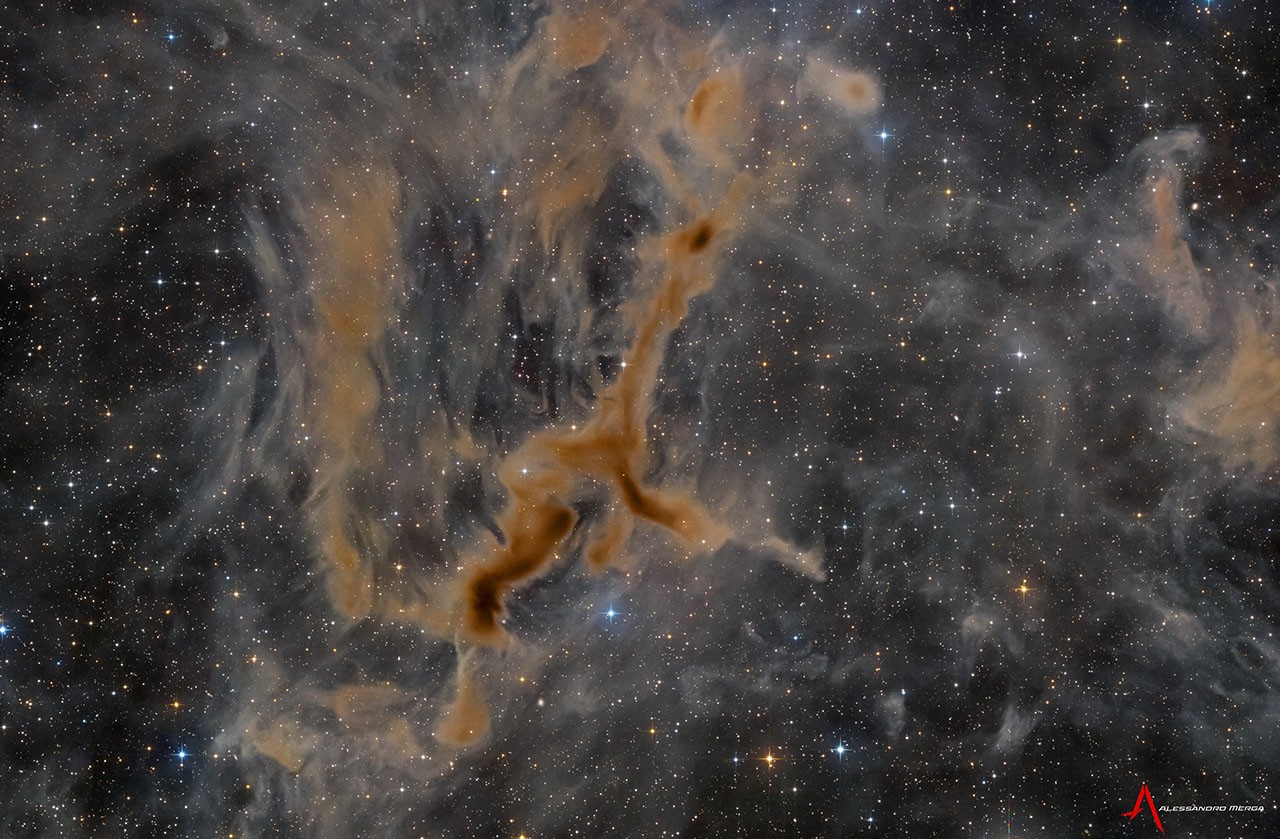
# Dark Nebula LDN 1295 Reveals the Hidden Architecture of Star Formation
NASA's Astronomy Picture of the Day featured LDN 1295, a dark nebula located in the constellation Cygnus, showcasing one of the universe's most elegant tools for understanding how stars form within vast clouds of gas and dust.
LDN 1295 belongs to a class of objects catalogued by Beverly Lynds in her systematic survey of dark nebulae published in the 1960s. The "LDN" designation refers to Lynds Dark Nebula, and these objects represent regions where dust is so densely packed that it blocks visible light from background stars. Rather than emitting their own light like emission nebulae, dark nebulae stand out as silhouettes against brighter stellar backgrounds or glowing regions beyond them.
The nickname "Giraffe Nebula" derives from the distinctive shape observers perceive in the cloud's structure. This pareidolia, the human tendency to recognize familiar patterns in random shapes, has driven astronomical nomenclature for centuries. Yet beneath this whimsical designation lies serious astrophysics.
Dark nebulae like LDN 1295 serve as laboratories for studying star birth. These cold, dense clouds contain molecular hydrogen, dust grains, and trace amounts of heavier elements. Gravity gradually compresses these materials into denser clumps. When compression reaches critical thresholds, nuclear fusion ignites at the cores of these collapsing masses, and new stars emerge. The dust within these nebulae also plays a protective role, shielding newly forming stellar objects from intense ultraviolet radiation that would otherwise disrupt their development.
Observations of LDN 1295 in infrared wavelengths penetrate the obscuring dust, revealing protostars and young stellar objects embedded within the cloud's depths. Ground-based telescopes and space observatories detect the heat signatures of these developing stars. Infrared studies bypass the optical obscuration that makes visible-light observation impossible, providing direct views of star formation in action.
The structure of dark nebulae like LDN 1295 offers clues about the physical processes governing stellar birth rates and the resulting mass distribution of newborn stars. Astronomers measure the cloud's density, temperature, and velocity to construct models explaining how interstellar material transforms into suns. Understanding these mechanisms in nearby clouds like LDN 1295 helps predict star formation rates across the galaxy and beyond.
LDN 1295's location within the Milky Way places it at a distance accessible to modern telescopes yet far enough to provide context for regional star-forming activity. The nebula represents one point in a vast, ongoing process that has populated galaxies since cosmic dawn. Every star, including our Sun, once occupied a similar compressed state within a molecular cloud billions of years ago.
The continued study of dark nebulae reinforces fundamental principles of stellar physics and gravitational dynamics. Each detailed observation of LDN 1295 contributes to comprehensive models of galactic evolution. These clouds are not static monuments but active workshops where the universe constructs its most enduring structures: stars themselves.