# Two Stars Merged Into a Binary System Within Living Memory
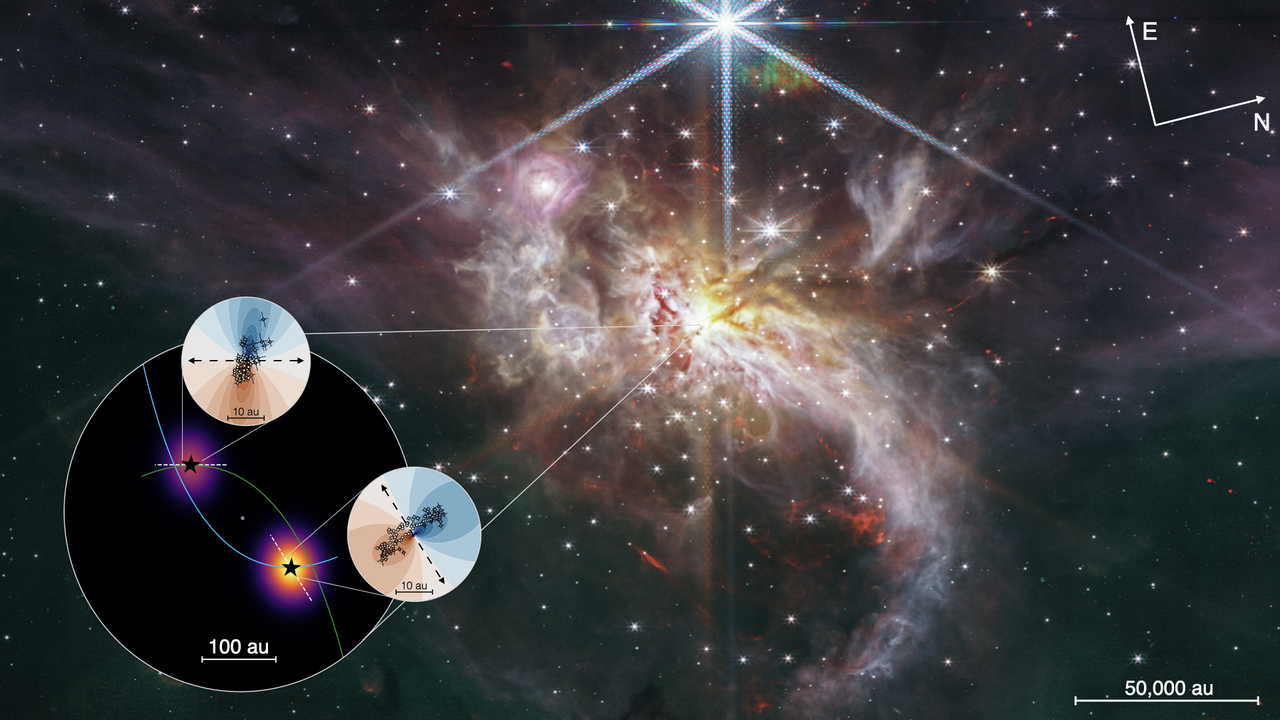
Astronomers using the Atacama Large Millimeter/submillimeter Array (ALMA) have detected something rarely observed directly: the moment two distinct stars merged into a bound binary system, an event that occurred just six decades ago in cosmic terms.
The discovery reveals a chaotic collision between two stellar objects with different origins and compositions. ALMA's sensitive millimeter-wavelength observations captured evidence of turbulent gas and debris surrounding the newly formed binary, providing a window into stellar dynamics that typically unfold over timescales far too long for human observation.
Binary star systems are common throughout the galaxy. An estimated one-third to one-half of all stars exist in pairs or groups, locked in mutual orbits by gravity. Yet witnessing the actual formation moment of such a system ranks among astronomy's rarest achievements. Most stellar binaries formed billions of years ago; their violent origins lie beyond direct observation.
This discovery stands apart because the merger occurred recently enough that astronomers can still observe the chaos. The turbulent gas, asymmetric outflows, and compositional differences between the two stellar objects provide direct evidence of their separate evolutionary paths before collision. The stars emerged from different molecular clouds or environments, carrying distinct chemical signatures and mass distributions. When gravity finally pulled them together into a bound orbit, the collision created observable disturbances that persist today.
ALMA, operated jointly by the European Southern Observatory, the National Radio Astronomy Observatory, and the National Institutes of Natural Sciences of Japan, excels at detecting millimeter and submillimeter wavelengths. This capability allows astronomers to peer through dust and gas that would obscure visible-light observations. The array consists of 66 radio dishes spread across Chile's Atacama Desert, combining observations to create images of unprecedented detail and sensitivity.
The research expands our understanding of how binary systems form and evolve. Hierarchical assembly models suggest that stellar pairs can merge from encounters within denser stellar regions, or through gradual orbital decay in environments containing abundant gas. Observing the immediate aftermath of such a merger provides constraints on merger rates and the environmental conditions that facilitate them.
The finding also carries implications for gravitational wave astronomy. When sufficiently massive stellar objects merge, they can eventually produce signals detectable by laser interferometer gravitational-wave observatories like LIGO and Virgo. Understanding the frequency and nature of stellar mergers helps astronomers predict future gravitational wave detections and refine searches for compact object collisions.
Previous detections of merging binary stars have relied primarily on dramatic outbursts or light variations associated with the collision itself. This ALMA observation captures the quieter aftermath, revealing structural details about the system's composition and dynamics. The ability to resolve such detail in recently merged systems opens new avenues for studying stellar interactions that shape galactic structure and chemical evolution.
As ALMA continues observing, astronomers expect to identify additional merger events at various stages of their evolution. Each observation adds data points to our understanding of one of astronomy's most dynamic processes, one that unfolds across the cosmos far more frequently than any human lifetime allows us to witness directly.