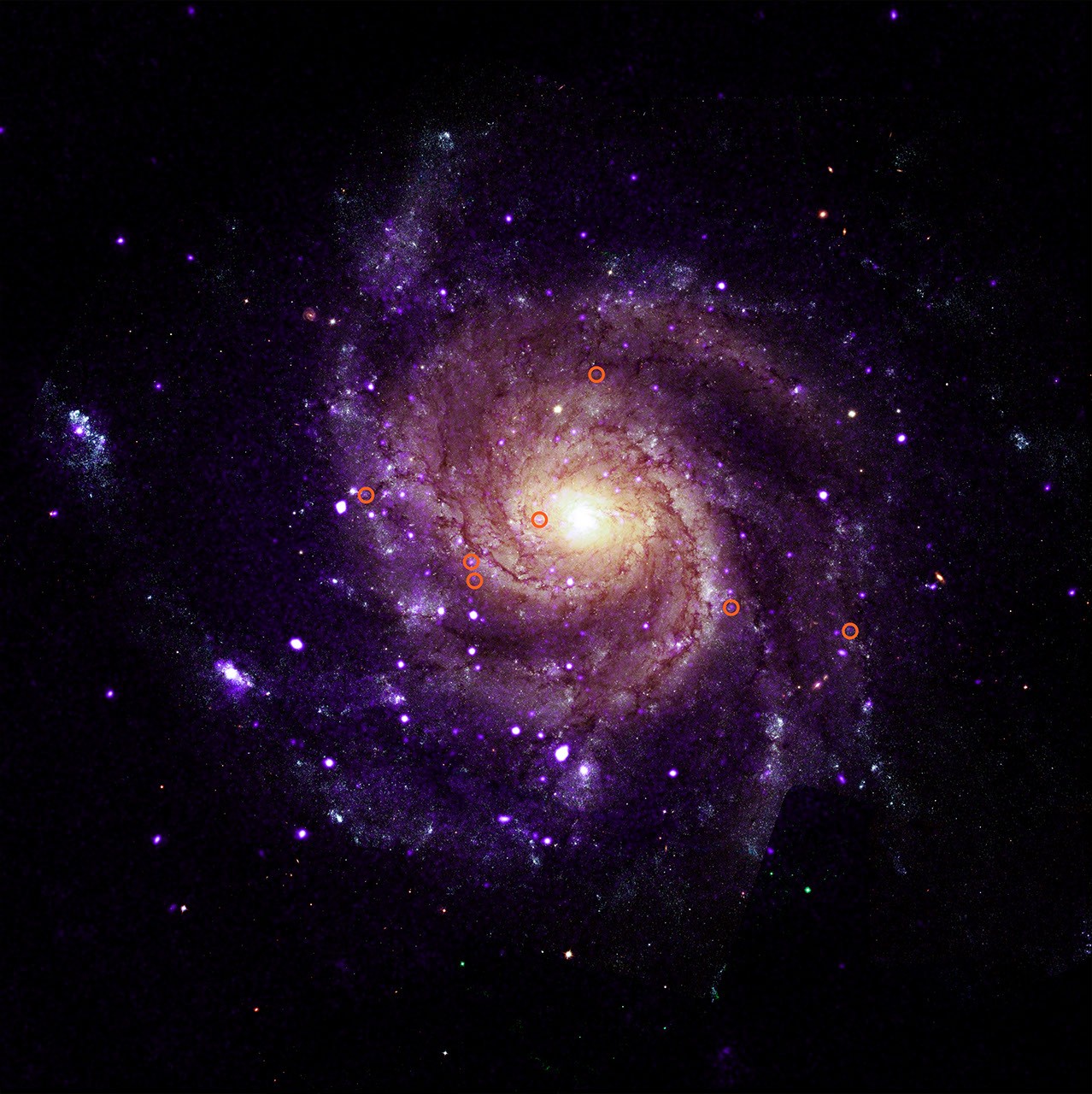
NASA's Chandra X-ray Observatory has detected a new class of celestial objects that defy conventional astrophysical classification. Located in distant galaxies, these sources emit unusually low-energy X-rays paired with intense ultraviolet radiation, a combination that breaks the established patterns astronomers have catalogued for decades.
The discovery emerges from data collected by Chandra, NASA's flagship X-ray telescope launched in 1999. Chandra observes the high-energy universe by detecting X-rays emitted by scorching gas, supermassive black holes, and stellar explosions across vast cosmic distances. This new class of objects challenges what physicists thought they understood about X-ray emitters.
Conventional sources of X-rays fall into well-defined categories. Neutron stars and black hole accretion systems typically produce bright, hard X-rays as matter spirals into gravitational wells at extreme velocities. Supernova remnants generate X-rays through shock waves heating gas to millions of degrees. Stellar coronae produce softer X-rays through magnetic activity. This new population fits none of these models.
The peculiar signature of low-energy X-rays combined with robust ultraviolet output points toward exotic physics. Astronomers propose these objects may represent accretion onto intermediate-mass black holes, a long-theorized phenomenon that remains poorly understood. Intermediate-mass black holes occupy a gap between stellar-mass black holes around 10 solar masses and supermassive monsters residing at galactic centers containing millions to billions of solar masses. Their formation mechanism remains one of astrophysics' outstanding puzzles.
Alternatively, these sources could represent ultra-luminous X-ray sources exhibiting unexpected spectral properties, or accretion onto neutron stars with unusual magnetic fields that redirect radiation in unexpected directions. Each possibility carries implications for how matter accumulates around compact objects and how radiation escapes from the innermost regions near event horizons.
The discovery addresses two persistent questions simultaneously. First, it provides observational evidence regarding how intermediate-mass black holes accrete material and radiate energy, helping constrain models of their formation and growth pathways. Second, it illuminates the physical mechanisms governing accretion disk structure and radiation emission across all mass scales of compact objects.
Chandra's unique sensitivity to low-energy X-rays makes it instrumental for identifying these faint sources. The observatory's advanced mirror system focuses X-rays onto imaging spectrometers, allowing astronomers to measure both the intensity and energy distribution of incoming photons with unprecedented precision. This capability proved essential for recognizing objects that would appear unremarkable in traditional optical surveys or harder X-ray bandpasses.
Follow-up observations with other observatories enhance the scientific value. Multiwavelength data spanning radio, infrared, optical, ultraviolet, and X-ray frequencies reveal how these objects produce energy across the electromagnetic spectrum. Correlations between brightness variations at different wavelengths constrain physical models and identify the dominant emission mechanisms.
Future X-ray telescopes like NASA's planned Einstein Probe and ESA's Athena will extend this research. These missions will scan larger sky areas and reach fainter objects, potentially revealing how common this new class appears across the universe. Statistical studies of object populations yield crucial information about cosmic black hole demographics, accretion physics, and the evolution of galaxies over cosmic time.
The Chandra discovery exemplifies how ground-based and space-based astronomy advances through instrument capability and careful data interpretation. Unlocking the nature of these mysterious emitters requires sustained observational campaigns and theoretical modeling efforts spanning years.